
Section 163 BNSS order and park closure curb Connaught Place assembly
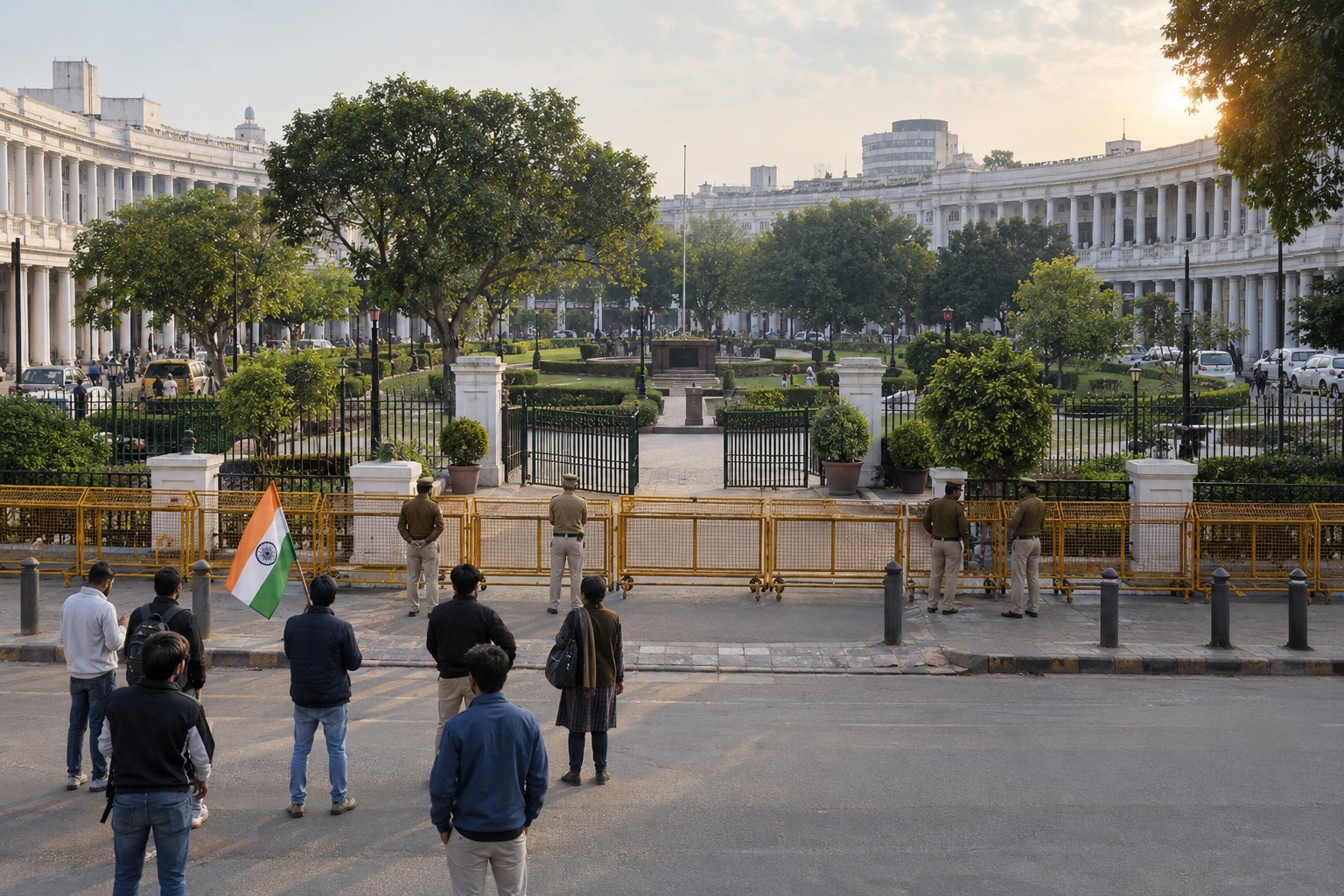
Delhi Police served a notice on the organiser of a planned flag march, citing a prohibitory order under section 163 of the Bharatiya Nagarik Suraksha Sanhita in force in the New Delhi area. The New Delhi Municipal Council shut Central Park, Connaught Place, to the public on 16 and 17 October for administrative reasons.
Syllabus: GS2 · Constitution; Prelims · Polity & Governance; GS2 · Executive & Judiciary
Why this matters for UPSC
GS2 Polity: fundamental rights and their limits. Prelims can ask what section 163 of the BNSS allows and for how long, Article 19(3)'s grounds and Naveen Jindal (2004); Mains, whether prohibitory orders unduly curb the right to assemble.
Why it matters
A student, an office worker or a shopkeeper in central Delhi found the city's best-known open space shut for two days, and any group gathering nearby risked prosecution. The step did not ban the flag; it barred the gathering around it, which is where the right to protest is decided. When a whole district sits under a standing order, the burden shifts: citizens must seek permission to meet, rather than the State having to justify each refusal. Traders, who asked for protection from crowds during the festive season, gain calm streets; protesters lose the place they chose. How narrowly such orders are drawn, and how quickly they lapse, decides whether peaceful dissent stays possible in the capital.
Prelims pointers
- Section 163(4), BNSS: an order lapses after two months; the State Government may extend it by notification for up to six months more.
- Section 163(2), BNSS: in an emergency, or when notice cannot be served in time, the order may be passed ex parte.
- Section 163(5) and (7), BNSS: a Magistrate may rescind or alter an order on an aggrieved person's plea, hearing them first and recording reasons for refusal.
- Article 19(3) permits curbs on peaceful assembly only for the sovereignty and integrity of India or public order; Article 19(2) lists wider grounds for speech.
- Article 51A(a): every citizen's fundamental duties include respecting the National Flag and the National Anthem.
- 1971 Act: lawful criticism of the flag is not an offence (Explanation 1); a repeat conviction carries at least one year's imprisonment (section 3A).
- Flag Code of India, 2002: amended in 2021 to allow polyester and machine-made flags, and in 2022 to let a house flag fly day and night; ratio 3:2.
- Prevention of Insults to National Honour (Amendment) Act, 2026 substituted section 3: preventing the singing of the National Song is now also punishable.
Practise a UPSC-style question
With reference to orders under section 163 of the Bharatiya Nagarik Suraksha Sanhita, 2023 (BNSS), consider the following statements:
1. In an emergency, such an order may be passed ex parte.
2. A Magistrate's order under the section can remain in force for up to four months from its making.
3. The State Government may, by notification, extend a Magistrate's order for a further period not exceeding six months.
Which of the statements given above is/are correct?
- (a) 1 and 2 only
- (b) 2 and 3 only
- (c) 1 and 3 only
- (d) 1, 2 and 3
Show the answer
Answer: (c) 1 and 3 only
Answer: (c) 1 and 3 only. Section 163 allows ex parte orders and a State extension, but caps the Magistrate's own order at two months.
Statement 1: correct. Section 163(2) lets the order be passed ex parte in an emergency or where notice cannot be served in time.
Statement 2: incorrect. Section 163(4) says no order shall remain in force for more than two months from its making.
Statement 3: correct. The proviso to section 163(4) lets the State Government extend it by up to six months to prevent danger to life or a riot.
Eliminate: statement 2 is the surest, since the two-month cap is the section's best-known limit. Out: (a), (b), (d).
Trap: Near-miss figure. Four months sits between the two-month cap and the six-month extension, so a student who half-remembers both numbers may accept it.
Remember: Section 163 BNSS: two months by the Magistrate, up to six more by State notification.
More from the 16 October 2026 edition
- Black Sea and the Turkish Straits: drone strikes hit merchant shipping World & IR
- India approves rollover of ₹30 billion currency swap for the Maldives World & IR
- Census Rules, 1990 amended to spell out who can be enumerators Polity
- Sports Ministry issues norms for revised National Sports Federations assistance scheme National
- India presses terrorism, connectivity norms at CICA's Baku summit World & IR
- ISRO: Aditya-L1 and Proba-3 coronagraphs jointly study coronal mass ejections Sci-Tech
- Centre cancels paraquat herbicide's registration; Madhya Pradesh orders stocks destroyed Environment
- UN DESA's World Social Report 2026 scores 168 countries on inclusive transformation World & IR
- AT-1 bonds: Supreme Court upholds quashing of Yes Bank write-down Economy
- CERT-In issues critical advisory on AI agents reaching Indian systems Sci-Tech
- UN report urges limits on neurotechnology and neural data in justice Sci-Tech
- Kunming-Montreal biodiversity framework off track, finds first global review report Environment