
NBA receives ₹9.68 crore under Access and Benefit Sharing; seed sector leads
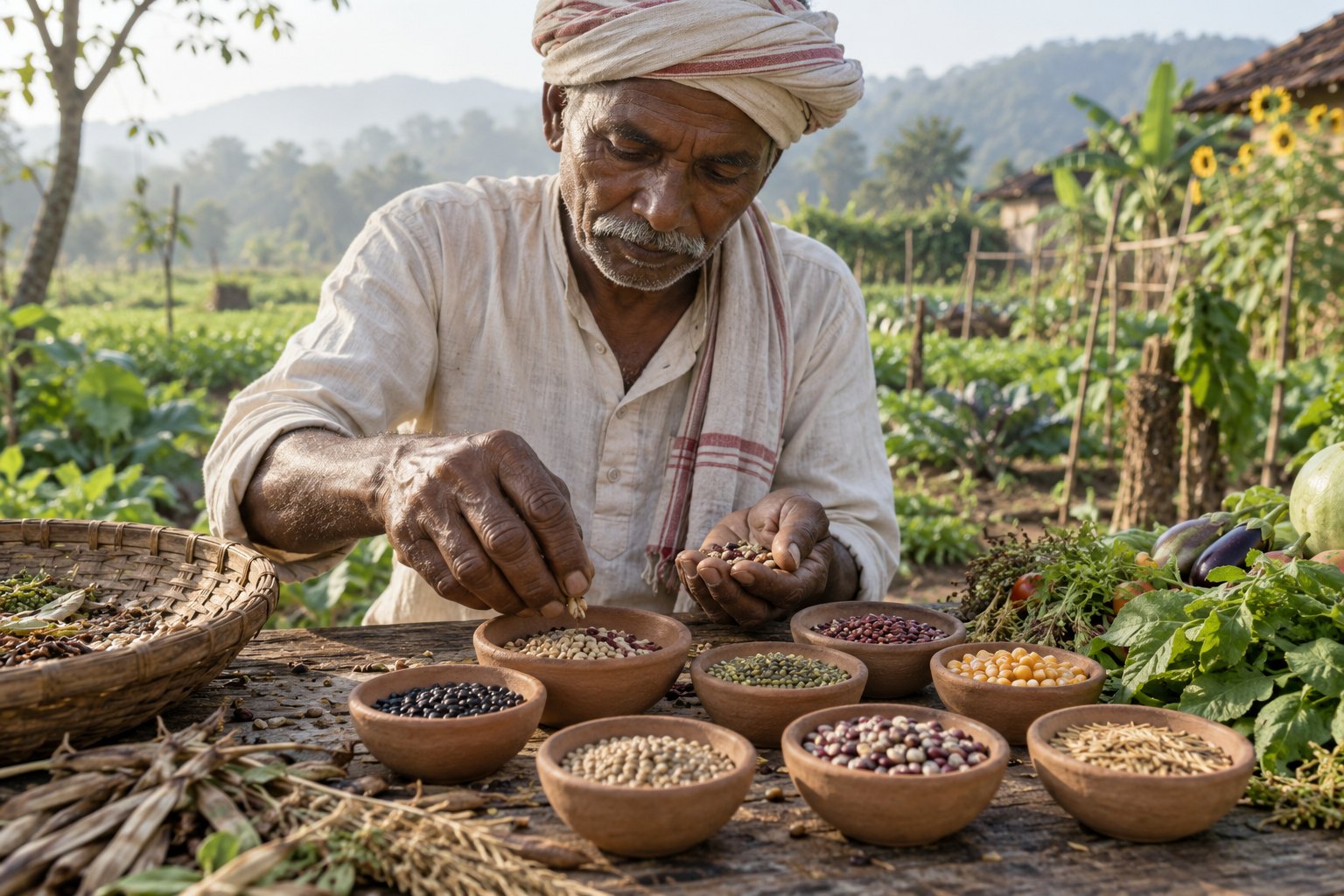
The National Biodiversity Authority received ₹9.68 crore from users of India's biological resources in April–September 2026 under the Biological Diversity Act, 2002, the Environment Ministry said on October 8. The agri-seed sector paid the most, ₹7.16 crore. Since 2008, Access and Benefit Sharing has brought the Authority about ₹278 crore, of which more than ₹200 crore has been disbursed.
Syllabus: Prelims; GS2 · Statutory & Regulatory Bodies; GS3 · Environment & Conservation
Why it matters
Think of a village that has kept a local crop variety alive, or a healer whose knowledge of a herb a drug maker later uses. Access and Benefit Sharing makes the company that profits pay a share. The National Biodiversity Authority and the State Biodiversity Boards then pass that money to conservation work, local biodiversity registers and the people who kept the resource. The April–September receipts show who pays: seed companies gave ₹7.16 crore of the ₹9.68 crore, so agricultural biodiversity, not only forests and wildlife, earns money for conservation. The open question is delivery: of about ₹278 crore realised since 2008, more than ₹200 crore has been disbursed.
Prelims pointers
- National Biodiversity Authority: statutory body set up in 2003 under the Biological Diversity Act, 2002, headquartered in Chennai; approves access by foreign users and determines benefit sharing.
- Three tiers: NBA (national); State Biodiversity Boards and UT Biodiversity Councils (state); Biodiversity Management Committees at gram panchayat and municipal level (local), which keep People's Biodiversity Registers.
- Access: foreigners and foreign-controlled companies need NBA's prior approval; Indian entities give prior intimation to the State Biodiversity Board for commercial use; Indian researchers working in India are exempt.
- ABS Regulations, 2025: nil up to ₹5 crore turnover, then 0.2%, 0.4% or 0.6% of ex-factory sales; Red Sanders, sandalwood, agarwood: at least 5% of sale proceeds as upfront payment.
- BMC collection fees come on top of benefit sharing; appeals against NBA or State Board orders lie with the National Green Tribunal (National Green Tribunal Act, 2010).
- Convention on Biological Diversity: opened for signature at the 1992 Rio Earth Summit, in force 29 December 1993; objectives are conservation, sustainable use and fair sharing of benefits.
- Nagoya Protocol: supplementary agreement to the CBD on Access and Benefit Sharing; adopted 29 October 2010 at Nagoya, Japan; in force 12 October 2014; financial mechanism: Global Environment Facility.
- Outside the Act: human genetic material and value-added products are not biological resources; conventional breeding and traditional farming practices are not commercial utilisation; notified commodities are exempt.
Practise a UPSC-style question
With reference to India's biodiversity institutions, consider the following statements:
1. The National Biodiversity Authority is a constitutional body set up under Article 48A of the Constitution of India.
2. Biodiversity Management Committees are constituted at the level of local bodies such as gram panchayats and municipalities.
Which of the statements given above is/are correct?
- (a) 1 only
- (b) 2 only
- (c) Both 1 and 2
- (d) Neither 1 nor 2
Show the answer
Answer: (b) 2 only
1 is incorrect: the National Biodiversity Authority is a statutory body set up in 2003 under the Biological Diversity Act, 2002, with its seat in Chennai; Article 48A is a Directive Principle on protecting the environment and creates no body. 2 is correct: the Act requires local bodies to set up Biodiversity Management Committees, at gram panchayat level in villages and at nagar panchayat or municipal level in towns.
More from the 9 October 2026 edition
- Article 21 speedy trial: victims may move High Court, Supreme Court rules Polity
- UNESCO GEM report puts rural India's upper-secondary gender parity at 0.59 National
- London Convention and Protocol parties adopt marine geoengineering assessment frameworks Environment
- Ravi Canal carries 400 cusecs; J&K seeks Rs 534 crore National
- Indian Railways electrifies 99.7% of broad gauge; 191 route km remain Economy
- Coral bleaching in 2024 hit Lakshadweep's reefs hardest, study finds Environment
- Gold imports by banks lose GST exemption, attract 3% IGST Economy
- Coal stock at domestic-coal power plants falls 66% in six months Economy
- Mines Ministry launches auction of two Andaman Sea offshore mineral blocks Economy
- Centre launches ₹23,731-crore GOBARdhan scheme for compressed biogas Economy
- Andhra Pradesh declares early Kharif drought in 388 mandals, 21 districts Environment
- BNSS does not define detention; Article 22 safeguards apply on arrest Polity