
Andhra Pradesh declares early Kharif drought in 388 mandals, 21 districts
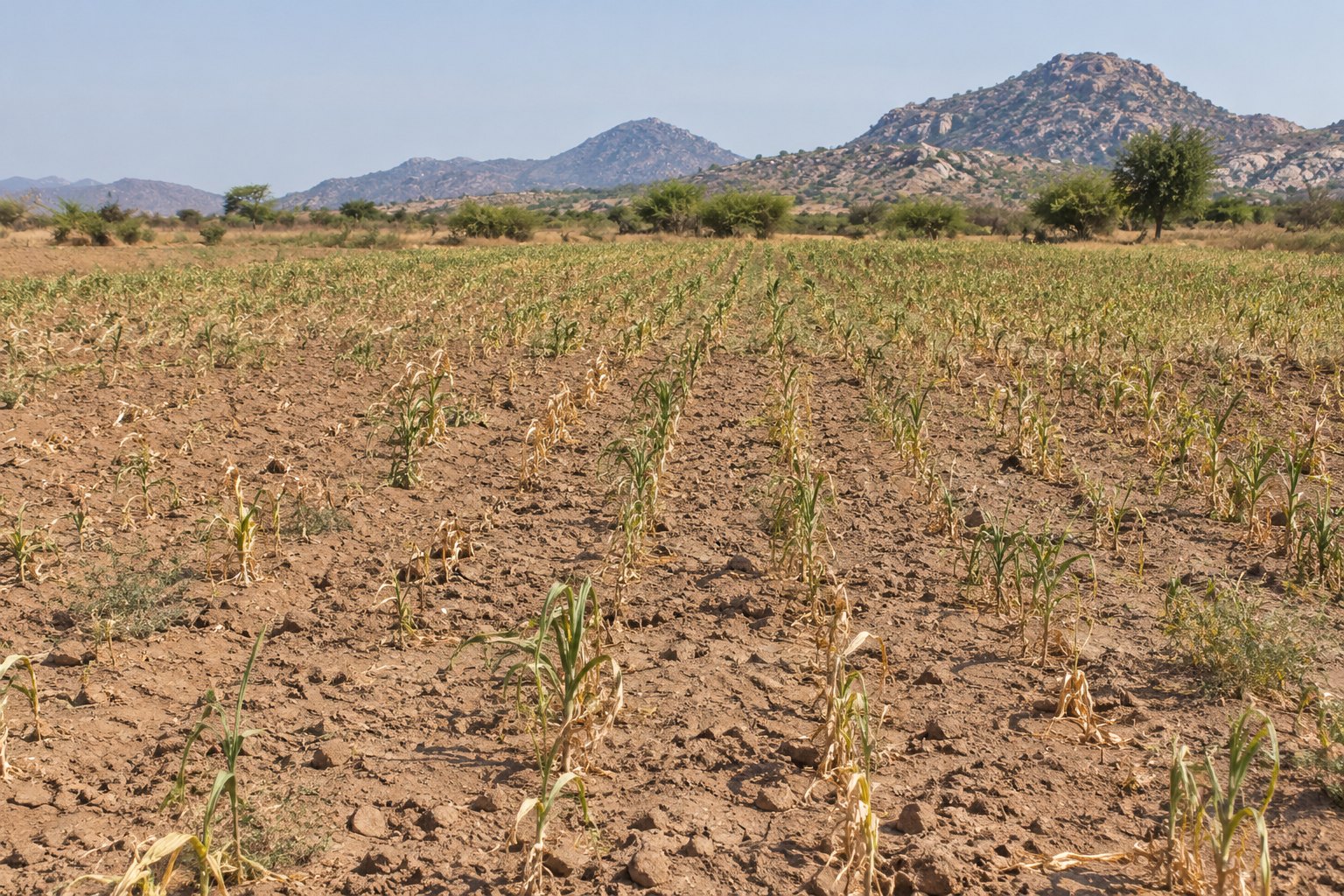
Andhra Pradesh on October 1, 2026 declared drought in 388 mandals of 21 districts for Kharif 2026, a month before the October 31 deadline in the Manual for Drought Management, 2016. It graded 283 mandals as severely and 105 as moderately affected. June–August rainfall was 197.6 mm against a normal 424.3 mm, a 53.4% deficit, amid El Niño conditions.
Syllabus: GS2 · Federalism & Local Government; Prelims · Geography; GS3 · Agriculture & Irrigation
Why it matters
A farmer in a rain-fed mandal of Rayalaseema whose crop has withered can be considered for drought relief only after that mandal is officially declared drought-affected. The national manual treats a declaration as the start of the government's response, and the Centre sends its assessment team only after a State notifies drought and asks for help. A late declaration therefore delays every later step. By acting on June–August data instead of waiting until October 31, Andhra Pradesh brought that start forward by a month. Karnataka and Maharashtra had declared drought earlier in the same monsoon. The larger question is whether rainfall, satellite and soil-moisture data can identify a drought early enough for help to reach farmers in time.
Prelims pointers
- Manual for Drought Management (December 2016, updated up to December 2020): issued by the Department of Agriculture and Farmers Welfare, Ministry of Agriculture and Farmers Welfare.
- Who declares drought: the State Government, by a notification naming the units (district, taluk, block or mandal) and the intensity; it stays valid for up to six months.
- Indices in the manual: five categories (rainfall, vegetation, water, crop, others). Rainfall is the most important, and rainfall data must mandatorily be considered.
- Trigger 1: set off by rainfall deviation, the Standardized Precipitation Index or a dry spell. Trigger 2: set off when the impact indicators show moderate or severe drought.
- Impact indicators: crop area sown, remote sensing, soil moisture and hydrology; States use any three. Severe: at least two read 'severe' and one 'moderate'. Moderate: at least two read 'moderate'.
- Ground truthing: field check in a random 10% of affected villages. Crop loss of 33% or more qualifies as drought; more than 50% as severe drought.
- India Meteorological Department categories: normal is within 19% of the Long Period Average; deficient is 20% to 59% below it; large deficient is 60% to 99% below.
- State Disaster Response Fund: Section 48 of the Disaster Management Act, 2005; the Finance Commission recommends its size. The National Disaster Response Fund (Section 46) supplements it in severe disasters.
Practise a UPSC-style question
With reference to the declaration of drought in India, consider the following statements:
1. The Union Ministry of Home Affairs declares an area drought-affected on the recommendation of the State Government.
2. Under the Manual for Drought Management, 2016, rainfall is the mandatory indicator in any assessment of drought.
Which of the statements given above is/are correct?
- (a) 1 only
- (b) 2 only
- (c) Both 1 and 2
- (d) Neither 1 nor 2
Show the answer
Answer: (b) 2 only
1 is incorrect: the State Government itself declares drought, by a notification naming the affected units and the intensity; no Union ministry declares it. 2 is correct: the manual calls rainfall the most important indicator and says rainfall data must mandatorily be considered, with the other indices read alongside it.
More from the 9 October 2026 edition
- Article 21 speedy trial: victims may move High Court, Supreme Court rules Polity
- UNESCO GEM report puts rural India's upper-secondary gender parity at 0.59 National
- London Convention and Protocol parties adopt marine geoengineering assessment frameworks Environment
- Ravi Canal carries 400 cusecs; J&K seeks Rs 534 crore National
- Indian Railways electrifies 99.7% of broad gauge; 191 route km remain Economy
- Coral bleaching in 2024 hit Lakshadweep's reefs hardest, study finds Environment
- Gold imports by banks lose GST exemption, attract 3% IGST Economy
- Coal stock at domestic-coal power plants falls 66% in six months Economy
- Mines Ministry launches auction of two Andaman Sea offshore mineral blocks Economy
- Centre launches ₹23,731-crore GOBARdhan scheme for compressed biogas Economy
- BNSS does not define detention; Article 22 safeguards apply on arrest Polity
- MeitY urges social media platforms to curb manipulated, out-of-context content Polity