
Indian Railways electrifies 99.7% of broad gauge; 191 route km remain
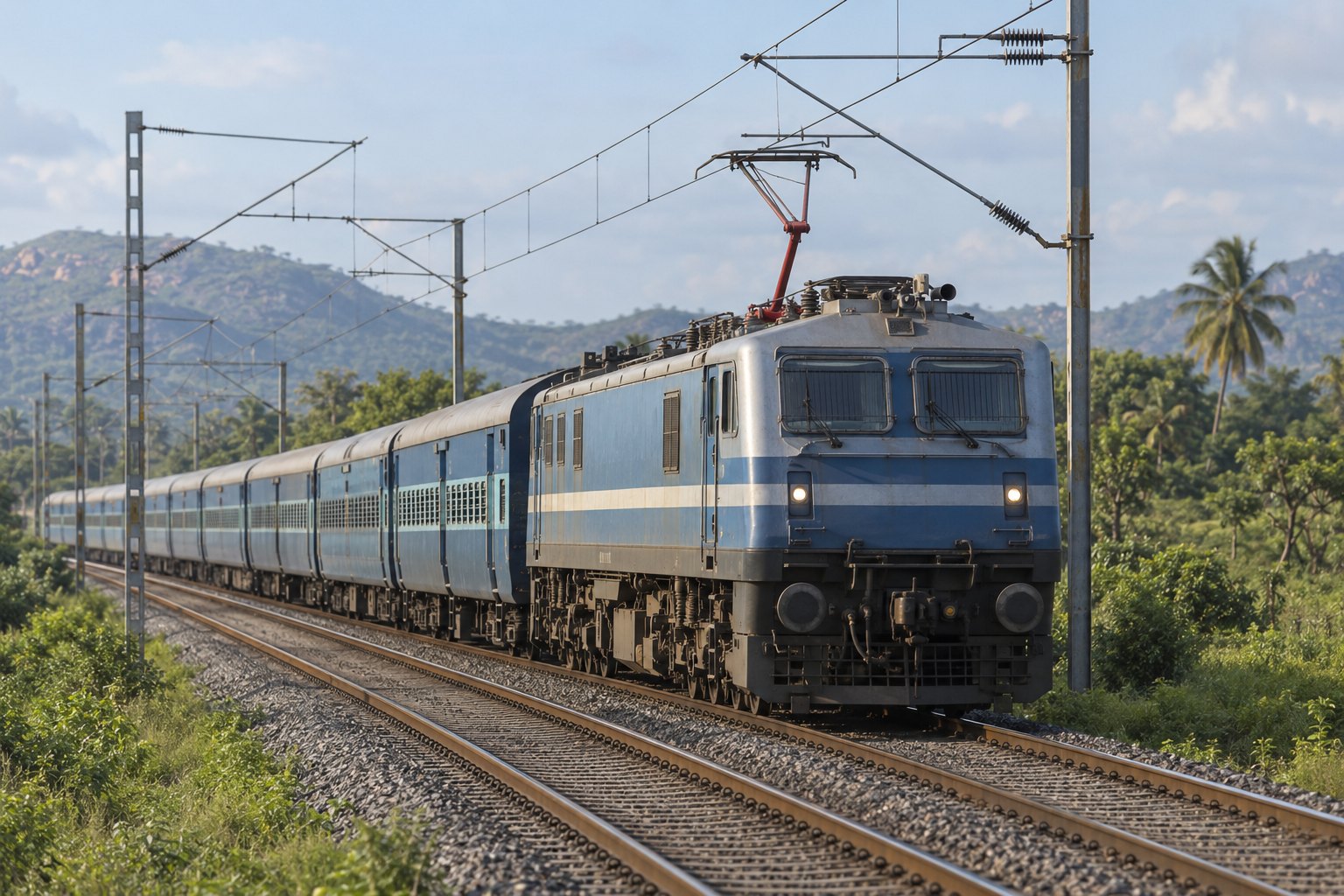
Indian Railways had electrified 70,311 of its 70,502 broad gauge route kilometres, or 99.7%, by September 30, 2026, the Ministry of Railways said. The remaining 191 route km lie in Karnataka (120), Assam (55) and Goa (16). Twenty-seven States and Union Territories have their entire broad gauge network electrified, and Southern Railway finished electrifying its 5,068 route km in September.
Syllabus: Prelims · Economy & Social Development; Prelims · Environment & Ecology; GS3 · Infrastructure
Why it matters
For a passenger or a freight customer, a fully wired route means a train no longer has to stop to swap an electric locomotive for a diesel one where the overhead wire ends. Electric traction also cuts the railways' diesel use. Diesel is refined from crude oil, most of which India imports, so each route that switches eases the import bill and removes exhaust fumes from stations and towns along the line. The climate gain depends on where the power comes from: most of India's electricity is still generated from coal. That is why the railways' net zero goal needs clean power for its trains as well as wires over its tracks.
Prelims pointers
- Track gauges of Indian Railways: broad gauge 1,676 mm, metre gauge 1,000 mm, narrow gauge 762 mm or 610 mm; standard gauge is 1,435 mm.
- Route kilometre: the length of a railway route counted once, however many parallel tracks run along it; track kilometres count every track.
- Traction: Indian Railways' electrified main lines use 25 kV, 50 Hz single-phase AC, collected from overhead wires by the locomotive's pantograph.
- Railways is a Union subject: Entry 22 of the Union List in the Seventh Schedule of the Constitution.
- Regenerative braking: three-phase electric locomotives turn braking energy into electricity and feed it back to the supply, saving energy.
- Net zero target: Indian Railways aims to become a net zero carbon emitter by 2030; full broad gauge electrification is a central measure.
- National Rail Plan: aims at a 'future ready' railway by 2030 and a rise in rail's share of freight traffic from 27% to 45%.
Practise a UPSC-style question
With reference to railway electrification in India, consider the following statements:
1. A route kilometre counts each parallel track laid along a route separately.
2. The target of 100% electrification of Indian Railways covers its metre gauge network as well.
Which of the statements given above is/are correct?
- (a) 1 only
- (b) 2 only
- (c) Both 1 and 2
- (d) Neither 1 nor 2
Show the answer
Answer: (d) Neither 1 nor 2
1 is incorrect: a route kilometre counts the length of the route once, however many tracks it carries; track kilometres count each track. 2 is incorrect: the 100% electrification target covers the broad gauge network, not metre or narrow gauge lines.
More from the 9 October 2026 edition
- Article 21 speedy trial: victims may move High Court, Supreme Court rules Polity
- UNESCO GEM report puts rural India's upper-secondary gender parity at 0.59 National
- London Convention and Protocol parties adopt marine geoengineering assessment frameworks Environment
- Ravi Canal carries 400 cusecs; J&K seeks Rs 534 crore National
- Coral bleaching in 2024 hit Lakshadweep's reefs hardest, study finds Environment
- Gold imports by banks lose GST exemption, attract 3% IGST Economy
- Coal stock at domestic-coal power plants falls 66% in six months Economy
- Mines Ministry launches auction of two Andaman Sea offshore mineral blocks Economy
- Centre launches ₹23,731-crore GOBARdhan scheme for compressed biogas Economy
- Andhra Pradesh declares early Kharif drought in 388 mandals, 21 districts Environment
- BNSS does not define detention; Article 22 safeguards apply on arrest Polity
- MeitY urges social media platforms to curb manipulated, out-of-context content Polity