
Coral bleaching in 2024 hit Lakshadweep's reefs hardest, study finds
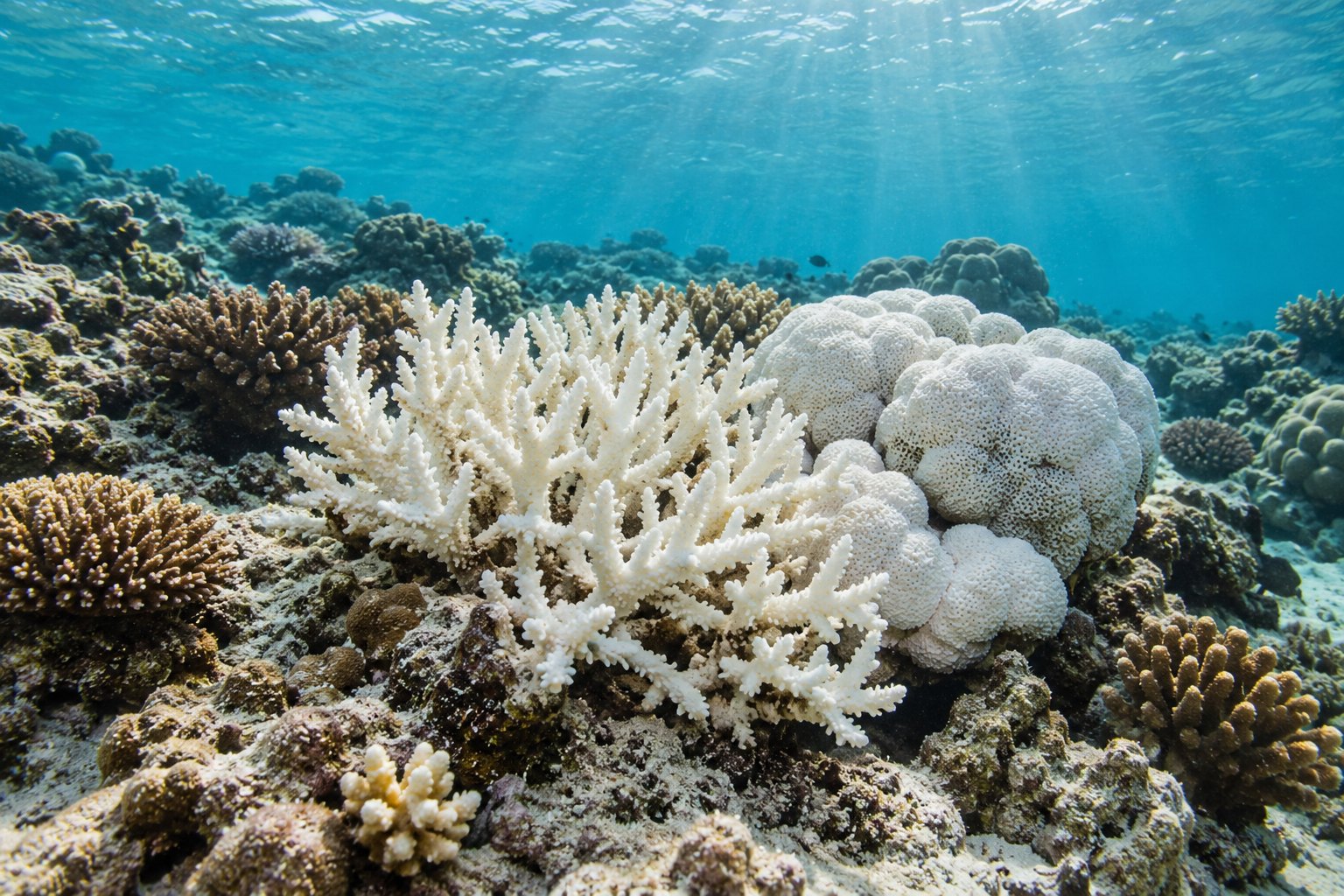
A study in the journal Coral Reefs finds the fourth global coral bleaching event hit India's reefs unevenly in 2024. Surveys of five reef regions found up to 37% of coral cover bleached or dead in Lakshadweep, against 11.5% in the marine national park at Wandoor, Andaman Islands. In Palk Bay, normally hardy Porites corals showed 61.8% mortality.
Syllabus: Prelims · Environment & Ecology; GS1 · Geophysical Phenomena; GS3 · Environment & Conservation
Why it matters
For people on Lakshadweep's low coral islands, a living reef shelters the fish they eat and sell and breaks the waves before they reach the shore. When corals bleach and die, both protections weaken. The study shows that the same global heat did very different damage from one reef to the next, depending on which corals grow there and on local sea conditions. So reef protection cannot wait for global emission cuts alone. Easing local pressures such as farm run-off, sewage and overfishing would, the lead author says, give reefs more time. With El Niño expected to turn very strong by late 2026, regular surveys would show which reefs need help first.
Prelims pointers
- Coral bleaching: under stress, chiefly unusually warm water, corals expel their zooxanthellae and turn white; a bleached coral is alive and can recover if the stress ends.
- Zooxanthellae: microscopic algae living in coral tissue in symbiosis; through photosynthesis they are the coral's main food source and give it colour.
- Corals are animals of the phylum Cnidaria; their polyps secrete calcium carbonate skeletons that build up into reefs.
- India's reef areas: atolls in Lakshadweep; mainly fringing reefs in the Andaman and Nicobar Islands, Gulf of Mannar, Palk Bay and Gulf of Kutch.
- Wildlife (Protection) Act, 1972: stony (reef-building) corals, black corals, fire corals and organ pipe coral are listed in Schedule I, the highest protection.
- Coastal Regulation Zone Notification, 2019, issued under the Environment (Protection) Act, 1986: corals and coral reefs are ecologically sensitive areas in CRZ-I A.
- INCOIS (Indian National Centre for Ocean Information Services), Hyderabad, under the Ministry of Earth Sciences, runs a Coral Bleaching Alert System using satellite sea surface temperature.
- El Niño: unusual warming of surface waters in the central and eastern equatorial Pacific Ocean; it raises global temperatures and is often linked to a weak Indian monsoon.
Practise a UPSC-style question
Consider the following statements about corals:
1. Coral polyps build their skeletons from silica drawn from sea water.
2. The algae living inside coral tissue supply the coral with most of its food.
Which of the statements given above is/are correct?
- (a) 1 only
- (b) 2 only
- (c) Both 1 and 2
- (d) Neither 1 nor 2
Show the answer
Answer: (b) 2 only
1 is incorrect: coral polyps build their skeletons from calcium carbonate, not silica. 2 is correct: the zooxanthellae in coral tissue photosynthesise and pass most of the food they make to the coral, which is why a coral that loses them starves.
More from the 9 October 2026 edition
- Article 21 speedy trial: victims may move High Court, Supreme Court rules Polity
- UNESCO GEM report puts rural India's upper-secondary gender parity at 0.59 National
- London Convention and Protocol parties adopt marine geoengineering assessment frameworks Environment
- Ravi Canal carries 400 cusecs; J&K seeks Rs 534 crore National
- Indian Railways electrifies 99.7% of broad gauge; 191 route km remain Economy
- Gold imports by banks lose GST exemption, attract 3% IGST Economy
- Coal stock at domestic-coal power plants falls 66% in six months Economy
- Mines Ministry launches auction of two Andaman Sea offshore mineral blocks Economy
- Centre launches ₹23,731-crore GOBARdhan scheme for compressed biogas Economy
- Andhra Pradesh declares early Kharif drought in 388 mandals, 21 districts Environment
- BNSS does not define detention; Article 22 safeguards apply on arrest Polity
- MeitY urges social media platforms to curb manipulated, out-of-context content Polity