
Centre rejects Musk's Starlink 'blocked' charge; three satcom licensees under security review
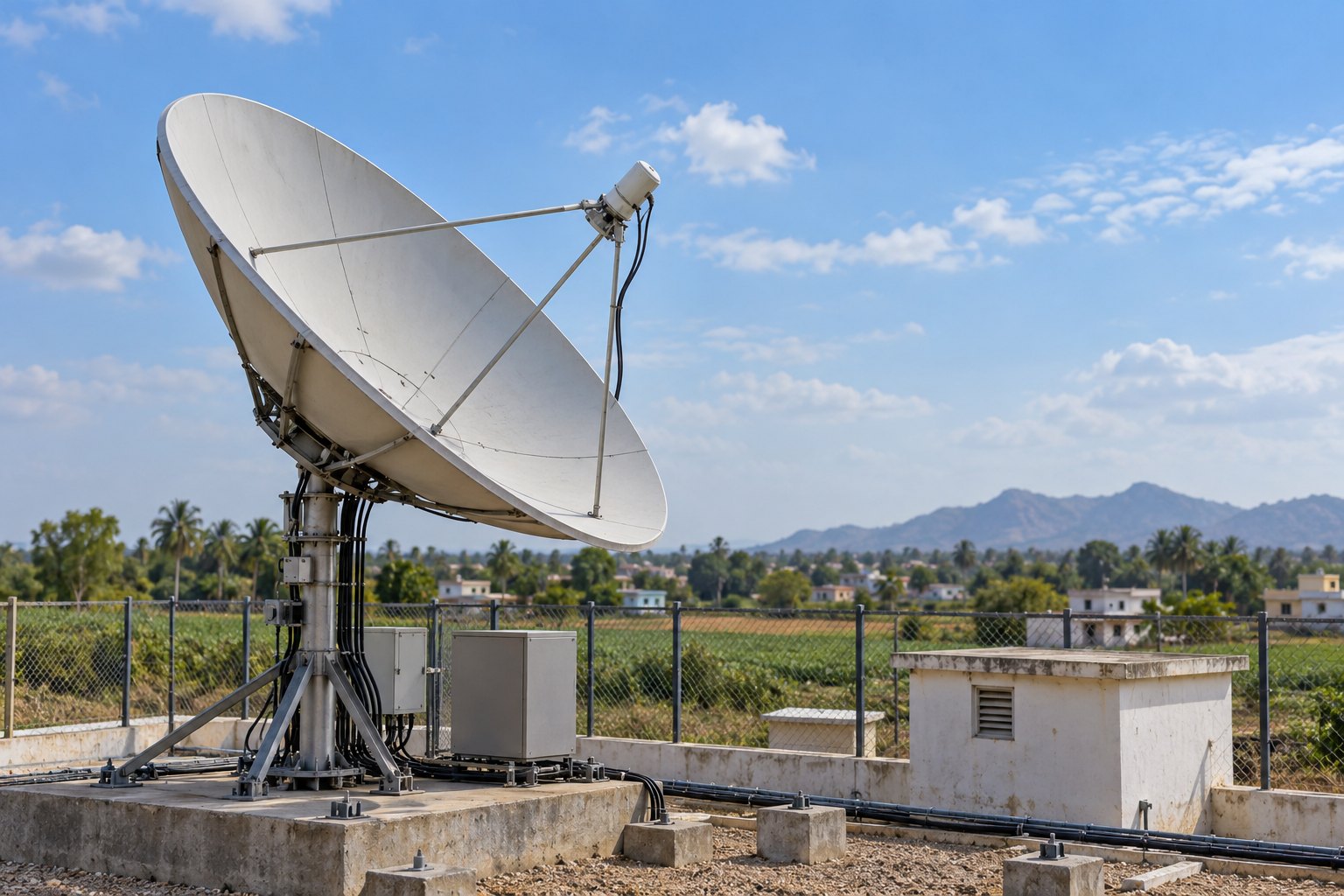
The Ministry of Communications said on October 8, 2026 that security assessments are under way for all three satellite communication licensees, which can seek spectrum only after clearing them. A day after Elon Musk alleged that 'certain oligarchs' were blocking Starlink, it called claims of discrimination baseless, saying all three are at broadly the same regulatory stage.
Syllabus: GS3 · Infrastructure; GS2 · Government Policies; GS3 · IT, Space, Biotech & IPR
Why it matters
A family in a remote village that no fibre line or mobile tower reaches could get internet through a satellite user terminal: the GMPCS authorisation is meant particularly for rural, remote and unserved areas. No company can switch that service on until it clears its security assessment and is then assigned spectrum. The security conditions decide where an Indian user's traffic goes: through a gateway in India, where lawful interception is possible and service can be denied in an area during hostilities, and not to a server abroad. Musk says Starlink is being blocked; the Ministry says one process applies equally to all three licensees. The larger issue is how India enables satellite communication services while keeping security control over its networks.
Prelims pointers
- GMPCS: a Unified Licence authorisation for satellite-based voice, data, internet and Internet of Things connectivity nationwide; backhaul to telecom operators and broadcasting are not permitted.
- Spectrum: a GMPCS licence confers no right to spectrum; a separate frequency assignment from DoT's Wireless Planning and Coordination Wing is required.
- Eligibility: an applicant must be an Indian company registered under the Companies Act, 2013; Foreign Direct Investment up to 100% is allowed through the automatic route, subject to conditions.
- Indian Space Policy, 2023: IN-SPACe authorises space activities of government and private entities; the Indian Space Research Organisation focuses on R&D; NewSpace India Limited commercialises publicly funded space technology.
- Telecommunications Act, 2023: spectrum is assigned by auction, except for uses listed in its First Schedule, including satellite services such as GMPCS, which are assigned administratively.
- Geostationary orbit: about 35,786 km above the equator; one orbit takes a sidereal day (23 h 56 min), matching the Earth's rotation, so the satellite appears fixed.
- Low Earth orbit: below 2,000 km; satellites circle in about 90 minutes and stay in view briefly, so communication systems use constellations; lower altitude also cuts signal delay.
- NavIC, earlier the Indian Regional Navigation Satellite System, and Japan's Quasi-Zenith Satellite System are regional; GPS, GLONASS, Galileo and BeiDou are global; Global Navigation Satellite System covers all.
Practise a UPSC-style question
With reference to the Global Mobile Personal Communication by Satellite (GMPCS) licence in India, consider the following statements:
1. The licence gives its holder the right to use the radio spectrum that the service needs.
2. Spectrum for the service requires a separate frequency assignment from the Wireless Planning and Coordination Wing of the Department of Telecommunications.
Which of the statements given above is/are correct?
- (a) 1 only
- (b) 2 only
- (c) Both 1 and 2
- (d) Neither 1 nor 2
Show the answer
Answer: (b) 2 only
1 is incorrect: DoT's terms say the GMPCS licence confers no right to the assignment and use of spectrum; the three licensees can seek spectrum only after clearing their security assessments. 2 is correct: a separate, specific frequency assignment from DoT's Wireless Planning and Coordination (WPC) Wing is required.
More from the 9 October 2026 edition
- Article 21 speedy trial: victims may move High Court, Supreme Court rules Polity
- UNESCO GEM report puts rural India's upper-secondary gender parity at 0.59 National
- London Convention and Protocol parties adopt marine geoengineering assessment frameworks Environment
- Ravi Canal carries 400 cusecs; J&K seeks Rs 534 crore National
- Indian Railways electrifies 99.7% of broad gauge; 191 route km remain Economy
- Coral bleaching in 2024 hit Lakshadweep's reefs hardest, study finds Environment
- Gold imports by banks lose GST exemption, attract 3% IGST Economy
- Coal stock at domestic-coal power plants falls 66% in six months Economy
- Mines Ministry launches auction of two Andaman Sea offshore mineral blocks Economy
- Centre launches ₹23,731-crore GOBARdhan scheme for compressed biogas Economy
- Andhra Pradesh declares early Kharif drought in 388 mandals, 21 districts Environment
- BNSS does not define detention; Article 22 safeguards apply on arrest Polity