
Optogenetics pioneers win 2026 Nobel Prize in Medicine
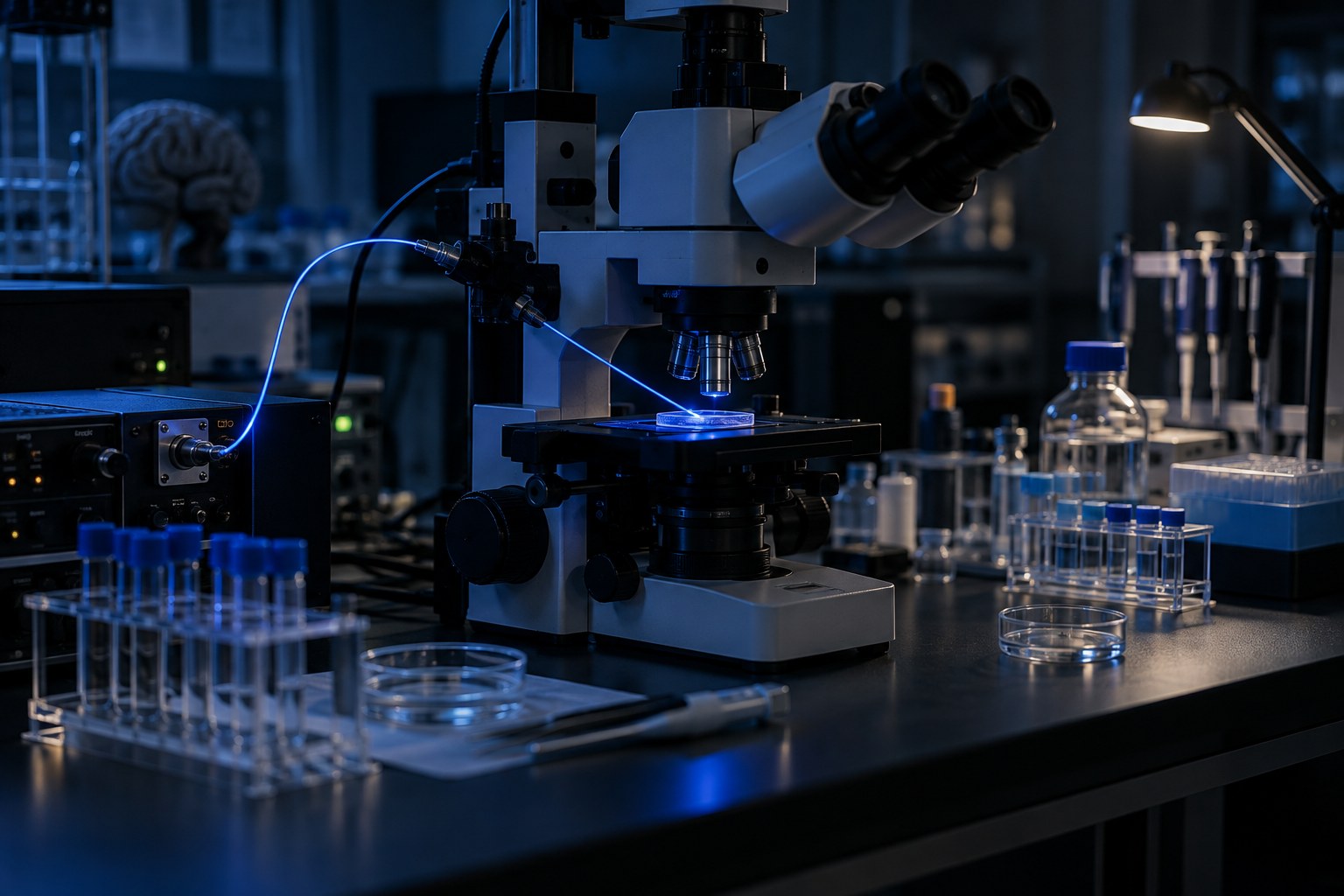
Karl Deisseroth, Peter Hegemann and Georg Nagel won the 2026 Nobel Prize in Physiology or Medicine on October 5 for discoveries concerning light-gated ion channels and optogenetics. Their work lets scientists switch specific nerve cells on or off with light, revealing circuits behind memory, fear and behaviour. The trio will share 12 million Swedish kronor equally.
Syllabus: Prelims · Science & Technology; GS3 · Science & Technology; GS3 · IT, Space, Biotech & IPR
Why it matters
Through the 20th century, scientists linked brain regions to functions but could not prove which nerve cells caused a feeling or an action. Optogenetics changed that: by making chosen cells respond to light, researchers can switch them on or off and watch what follows. It has revealed circuits for pain, fear, thirst and attention, and helps the study of depression, schizophrenia, Alzheimer's and Parkinson's. In one trial, a blind person regained enough sight to find and pick up nearby objects. It is still very much a basic science tool, says Nobel Committee member Anna Wedell: most of the work is done in animals such as mice, and its use in patients is at an early stage. It all began with curiosity about a tiny alga.
Prelims pointers
- Citation: 'for their discoveries concerning light-gated ion channels and optogenetics'.
- The Nobel Prize in Physiology or Medicine is awarded by the Nobel Assembly at Sweden's Karolinska Institutet and is traditionally the first Nobel announced each year.
- Chlamydomonas: a single-celled alga that senses light through an orange 'eyespot' and swims towards it.
- Opsin: a light-sensitive protein; in optogenetics its gene is delivered into target cells, often by a viral vector, so that light can switch those cells on or off.
- Channelrhodopsin-2, activated by blue light, lets positively charged ions in and makes a nerve cell fire; halorhodopsin, a chloride pump driven by yellow light, silences it.
- Francis Crick, who shared the 1962 Nobel Prize in Physiology or Medicine for the DNA double helix, proposed light as the ideal way to control nerve cells.
- Retinitis pigmentosa: an inherited disease that destroys the retina's rods and cones; in ongoing clinical trials, a channelrhodopsin-like protein restored some vision to a blind person.
- Cochlear implant: it now stimulates the auditory nerve with electricity; researchers hope optogenetics could let it activate the nerve with greater precision.
Practise a UPSC-style question
With reference to optogenetics, consider the following statements:
1. Genes for light-sensitive proteins are delivered into chosen cells, often by using a viral vector.
2. Channelrhodopsin-2, on which the technique rests, lets negatively charged ions into the cell when light falls on it.
3. It switches chosen nerve cells on or off more precisely than drugs or electrical stimulation can.
Which of the statements given above is/are correct?
- (a) 1 and 2 only
- (b) 2 and 3 only
- (c) 1 and 3 only
- (d) 1, 2 and 3
Show the answer
Answer: (c) 1 and 3 only
1 is correct: target cells are made to carry genes for opsins, light-sensitive proteins, often delivered by a viral vector. 2 is incorrect: channelrhodopsin-2 opens within 0.2 milliseconds of light and lets positively charged ions in, producing an electrical signal. 3 is correct: genetic targeting plus light gives finer control over particular cells than drugs or electrical stimulation.
More from the 7 October 2026 edition
- NCAHP notifies autonomous boards, central assessment committee for allied health National
- India, EU formally launch Green Shipping Corridor industry coalition Environment
- First self-stabilising thorium-229 nuclear clock runs in Vienna Sci-Tech
- Defence Ministry eases industry access to DRDO and military test ranges Defence
- MoSPI releases 2026–2030 roadmap for environmental-economic accounting Environment
- Farm workers moving to cities land in low-productivity informal jobs: study Economy
- India readies NSAM 2.0 after 3D-printing push trains 1.54 lakh people Sci-Tech
- Navy's first Fleet Support Ship, FSS-1, launched at Visakhapatnam Defence
- Projectile strikes ship in Strait of Hormuz, injuring 11 Indian crew World & IR
- India, Switzerland sign mobility pacts, widen defence and nuclear cooperation World & IR
- MoSPI plans to widen monthly services index to 78.4% of services GVA Economy
- Seven-judge SC bench closes legislative privilege case, keeps free-speech questions open Polity