
Farm workers moving to cities land in low-productivity informal jobs: study
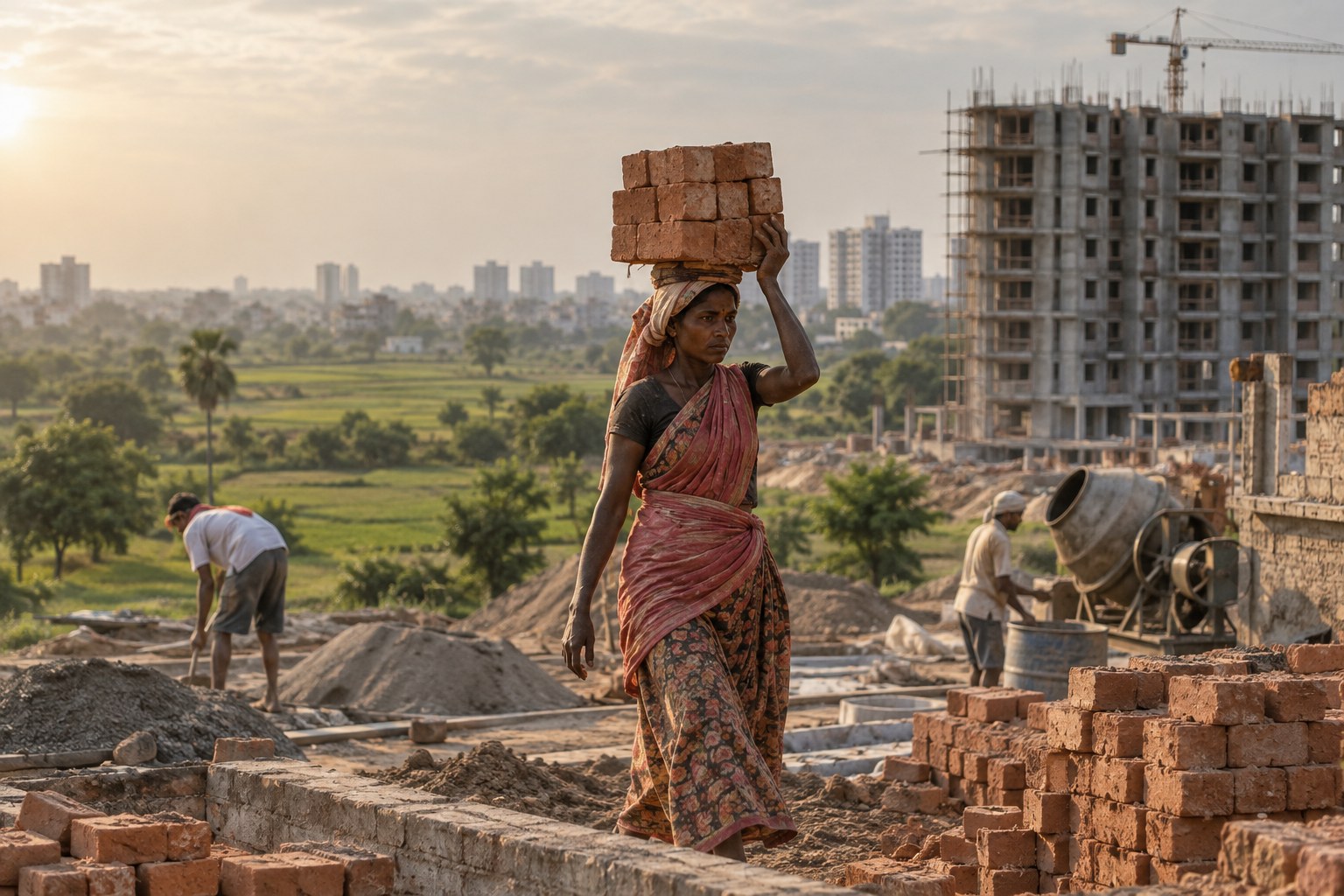
A study by economists Rajveer Jat and Bharat Ramaswami finds that most workers who left Indian farms for cities landed in informal jobs, such as transport and restaurants, that are no more productive than agriculture. Using RBI data for 1999–2024, it places 63–75% of non-farm workers in such industries and locates the real divide between formal and informal work.
Syllabus: GS3 · Indian Economy & Growth; GS3 · Inclusive Growth; GS1 · Women, Population & Urbanisation
Why it matters
Moving workers off farms is supposed to make both them and the country better off, but this study suggests that for most farm workers who moved to cities it has not. Those who left farming mostly found informal jobs, in transport or restaurants for example, that produce no more per worker than farming, so their lives and the wider economy changed little. Only the small formal segment produces clearly more: two to three times as much per worker as agriculture. That makes the kind of job, not just the move to a city, the real question for employment policy. The authors point to better education and healthcare, and Jat to college degrees and English, as routes into more productive work.
Prelims pointers
- KLEMS: Reserve Bank of India database of industry-level inputs and productivity, covering Capital (K), Labour (L), Energy (E), Materials (M) and Services (S).
- Agricultural productivity gap (APG): how much higher value added per worker is outside agriculture than within it.
- Per the study, the formal non-farm segment, small in size but economically dominant, mainly drives India's large aggregate APG.
- Structural dualism, per the study: high-productivity formal sector versus low-productivity informal sector, with agriculture in the latter.
- Lewis dual-sector model (W. Arthur Lewis, 1954): development proceeds as surplus labour moves from a traditional, low-productivity sector to a modern, high-productivity one.
- NCEUS (National Commission for Enterprises in the Unorganised Sector) defined the unorganised sector as unincorporated proprietary or partnership enterprises of individuals or households with fewer than ten workers.
- Labour share: the part of value added paid to workers; the study adjusts for it, along with human capital and hours worked.
Practise a UPSC-style question
Consider the following statements about the findings of the Jat–Ramaswami study on India's agricultural productivity gap:
1. Most farm workers who moved to cities entered informal jobs, such as transport and restaurants, no more productive than farming.
2. Even after adjustments, the formal non-farm sector's value added per worker is five to six times that of agriculture.
3. The large aggregate agricultural productivity gap is driven mainly by the small formal segment of the non-farm economy.
Which of the statements given above is/are correct?
- (a) 1 and 2 only
- (b) 2 and 3 only
- (c) 1 and 3 only
- (d) 1, 2 and 3
Show the answer
Answer: (c) 1 and 3 only
1 is correct: the study finds migrants from farming went mostly into low-productivity informal work such as transport and restaurants. 2 is incorrect: the formal non-farm sector's value added per worker is two to three times that of agriculture, not five to six. 3 is correct: the study finds the aggregate gap comes mainly from the small but economically dominant formal segment.
More from the 7 October 2026 edition
- NCAHP notifies autonomous boards, central assessment committee for allied health National
- India, EU formally launch Green Shipping Corridor industry coalition Environment
- First self-stabilising thorium-229 nuclear clock runs in Vienna Sci-Tech
- Defence Ministry eases industry access to DRDO and military test ranges Defence
- MoSPI releases 2026–2030 roadmap for environmental-economic accounting Environment
- India readies NSAM 2.0 after 3D-printing push trains 1.54 lakh people Sci-Tech
- Navy's first Fleet Support Ship, FSS-1, launched at Visakhapatnam Defence
- Projectile strikes ship in Strait of Hormuz, injuring 11 Indian crew World & IR
- India, Switzerland sign mobility pacts, widen defence and nuclear cooperation World & IR
- MoSPI plans to widen monthly services index to 78.4% of services GVA Economy
- Seven-judge SC bench closes legislative privilege case, keeps free-speech questions open Polity
- India seeks equal focus on adaptation at Pre-COP31 in Fiji Environment