
Navy's first Fleet Support Ship, FSS-1, launched at Visakhapatnam
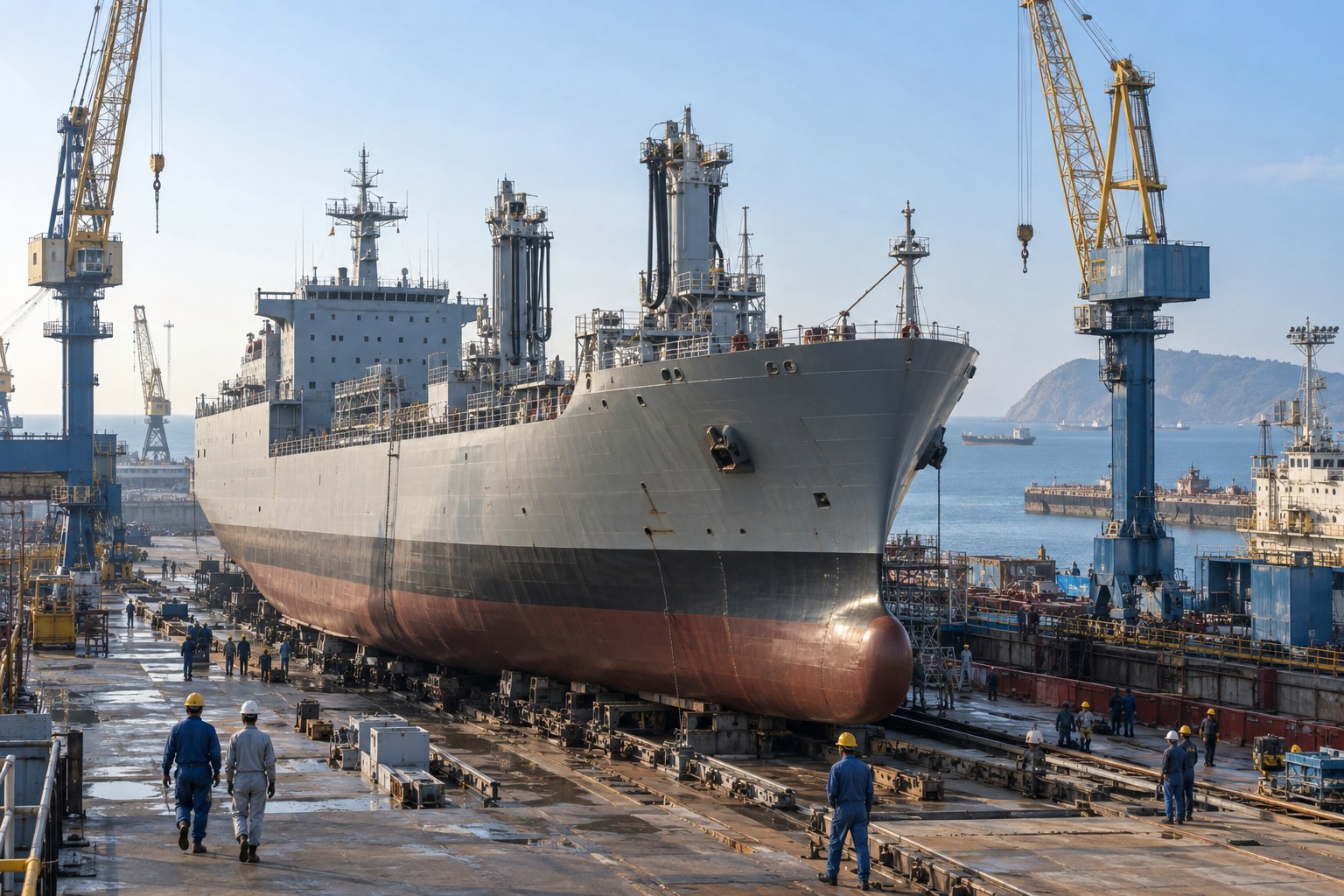
FSS-1, the first of the Indian Navy's Fleet Support Ships, was launched at Hindustan Shipyard Limited, Visakhapatnam, on 6 October 2026, with Raksha Mantri Rajnath Singh as chief guest. The keel of the fifth ship, FSS-5, was also laid. Designed and built in India with over 82% indigenous content, the ships will replenish warships at sea.
Syllabus: Prelims · Current Affairs & IR; GS3 · Indian Achievements in S&T; GS3 · Security Forces & Agencies
Why it matters
A warship operating far from home eventually runs low on fuel and supplies, and sailing back to port cuts its mission short. Ships that resupply the fleet at sea let the Navy stay deployed longer and operate farther from India's shores, which is what blue-water capability means. The same ships would be able to carry relief to disaster-hit areas and help evacuate people from danger. Because they are designed and built in India with over 82% local content, the project also draws on Indian shipyards, defence firms and small businesses. The larger issue is India's push for self-reliance in making its own defence equipment.
Prelims pointers
- Hindustan Shipyard Limited (HSL), Visakhapatnam, a defence public sector shipyard under the Ministry of Defence, designs and builds the Navy's Fleet Support Ships.
- Shipbuilding milestones in order: steel cutting (fabrication begins), keel laying (hull assembly formally begins), launch (hull first floated), outfitting and sea trials, delivery, then commissioning.
- Fleet Support Ships replenish warships at sea; their secondary roles are HADR and NEO.
- HADR: Humanitarian Aid and Disaster Relief. NEO: Non-Combatant Evacuation Operations, which evacuate civilians from places facing conflict or crisis.
- Blue-water navy: one able to operate on the open ocean, far from its own coast, for sustained periods; replenishment at sea extends that reach.
- Indigenous content: the share of a ship's cost sourced within India rather than imported; it is over 82% for the Fleet Support Ships.
- Make in India was launched in 2014 and the Aatmanirbhar Bharat Abhiyan in 2020; the official release links the FSS project to both.
Practise a UPSC-style question
Consider the following statements about the Indian Navy's Fleet Support Ships:
1. Their primary role is Humanitarian Aid and Disaster Relief, with replenishing fleet ships at sea as a secondary role.
2. They are being designed as well as built by Hindustan Shipyard Limited at Visakhapatnam.
3. They are being built with more than 82 per cent indigenous content.
Which of the statements given above is/are correct?
- (a) 1 and 2 only
- (b) 2 and 3 only
- (c) 1 and 3 only
- (d) 1, 2 and 3
Show the answer
Answer: (b) 2 and 3 only
1 is incorrect: the roles are the other way round; replenishing fleet ships at sea is the primary role, and Humanitarian Aid and Disaster Relief (with Non-Combatant Evacuation Operations) is the secondary one. 2 is correct: the ships are indigenously designed and built by Hindustan Shipyard Limited (HSL), Visakhapatnam. 3 is correct: their indigenous content is over 82 per cent.
More from the 7 October 2026 edition
- NCAHP notifies autonomous boards, central assessment committee for allied health National
- India, EU formally launch Green Shipping Corridor industry coalition Environment
- First self-stabilising thorium-229 nuclear clock runs in Vienna Sci-Tech
- Defence Ministry eases industry access to DRDO and military test ranges Defence
- MoSPI releases 2026–2030 roadmap for environmental-economic accounting Environment
- Farm workers moving to cities land in low-productivity informal jobs: study Economy
- India readies NSAM 2.0 after 3D-printing push trains 1.54 lakh people Sci-Tech
- Projectile strikes ship in Strait of Hormuz, injuring 11 Indian crew World & IR
- India, Switzerland sign mobility pacts, widen defence and nuclear cooperation World & IR
- MoSPI plans to widen monthly services index to 78.4% of services GVA Economy
- Seven-judge SC bench closes legislative privilege case, keeps free-speech questions open Polity
- India seeks equal focus on adaptation at Pre-COP31 in Fiji Environment