
First self-stabilising thorium-229 nuclear clock runs in Vienna
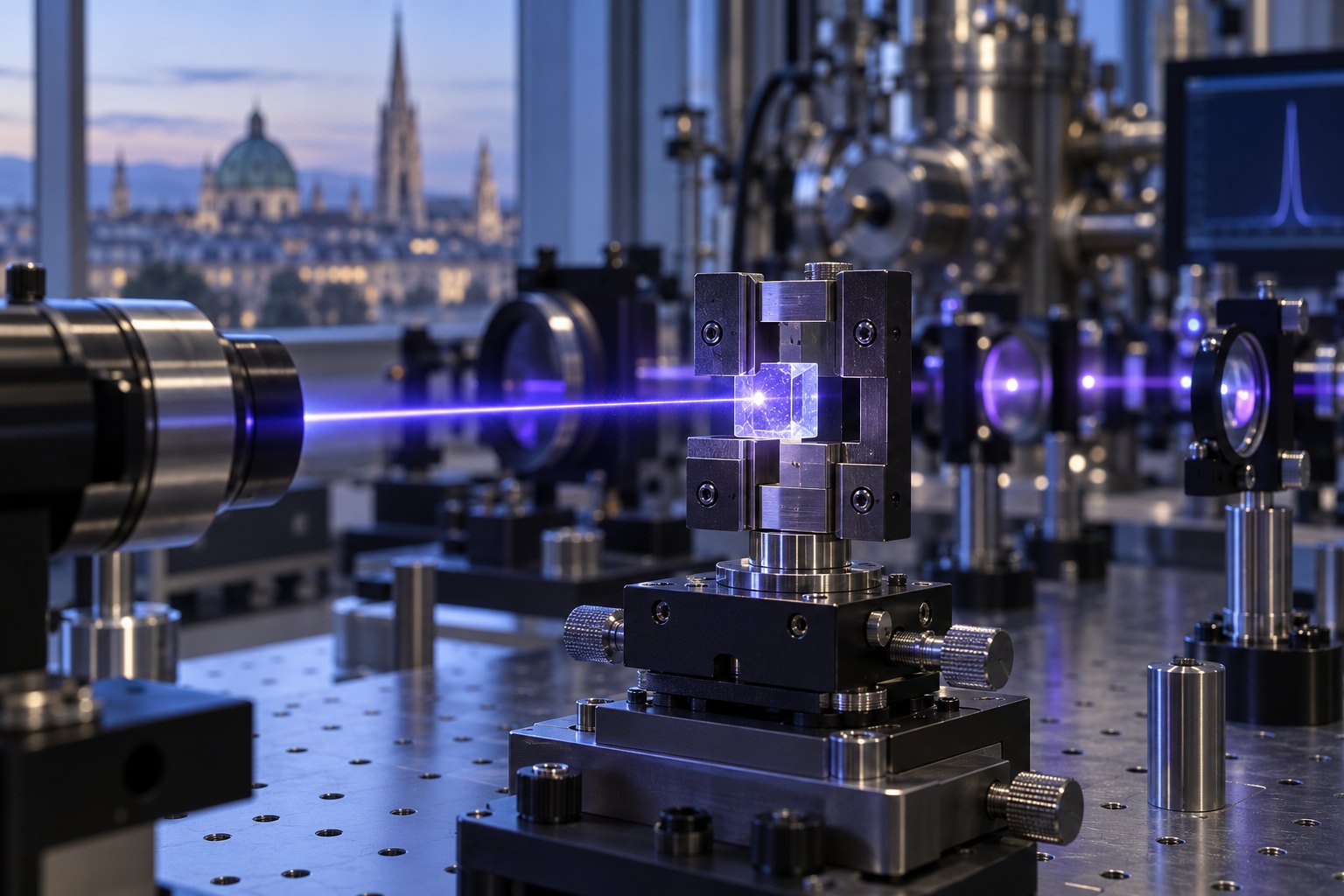
Physicists at TU Wien in Vienna and Germany's Physikalisch-Technische Bundesanstalt (PTB) reported in Nature on October 7, 2026 the first nuclear clock that stabilises itself. A 148-nanometre laser is locked to thorium-229 nuclei held in a calcium fluoride crystal. It ran over 24 hours unattended, at a precision near 10⁻¹⁵, below the best optical atomic clocks.
Syllabus: Prelims · Current Affairs & IR; Prelims · Science & Technology; GS3 · Science & Technology
Why it matters
Anyone who opens a map on a phone relies on atomic clocks. Satellites of the Global Positioning System (GPS) carry them, and a receiver works out its position from the time the signals take to arrive, so a timing error of one-billionth of a second shifts the position by about 30 cm. A nucleus is more than 10,000 times smaller than an atom and reacts far more weakly to outside disturbances, so it can be a steadier timekeeper. Because the thorium sits in a solid crystal, with no atoms held in a vacuum, such a clock could also be made sturdier. Physicists expect to use it to test basic laws of physics; the Vienna clock has already run a first search for dark matter.
Prelims pointers
- Atomic clock: keeps time by the frequency of radiation that moves electrons between two energy levels of an atom.
- SI second: defined by the transition between two hyperfine levels of the ground state of the caesium-133 atom, a microwave frequency of 9,192,631,770 hertz.
- Optical atomic clock: uses a transition at the much higher frequency of visible or ultraviolet light, read with a laser; atoms or ions are held in a vacuum.
- Nuclear clock: uses a transition between two energy states of an atomic nucleus; the first one is based on the isotope thorium-229.
- Thorium-229: its nucleus has two energy states so close together that an ultraviolet laser of 148 nanometres can switch it; other nuclei need far more energy.
- PTB (Physikalisch-Technische Bundesanstalt): Germany's national metrology institute, at Braunschweig. TU Wien: the Vienna University of Technology, Austria.
- Isotopes: atoms of one element with the same number of protons and different numbers of neutrons; thorium has 90 protons.
Practise a UPSC-style question
With reference to atomic clocks, consider the following statements:
1. The SI unit of time, the second, is defined by a transition in the strontium-87 atom.
2. Optical atomic clocks work at higher frequencies than caesium clocks, which operate in the microwave region.
Which of the statements given above is/are correct?
- (a) 1 only
- (b) 2 only
- (c) Both 1 and 2
- (d) Neither 1 nor 2
Show the answer
Answer: (b) 2 only
1 is incorrect: the second is defined by the transition between two hyperfine levels of the ground state of the caesium-133 atom, at 9,192,631,770 hertz; strontium is used in optical clocks. 2 is correct: the caesium transition is a microwave frequency, while optical clocks use the far higher frequencies of visible or ultraviolet light.
More from the 7 October 2026 edition
- NCAHP notifies autonomous boards, central assessment committee for allied health National
- India, EU formally launch Green Shipping Corridor industry coalition Environment
- Defence Ministry eases industry access to DRDO and military test ranges Defence
- MoSPI releases 2026–2030 roadmap for environmental-economic accounting Environment
- Farm workers moving to cities land in low-productivity informal jobs: study Economy
- India readies NSAM 2.0 after 3D-printing push trains 1.54 lakh people Sci-Tech
- Navy's first Fleet Support Ship, FSS-1, launched at Visakhapatnam Defence
- Projectile strikes ship in Strait of Hormuz, injuring 11 Indian crew World & IR
- India, Switzerland sign mobility pacts, widen defence and nuclear cooperation World & IR
- MoSPI plans to widen monthly services index to 78.4% of services GVA Economy
- Seven-judge SC bench closes legislative privilege case, keeps free-speech questions open Polity
- India seeks equal focus on adaptation at Pre-COP31 in Fiji Environment