
MoSPI releases 2026–2030 roadmap for environmental-economic accounting
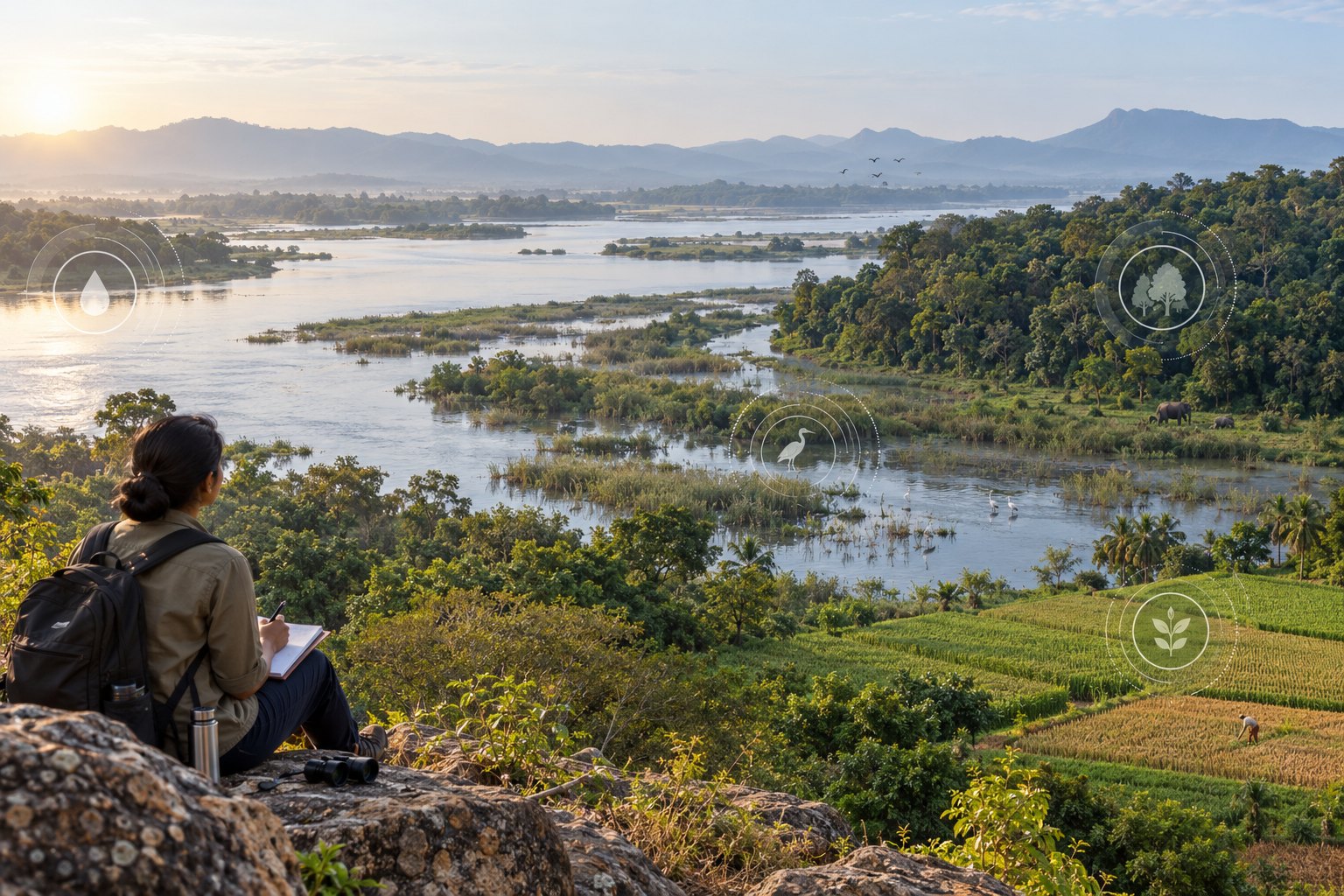
The Ministry of Statistics and Programme Implementation (MoSPI) announced its Strategy for Environmental Economic Accounts in India 2026–2030 on October 7, 2026. It extends a 2022–2026 strategy and plans new or wider accounts for forests, minerals, soil, land, water, carbon stock and biodiversity. It follows the UN's System of Environmental-Economic Accounting and serves as guidance for States and Union Territories.
Syllabus: GS3 · Indian Economy & Growth; Prelims; GS3 · Environment & Conservation
Why it matters
A State official approving a mine, a borewell cluster or new farmland sees the income it adds to the economy, but not the forest, soil or groundwater it uses up. Environmental accounts put both on one page: how much water industries draw in a year beside how much remains, or how much forest a district has beside its condition. They work even without a price tag. South Africa's river accounts showed a 10% fall in river health between 1999 and 2011, enough to guide decisions without valuing the rivers in money. The new roadmap gives States a guiding framework to start such accounts. The larger question is whether India's growth figures should show the natural capital that growth consumes.
Prelims pointers
- SEEA Central Framework: adopted by the UN Statistical Commission in 2012 as the first international standard for environmental-economic accounting; it uses System of National Accounts concepts.
- Central Framework covers three areas: environmental flows, stocks of environmental assets, and economic activity related to the environment, such as environmental protection spending.
- Stock versus flow: a stock is measured at a point in time, such as standing timber at year-end; a flow over a period, such as timber felled that year.
- SEEA Ecosystem Accounting has five core accounts: extent, condition, services flow (physical), services flow (monetary) and monetary ecosystem assets. Countries compile those their decision-makers need.
- Extent accounts record the area of each ecosystem type; condition accounts record its state against a reference level. A wetland can keep its area while its condition worsens.
- SEEA Ecosystem Accounting classifies ecosystem types with the Global Ecosystem Typology of the International Union for Conservation of Nature (IUCN).
- Monetary valuation is optional in SEEA. Its monetary entries use exchange values, so they do not claim to measure the full value of nature.
- National Statistical Office (NSO): formed under MoSPI in 2019 by merging the Central Statistics Office and the National Sample Survey Office.
Practise a UPSC-style question
With reference to the System of Environmental-Economic Accounting (SEEA), consider the following statements:
1. Its Central Framework was adopted by the United Nations Statistical Commission in 2012 as an international statistical standard.
2. It requires environmental assets to be valued in monetary terms before an account can be compiled.
3. It uses concepts and classifications consistent with the System of National Accounts.
Which of the statements given above is/are correct?
- (a) 1 and 2 only
- (b) 2 and 3 only
- (c) 1 and 3 only
- (d) 1, 2 and 3
Show the answer
Answer: (c) 1 and 3 only
1 is correct: the UN Statistical Commission adopted the SEEA Central Framework in 2012 as the first international standard for environmental-economic accounting. 2 is incorrect: monetary valuation is possible but not required, and accounts in physical terms can be compiled and used on their own. 3 is correct: the SEEA follows the accounting structure and concepts of the System of National Accounts, so environmental data can be read beside GDP and other economic measures.
More from the 7 October 2026 edition
- NCAHP notifies autonomous boards, central assessment committee for allied health National
- India, EU formally launch Green Shipping Corridor industry coalition Environment
- First self-stabilising thorium-229 nuclear clock runs in Vienna Sci-Tech
- Defence Ministry eases industry access to DRDO and military test ranges Defence
- Farm workers moving to cities land in low-productivity informal jobs: study Economy
- India readies NSAM 2.0 after 3D-printing push trains 1.54 lakh people Sci-Tech
- Navy's first Fleet Support Ship, FSS-1, launched at Visakhapatnam Defence
- Projectile strikes ship in Strait of Hormuz, injuring 11 Indian crew World & IR
- India, Switzerland sign mobility pacts, widen defence and nuclear cooperation World & IR
- MoSPI plans to widen monthly services index to 78.4% of services GVA Economy
- Seven-judge SC bench closes legislative privilege case, keeps free-speech questions open Polity
- India seeks equal focus on adaptation at Pre-COP31 in Fiji Environment