
Defence Ministry eases industry access to DRDO and military test ranges
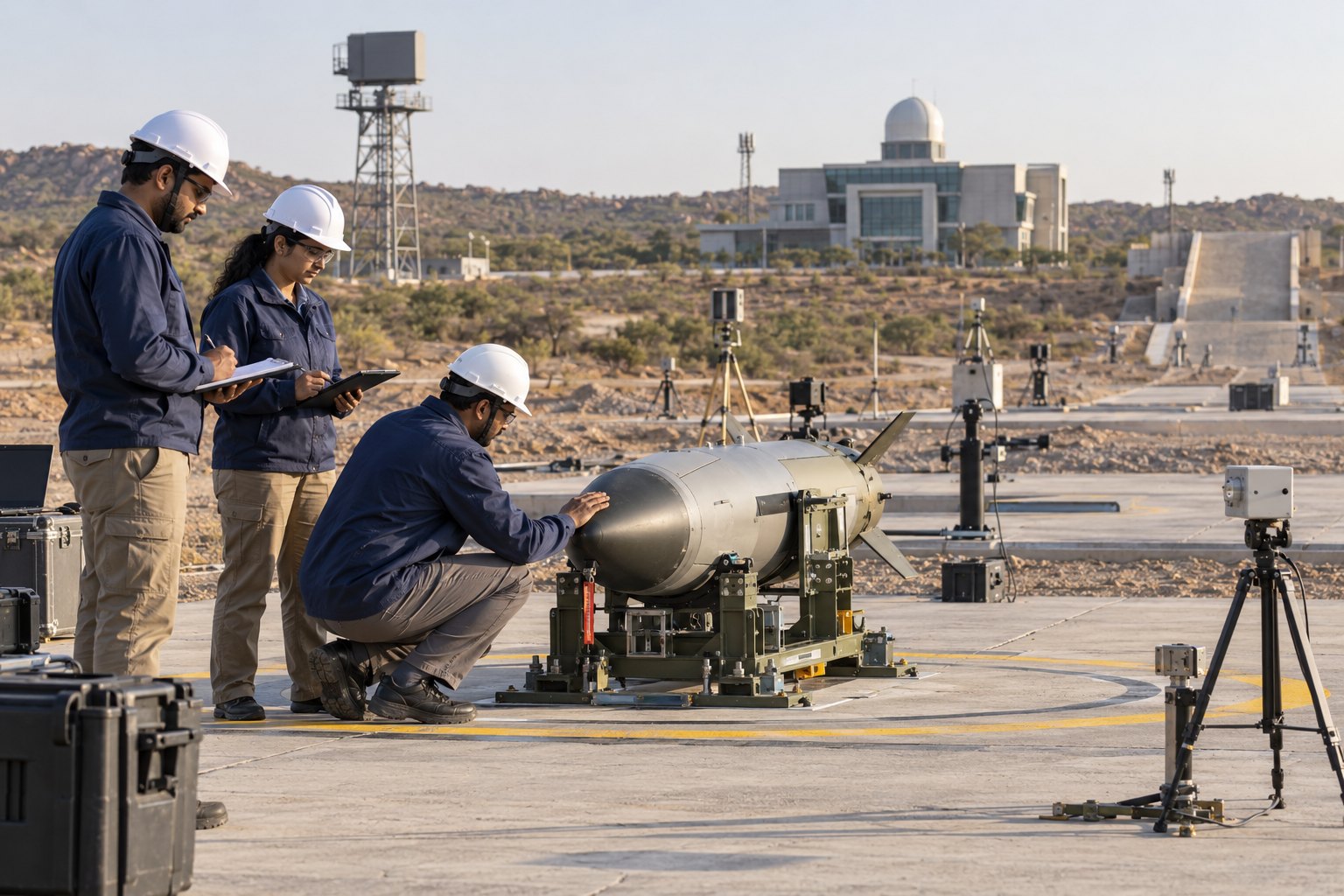
The Defence Ministry on October 7 announced a revised Standard Operating Procedure, approved by Defence Minister Rajnath Singh, for Indian defence industry to use its proof ranges, field firing ranges and test facilities. Testing charges are waived for iDEX, Technology Development Fund and Make projects. A three-day quarterly slot is reserved at proof ranges, and conciliation replaces arbitration for disputes.
Syllabus: Prelims; GS3 · Science & Technology; GS3 · Indian Achievements in S&T
Why it matters
A start-up that designs a new shell fuse or protective armour cannot sell it to the armed forces until it has been fired, measured and proven, and few small firms can afford a firing range of their own. Under the revised SOP, an iDEX or TDF winner pays no testing charges at a government proof range and can plan its trials around a fixed three-day quarterly slot. If a dispute arises over a booking or a bill, the two sides now try to agree a settlement through conciliation, which the Ministry expects to be quicker than arbitration. Cheaper, predictable testing can shorten the path from prototype to a product the Services can buy, which is how indigenous defence production grows.
Prelims pointers
- Defence Research and Development Organisation (DRDO): India's defence research agency under the Ministry of Defence, formed in 1958; it executes the Technology Development Fund.
- iDEX is the operational framework of the Defence Innovation Organisation, formed under the Department of Defence Production as a Section 8 company under the Companies Act, 2013.
- iDEX funds are grant-in-aid: DIO takes no equity, intellectual property stays with the winner, and the nodal agency alone decides on procurement.
- Make-II: industry-funded prototype development, mainly for import substitution; no government funding for the prototype and at least 50% indigenous content.
- DGQA and DGAQA work under the Department of Defence Production; DGAQA assures quality of military aircraft, Unmanned Aerial Vehicles (UAVs), aero-engines and missiles.
- Terminal Ballistics Research Laboratory (TBRL), Chandigarh: a DRDO laboratory for design, development and full-scale testing of explosives and ammunition.
- Ballistics has three main branches: internal (inside the barrel), external (flight through air) and terminal (impact and damage at the target).
- MSMEs are classified under the Micro, Small and Medium Enterprises Development Act, 2006, by investment in plant and machinery or equipment and by annual turnover.
Practise a UPSC-style question
With reference to defence innovation schemes in India, consider the following statements:
1. Innovations for Defence Excellence (iDEX) is funded and managed by the Defence Research and Development Organisation.
2. The Technology Development Fund scheme is executed by the Defence Innovation Organisation under the Ministry of Defence.
Which of the statements given above is/are correct?
- (a) 1 only
- (b) 2 only
- (c) Both 1 and 2
- (d) Neither 1 nor 2
Show the answer
Answer: (d) Neither 1 nor 2
1 is incorrect: iDEX is funded and managed by the Defence Innovation Organisation (DIO), a not-for-profit company formed under the Department of Defence Production. 2 is incorrect: the Technology Development Fund is a Ministry of Defence scheme executed by DRDO, which supports industry, especially MSMEs and start-ups. The two bodies are swapped in the statements.
More from the 7 October 2026 edition
- NCAHP notifies autonomous boards, central assessment committee for allied health National
- India, EU formally launch Green Shipping Corridor industry coalition Environment
- First self-stabilising thorium-229 nuclear clock runs in Vienna Sci-Tech
- MoSPI releases 2026–2030 roadmap for environmental-economic accounting Environment
- Farm workers moving to cities land in low-productivity informal jobs: study Economy
- India readies NSAM 2.0 after 3D-printing push trains 1.54 lakh people Sci-Tech
- Navy's first Fleet Support Ship, FSS-1, launched at Visakhapatnam Defence
- Projectile strikes ship in Strait of Hormuz, injuring 11 Indian crew World & IR
- India, Switzerland sign mobility pacts, widen defence and nuclear cooperation World & IR
- MoSPI plans to widen monthly services index to 78.4% of services GVA Economy
- Seven-judge SC bench closes legislative privilege case, keeps free-speech questions open Polity
- India seeks equal focus on adaptation at Pre-COP31 in Fiji Environment