
First captive-bred great Indian bustards released into the wild
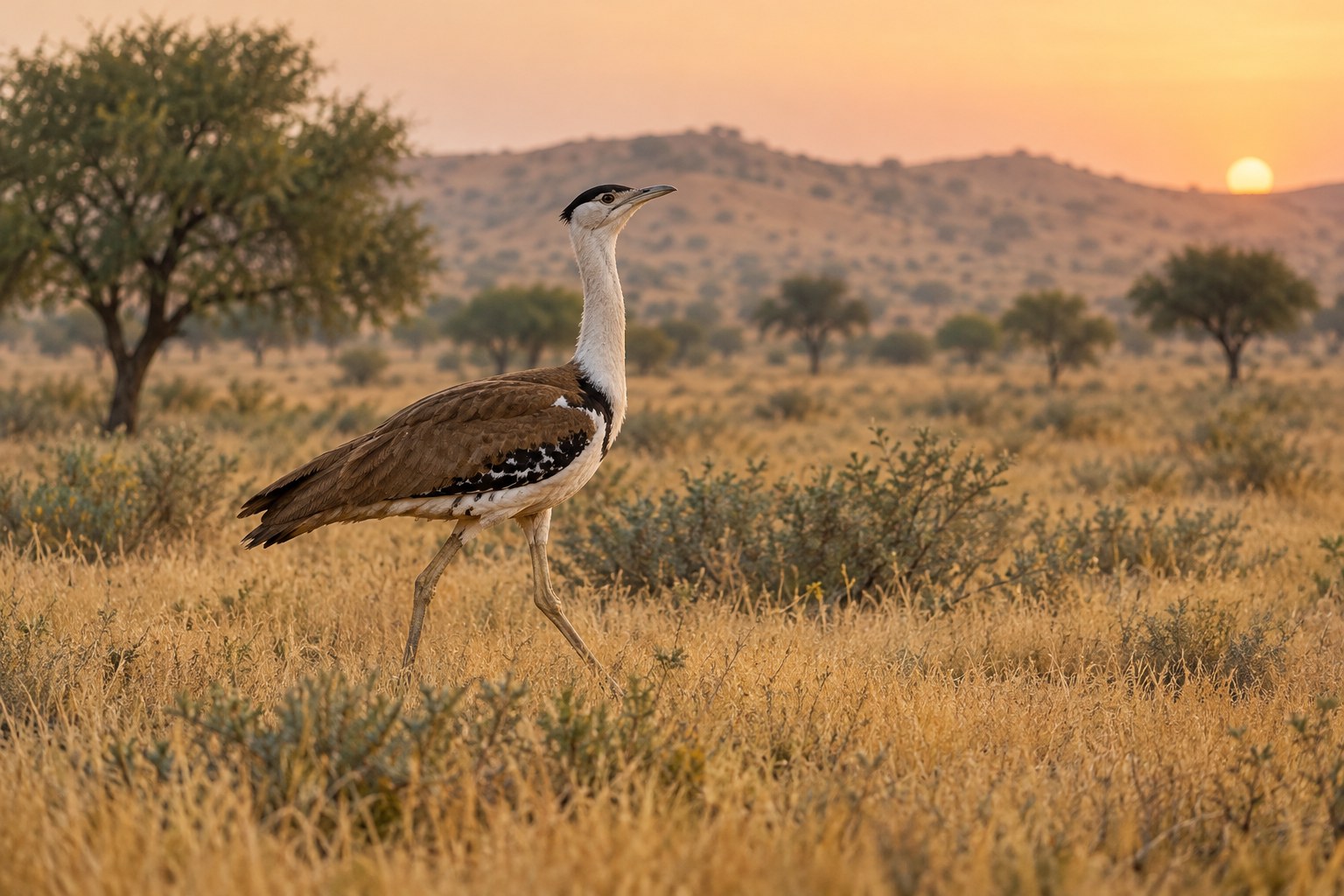
Two captive-bred male great Indian bustards were released into the wild for the first time on October 4 in Rajasthan's Desert National Park near Jaisalmer. The pilot, run by the Environment Ministry, the Rajasthan Forest Department and the Wildlife Institute of India, begins rewilding a species whose wild population has fallen to about 150.
Syllabus: Prelims · Environment & Ecology; GS3 · Environment & Conservation
Why it matters
For the scientists and forest staff who raised these birds, the release is the first real test of whether a bustard bred in captivity can feed itself and survive in the open. The two males are being watched for behaviour and diet, the Minister said; WII's director said more birds will be released gradually once this first step is assessed. In the open, overhead power lines are a known killer: the bird lacks frontal vision and is too heavy to swerve at close range. WII's 2024-25 survey report says the species will last only if its habitat is made secure alongside conservation breeding. It found power lines, roads, farm fencing and solar plants spreading across the Thar.
Prelims pointers
- Great Indian bustard (Ardeotis nigriceps): Critically Endangered on the IUCN Red List since 2011; one of the heaviest flying birds in the world; a bird of arid and semi-arid grasslands.
- Wildlife (Protection) Act, 1972: the great Indian bustard is in Schedule I, the highest level of protection from hunting. It is Rajasthan's state bird, locally called Godawan.
- Convention on Migratory Species: the great Indian bustard is in Appendix I, included on India's proposal; it was the mascot of the 13th Conference of Parties at Gandhinagar.
- The bird lacks frontal vision and is too heavy to manoeuvre at close range, so it collides with overhead power lines, the Power Ministry told the Supreme Court in 2021.
- Outside Rajasthan, the Environment Ministry told the Lok Sabha in 2022 of fewer than 10 birds each in Gujarat, Maharashtra, Andhra Pradesh and Karnataka.
- Desert National Park: 3,162 sq km of the Thar Desert in Rajasthan's Jaisalmer and Barmer districts, notified in 1980.
- The Wildlife Institute of India, Dehradun, is an autonomous institution under the Union Ministry of Environment, Forest and Climate Change.
- Supreme Court priority areas for the GIB: 14,013 sq km in Rajasthan and 740 sq km in Gujarat.
Practise a UPSC-style question
With reference to the great Indian bustard, consider the following statements:
1. The great Indian bustard is listed in Schedule II of the Wildlife (Protection) Act, 1972.
2. It is one of the heaviest flying birds in the world and typically occupies grasslands or arid regions.
3. It is listed as Critically Endangered on the IUCN Red List of Threatened Species.
Which of the statements given above is/are correct?
- (a) 1 and 2 only
- (b) 2 and 3 only
- (c) 1 and 3 only
- (d) 1, 2 and 3
Show the answer
Answer: (b) 2 and 3 only
1 is incorrect: the great Indian bustard is in Schedule I of the Wildlife (Protection) Act, 1972, the highest level of protection. 2 is correct: it is among the heaviest flying birds in the world and lives in arid and semi-arid grasslands. 3 is correct: the IUCN lists it as Critically Endangered, with only about 150 left in the wild.
More from the 7 October 2026 edition
- NCAHP notifies autonomous boards, central assessment committee for allied health National
- India, EU formally launch Green Shipping Corridor industry coalition Environment
- First self-stabilising thorium-229 nuclear clock runs in Vienna Sci-Tech
- Defence Ministry eases industry access to DRDO and military test ranges Defence
- MoSPI releases 2026–2030 roadmap for environmental-economic accounting Environment
- Farm workers moving to cities land in low-productivity informal jobs: study Economy
- India readies NSAM 2.0 after 3D-printing push trains 1.54 lakh people Sci-Tech
- Navy's first Fleet Support Ship, FSS-1, launched at Visakhapatnam Defence
- Projectile strikes ship in Strait of Hormuz, injuring 11 Indian crew World & IR
- India, Switzerland sign mobility pacts, widen defence and nuclear cooperation World & IR
- MoSPI plans to widen monthly services index to 78.4% of services GVA Economy
- Seven-judge SC bench closes legislative privilege case, keeps free-speech questions open Polity