
CJI says Supreme Court never approved changes to voter Form 6
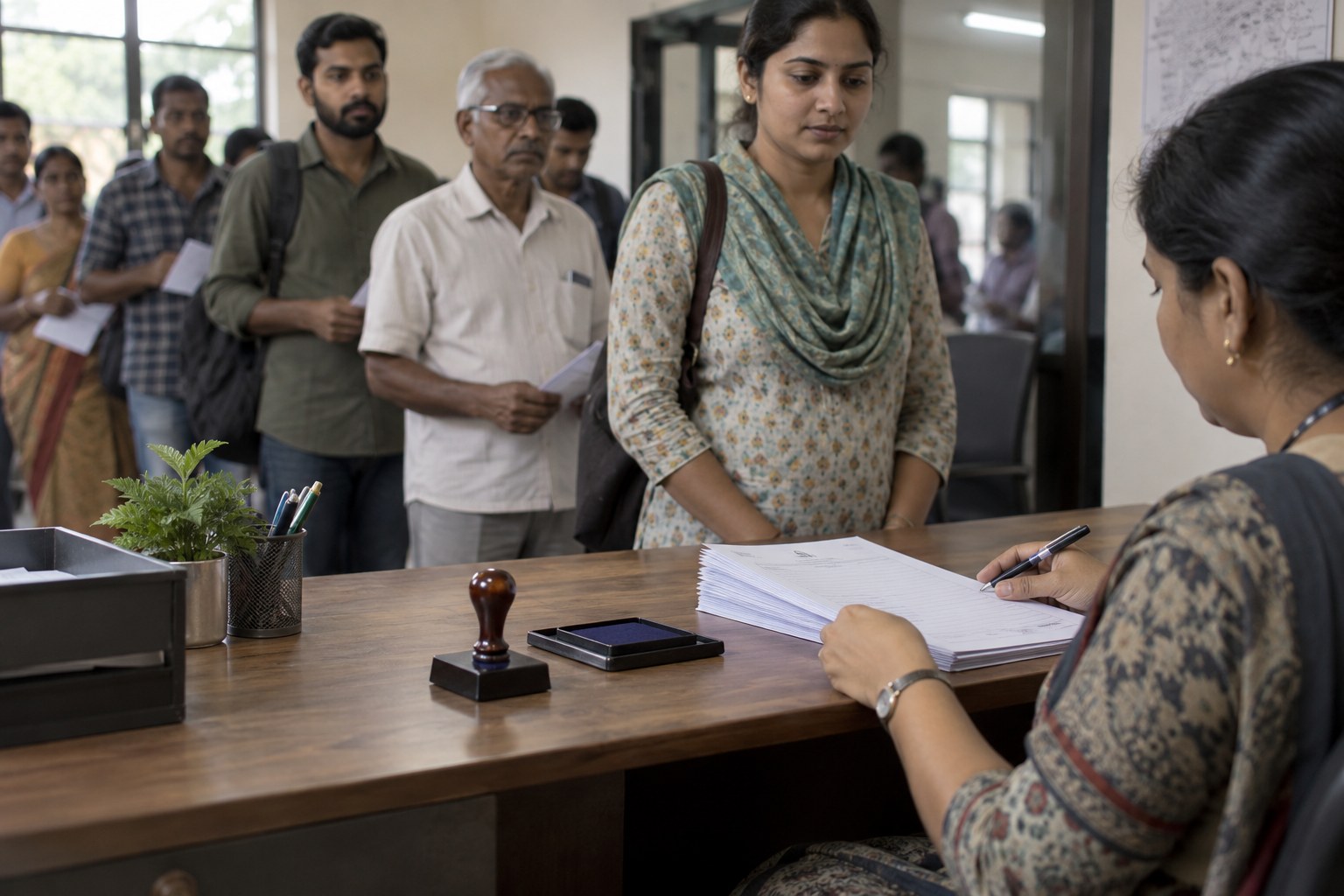
Chief Justice of India Surya Kant said on October 5 that the Supreme Court had not approved any modification to Form 6, the voter enrolment form. A three-judge bench hearing petitions against Chief Election Commissioner Gyanesh Kumar issued notices to the Election Commission and the Centre, and will examine who altered the form once the records are produced.
Syllabus: Prelims · Polity & Governance; GS2 · Representation of the People Act; GS2 · Constitutional Bodies
Why it matters
Form 6 is how a new voter gets onto the electoral roll. From July 2026, a person applying online had to state whether they, a parent or a grandparent appeared in a roll from the early 2000s, and could not submit the form without the declaration. Election Commission officials say the declaration helps map electors and reduces the documents new applicants must submit. The legal question is who may add such a requirement, because the rules that prescribe the form are made by the Centre and laid before Parliament. Opposition leaders say the CJI's remark contradicts the EC's statement that the court had upheld the declaration, while the BJP says the CJI never called the form illegal.
Prelims pointers
- Form 6, the application for inclusion in the electoral roll, is published in the Registration of Electors Rules, 1960, framed under the RP Act, 1950.
- Section 28 of the RP Act, 1950: the Centre may, after consulting the Election Commission, make rules by notification in the Official Gazette.
- Every rule made under the RP Act, 1950 must be laid before each House of Parliament "as soon as may be" after it is made.
- Article 324 vests the superintendence, direction and control of preparing electoral rolls and conducting elections in the Election Commission.
- Article 326: Lok Sabha and Assembly elections are held on adult suffrage; every citizen aged 18 or above, unless otherwise disqualified, is entitled to be registered.
- Section 19 of the RP Act, 1950 entitles a person aged at least 18 on the qualifying date and ordinarily resident in a constituency to enrolment there.
- EPIC means Electors Photo Identity Card; the statutory Form 6 asks for the name and EPIC number of a family member already on the roll at the applicant's address.
- Section 18 of the Chief Election Commissioner and Other Election Commissioners Act, 2023: the EC transacts business unanimously as far as possible; differences are decided by majority.
Practise a UPSC-style question
With reference to the Election Commission of India, consider the following statements:
1. Article 324 vests in it the superintendence, direction and control of preparing electoral rolls and conducting elections.
2. The Chief Election Commissioner can be removed from office in the same manner and on the same grounds as a Supreme Court judge.
3. The Constitution itself fixes the number of Election Commissioners, besides the Chief Election Commissioner, at two.
Which of the statements given above is/are correct?
- (a) 1 and 2 only
- (b) 2 and 3 only
- (c) 1 and 3 only
- (d) 1, 2 and 3
Show the answer
Answer: (a) 1 and 2 only
1 is correct: Article 324(1) vests the superintendence, direction and control of the preparation of electoral rolls and the conduct of elections to Parliament and the state legislatures in the Commission. 2 is correct: under Article 324(5), the CEC cannot be removed except in like manner and on like grounds as a Supreme Court judge. 3 is incorrect: Article 324(2) leaves the number of other Election Commissioners to be fixed by the President from time to time.
More from the 7 October 2026 edition
- NCAHP notifies autonomous boards, central assessment committee for allied health National
- India, EU formally launch Green Shipping Corridor industry coalition Environment
- First self-stabilising thorium-229 nuclear clock runs in Vienna Sci-Tech
- Defence Ministry eases industry access to DRDO and military test ranges Defence
- MoSPI releases 2026–2030 roadmap for environmental-economic accounting Environment
- Farm workers moving to cities land in low-productivity informal jobs: study Economy
- India readies NSAM 2.0 after 3D-printing push trains 1.54 lakh people Sci-Tech
- Navy's first Fleet Support Ship, FSS-1, launched at Visakhapatnam Defence
- Projectile strikes ship in Strait of Hormuz, injuring 11 Indian crew World & IR
- India, Switzerland sign mobility pacts, widen defence and nuclear cooperation World & IR
- MoSPI plans to widen monthly services index to 78.4% of services GVA Economy
- Seven-judge SC bench closes legislative privilege case, keeps free-speech questions open Polity