
Voyager 1 at one light-day: heliosphere, interstellar space and light units
Why in news: NASA says Voyager 1 will be one light-day, about 25.9 billion km, from Earth on 18 November 2026, a distance no human-made object has reached.
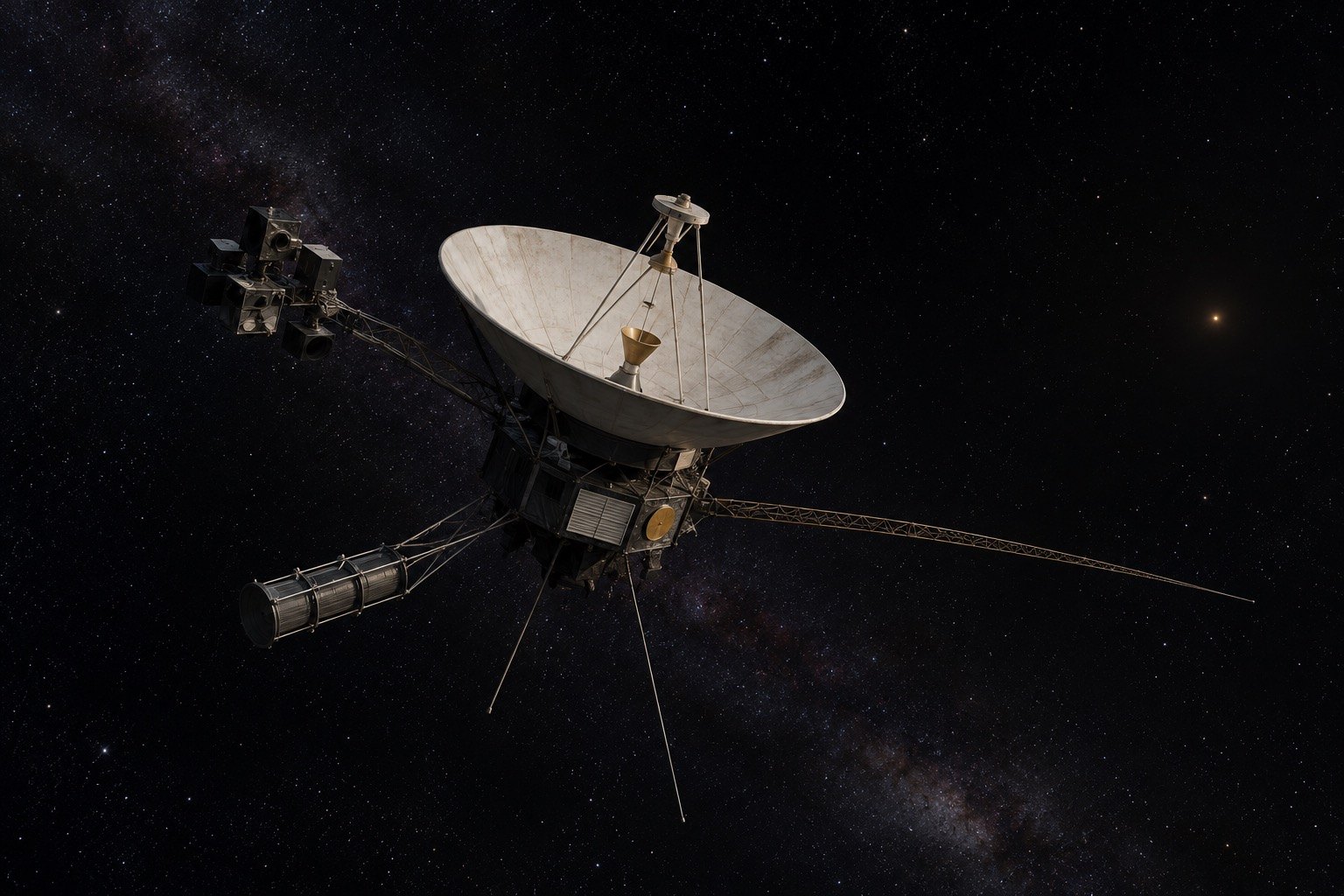
The heliosphere is the bubble of solar wind and magnetic fields that the Sun blows around its planets; its outer edge, the heliopause, opens onto interstellar space. NASA's Voyager 1, launched in 1977, crossed that edge in 2012 and Voyager 2 in 2018. NASA expects Voyager 1 to be one light-day from Earth on 18 November 2026.
Syllabus: Prelims · Science & Technology; GS3 · Science & Technology; GS3 · IT, Space, Biotech & IPR
Why this matters for UPSC
GS3 science and technology: space missions and the Sun's heliosphere. Prelims can ask about the heliopause, RTG power and light-distance units.
In short
The Voyager mission is NASA's pair of probes launched in 1977 to fly past the outer planets; both have since crossed the heliopause, the Sun's outer boundary, into interstellar space.
Voyager shows that boundary science rests on endurance: careful power rationing, not new hardware, now decides how long humanity samples interstellar space.
Why it matters
A scientist studying space weather learns from Voyager what lies at the far edge of the Sun's influence. The two probes are the only instruments sampling the region outside the bubble directly, so their readings show how well the bubble keeps out cosmic radiation arriving from other stars. That shielding is part of what keeps planets habitable. Distance brings a practical cost too. A command sent to Voyager 1 now needs a full day to arrive and its reply another day, so engineers must plan each step well ahead and trust the spacecraft to protect itself. With power shrinking every year, each decision to switch something off sets how long humanity keeps a direct view of interstellar space.
Prelims pointers
- Going outward from the Sun: termination shock, heliosheath, heliopause, then interstellar space. Voyager 1 met the termination shock at 94 AU, Voyager 2 at 84 AU.
- Look-alikes: the heliosphere is the Sun's bubble around all the planets; the magnetosphere is Earth's own magnetic shield, which also stops the solar wind eroding the atmosphere.
- The Andromeda galaxy, the next-closest galaxy to the Milky Way, is about 2.5 million light-years away.
- In an RTG, plutonium-238 decays and emits alpha particles; their energy becomes heat, which a thermoelectric converter turns into electricity.
- The Voyager Golden Record is a 12-inch gold-plated copper disc carrying greetings in 55 languages, 115 images and 90 minutes of music; Carl Sagan led its selection committee.
- Voyager 1 has been the most distant human-made object since it overtook Pioneer 10 in 1998.
- NASA's Jet Propulsion Laboratory, managed by Caltech, built and operates the Voyagers and runs the Deep Space Network; NASA's Heliophysics Division funds the mission.
Practise a UPSC-style question
With reference to the boundaries of the heliosphere, consider the following statements:
1. At the termination shock, the solar wind slows from supersonic to subsonic speed.
2. The heliopause is the outer edge of the heliosphere, beyond which lies interstellar space.
3. The heliosheath lies outside the heliopause and is dominated by the interstellar magnetic field.
Which of the statements given above is/are correct?
- (a) 1 and 2 only
- (b) 2 and 3 only
- (c) 1 and 3 only
- (d) 1, 2 and 3
Show the answer
Answer: (a) 1 and 2 only
Answer: (a) 1 and 2 only. The heliosheath sits inside the heliopause, not outside it.
Statement 1: correct. NASA describes the termination shock as the point where the solar wind, pushing on the interstellar medium, falls below the speed of sound.
Statement 2: correct. The heliopause marks where the heliosphere ends; both Voyagers crossed it to enter interstellar space.
Statement 3: incorrect. The heliosheath is the outer layer of the heliosphere, between the termination shock and the heliopause, and the Sun's magnetic field still dominates it.
Eliminate: statement 3 puts the heliosheath on the wrong side of the heliopause. Out: (b), (c), (d).
Trap: Swapped attribution. The heliosheath is handed the interstellar field and placed outside the boundary, which suits a student who knows the names but not their order.
Remember: Outward order: termination shock, heliosheath, heliopause, interstellar space.
More Explainers
- CDRI: India's coalition for disaster-resilient infrastructure Environment
- Pichwai painting of Nathdwara, Rajasthan National
- Kerch Strait: the sea link between the Black Sea and Azov World & IR
- Wind energy in India: potential, offshore wind and the policy push Economy
- Pallikaranai marsh: a Chennai Ramsar site and its zone of influence Environment
- Andaman cobra: India's only island cobra, Endangered and endemic Environment
- International Coconut Community and India's Coconut Development Board World & IR
- Real Estate (Regulation and Development) Act, 2016: how it protects homebuyers Polity
- Open correctional institutions and the Supreme Court's 2026 directions Polity
- ICTP, Trieste: the UNESCO-IAEA centre for physics and mathematics Sci-Tech
- PJ.2.1 and how new Covid variants are classified and tracked Sci-Tech
- Berlin Conference of 1884-85 and the rules for colonising Africa World & IR