
Wind energy in India: potential, offshore wind and the policy push
Why in news: PIB's backgrounder of 18 November 2026 set out India's wind capacity, its potential and the policies for onshore and offshore wind.
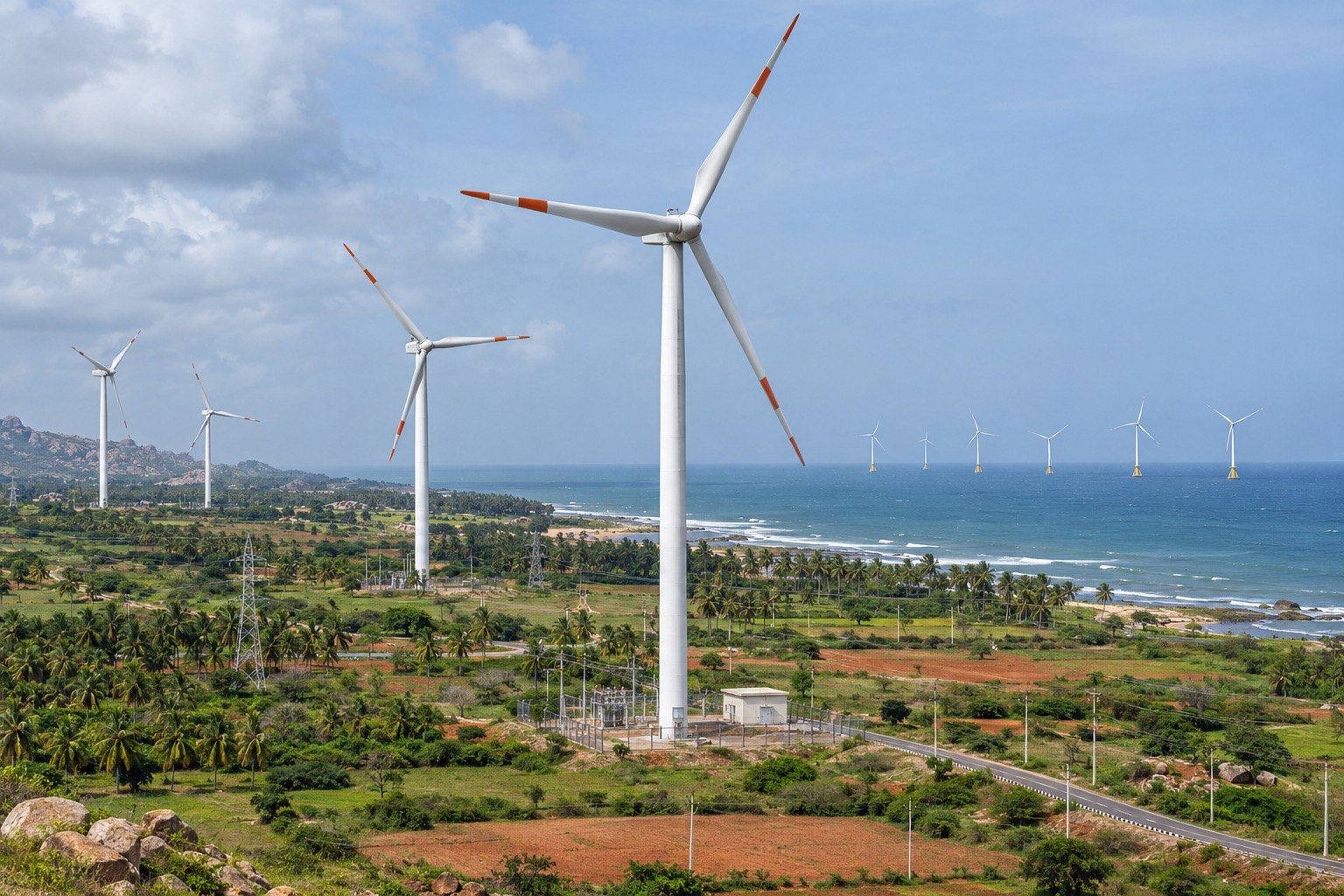
Wind energy converts the movement of air into electricity, a renewable substitute for fossil fuels. Per government figures, wind accounted for 59.20 GW of India's 299.25 GW installed renewable capacity on 30 September 2026, up from 21 GW in March 2014. A PIB backgrounder of 18 November 2026 set out its potential, offshore plans and policies.
Syllabus: Prelims · Environment & Ecology; GS3 · Infrastructure; GS2 · Government Policies
Why this matters for UPSC
GS3 infrastructure and energy: wind power in India's renewable energy transition. Prelims can ask about wind potential, NIWE and offshore wind policy; Mains, about meeting the 2030 target.
In short
Wind energy turns moving air into electricity. India's gross wind potential far exceeds its installed base, making wind a pillar of energy security and the renewable transition.
Wind can carry India to its 2030 target only if transmission, storage and offshore funding keep pace with the resource its wind maps reveal.
Why it matters
A factory owner who wants clean power can now buy it straight from a wind or solar developer, and power buyers must keep taking a share of wind power. That steady demand is what persuades companies to build wind farms and factories that make blades and towers in India. Because a large part of wind output arrives when people use the most electricity, it eases the strain on the grid at the hardest hours and reduces reliance on conventional sources. For coastal States, offshore wind could become a new industry, but it needs public support to begin. How quickly these projects come up will decide whether India meets its clean-energy promises without power shortages.
Prelims pointers
- NIWE has installed more than 900 wind-monitoring stations; its wind potential maps cover hub heights of 50, 80, 100, 120 and 150 metres.
- The offshore wind policy covers waters up to 200 nautical miles from the baseline, the extent of India's EEZ; India's coastline is about 7,600 km long.
- The eight high-potential States at 150 metres: Rajasthan, Gujarat, Maharashtra, Karnataka, Andhra Pradesh, Tamil Nadu, Madhya Pradesh, Telangana; Odisha is only an emerging wind State.
- Renewable Purchase Obligations create demand by mandating purchases; the Green Energy Open Access Rules instead help industries procure renewable power directly.
- The Generation Based Incentive applied to wind projects commissioned ahead of March 2017; Viability Gap Funding now backs offshore wind.
- The 2015 offshore policy links offshore wind to energy security and the targets of the National Action Plan on Climate Change (NAPCC).
- India's offshore wind ties: a taskforce with the United Kingdom, a renewed MoU with Denmark (May 2025) and cooperation with Belgium.
Practise a UPSC-style question
With reference to the National Offshore Wind Energy Policy of India, consider the following statements:
1. The Ministry of New and Renewable Energy is the nodal ministry for offshore areas inside the Exclusive Economic Zone.
2. The National Institute of Wind Energy is the nodal agency that allocates offshore wind energy blocks.
3. The policy covers offshore wind development up to 200 nautical miles from the baseline.
Which of the statements given above is/are correct?
- (a) 1 and 2 only
- (b) 2 and 3 only
- (c) 1 and 3 only
- (d) 1, 2 and 3
Show the answer
Answer: (d) 1, 2 and 3
Answer: (d) 1, 2 and 3. All three describe the policy the Union Cabinet approved in September 2015.
Statement 1: correct. The 2015 policy authorised the Ministry of New and Renewable Energy (MNRE) as the nodal ministry for offshore areas within India's EEZ.
Statement 2: correct. The National Institute of Wind Energy (NIWE) was made the nodal agency, carrying out allocation of offshore wind energy blocks and coordination.
Statement 3: correct. The policy applies to waters up to 200 nautical miles from the baseline, which is the extent of India's Exclusive Economic Zone.
Eliminate: statement 3 is correct, which removes the options without it. Out: (a).
Eliminate: statements 1 and 2 are both correct. Out: (b), (c).
Trap: Swapped attribution. A student may expect the Ministry of Power or an energy PSU as the nodal body, but the policy names MNRE and NIWE.
Remember: Offshore wind: MNRE is the nodal ministry, NIWE the nodal agency that allocates blocks.
More Explainers
- CDRI: India's coalition for disaster-resilient infrastructure Environment
- Pichwai painting of Nathdwara, Rajasthan National
- Kerch Strait: the sea link between the Black Sea and Azov World & IR
- Pallikaranai marsh: a Chennai Ramsar site and its zone of influence Environment
- Andaman cobra: India's only island cobra, Endangered and endemic Environment
- International Coconut Community and India's Coconut Development Board World & IR
- Real Estate (Regulation and Development) Act, 2016: how it protects homebuyers Polity
- Open correctional institutions and the Supreme Court's 2026 directions Polity
- ICTP, Trieste: the UNESCO-IAEA centre for physics and mathematics Sci-Tech
- PJ.2.1 and how new Covid variants are classified and tracked Sci-Tech
- Berlin Conference of 1884-85 and the rules for colonising Africa World & IR
- Voyager 1 at one light-day: heliosphere, interstellar space and light units Sci-Tech