
ICTP, Trieste: the UNESCO-IAEA centre for physics and mathematics
Why in news: On 15 November 2026, PIB said DST and ICTP signed a Letter of Intent initiating a proposed India-ICTP Co-operation Fund for researcher mobility.
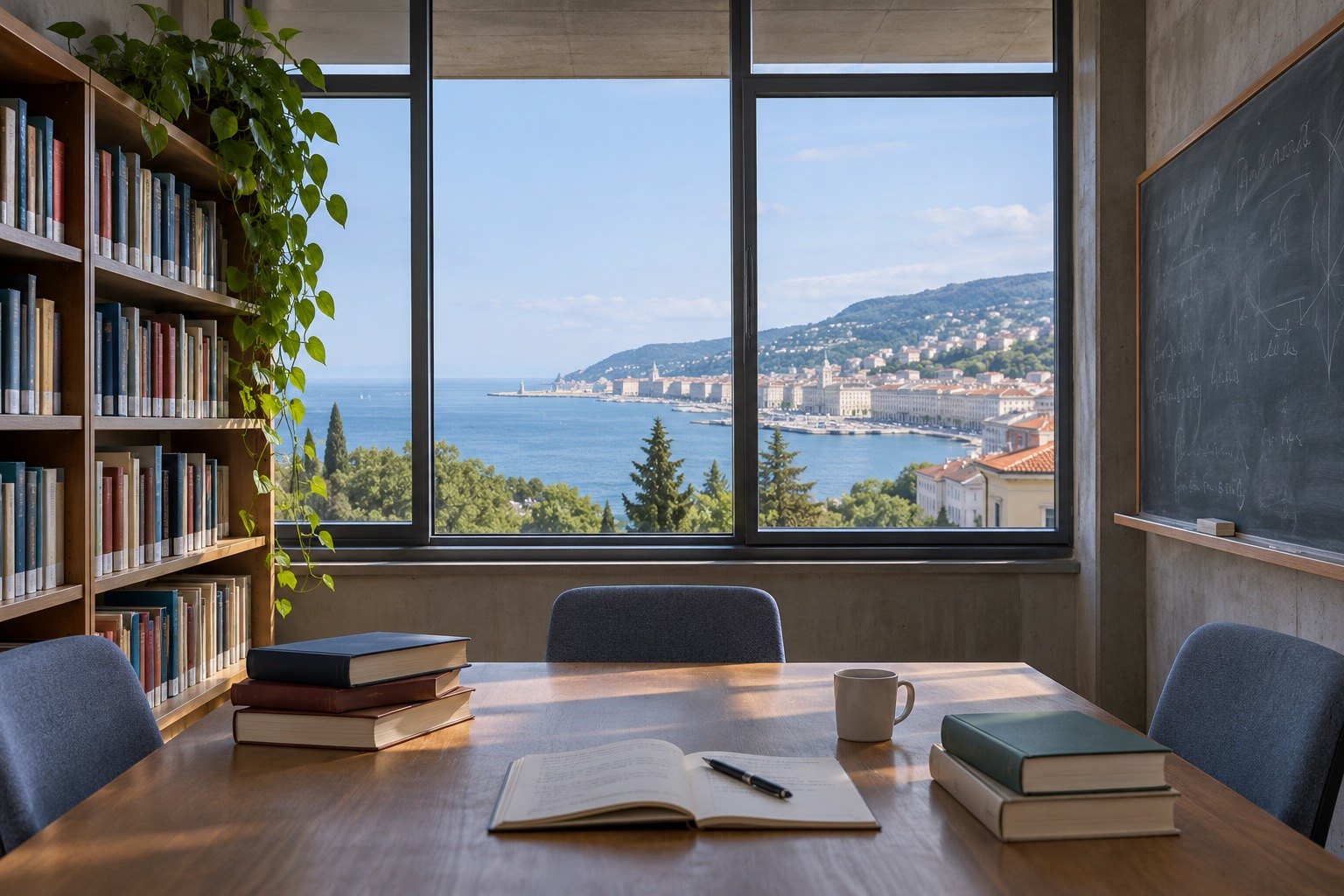
The International Centre for Theoretical Physics (ICTP), set up in Trieste, Italy, in 1964 by Nobel Laureate Abdus Salam, runs under an agreement among Italy, the IAEA and UNESCO. It serves frontier research, advanced study for developing countries and cooperation through science. On 15 November 2026, PIB said DST signed a Letter of Intent with ICTP on a proposed fund.
Syllabus: Prelims · Current Affairs & IR; GS3 · Science & Technology; GS3 · Indian Achievements in S&T
Why this matters for UPSC
GS2 international institutions and GS3 science: ICTP, its founders, parent bodies and India's links. Prelims can ask who runs ICTP; Mains, science diplomacy and researcher mobility.
In short
The International Centre for Theoretical Physics (ICTP), Trieste, is a UNESCO Category 1 institute run under an Italy-IAEA-UNESCO agreement, built to carry frontier physics and mathematics to developing countries.
ICTP's worth to India now rests on follow-through: the proposed fund needs defined money and terms so that mobility builds research capacity at home.
Why it matters
A young physicist at an Indian university or IIT stands to gain from ICTP. The Centre's visiting fellowships, diploma courses and postdoctoral posts let such a researcher work beside leading scientists and join a network built for the developing world. A structured fund could turn occasional visits into a steady flow, so that Indian work in astrophysics, high-energy physics, computational science and climate modelling stays in touch with the global frontier. The larger issue is the knowledge gap between rich and poor countries. ICTP exists to narrow it, and India, a long-standing partner and once the funder of one of its prizes, has a stake in that work.
Prelims pointers
- UNESCO was not a 1964 founding sponsor of ICTP (Italy, the UN and the IAEA were), but it is a party to the agreement and has administered ICTP since 1996.
- ICTP's Steering Committee holds one representative of each party and decides general guidelines and budget levels.
- Dirac Medal: given by ICTP since 1985 in honour of P.A.M. Dirac, every year on 8 August, for theoretical physics.
- ICTP Prize: set up in 1982 by ICTP's Scientific Council for young physicists from, and working in, developing countries.
- Ramanujan Prize: yearly since 2005 for a developing-country mathematician under 45 working in a developing country; the Abel Fund, an original partner, left in 2012.
- Brahmagupta AI Prize: a yearly ICTP-IBM award for the best early-career researcher in AI for Science or Science for AI.
- ICTP's three pillars are frontier research, advanced studies in physical and mathematical sciences for the developing world, and science advocacy with international cooperation.
Practise a UPSC-style question
With reference to the International Centre for Theoretical Physics (ICTP), consider the following statements:
1. It was established in Trieste in 1964 by Abdus Salam in collaboration with Paolo Budinich.
2. UNESCO was one of its founding sponsors along with the Italian government and the IAEA.
3. UNESCO has designated it a Category 1 institute.
Which of the statements given above is/are correct?
- (a) 1 and 2 only
- (b) 2 and 3 only
- (c) 1 and 3 only
- (d) 1, 2 and 3
Show the answer
Answer: (c) 1 and 3 only
Answer: (c) 1 and 3 only. UNESCO was not among the 1964 founding sponsors.
Statement 1: correct. ICTP's history page says Abdus Salam set up ICTP in Trieste in 1964, acting with Italian physicist Paolo Budinich.
Statement 2: incorrect. The founding sponsors Salam secured were the Italian government, the United Nations and the IAEA; UNESCO is a party to the later tripartite agreement.
Statement 3: correct. UNESCO named ICTP a Category 1 institute for building science capacity in developing nations.
Eliminate: Statement 2 is the surest call, since the founding sponsors were Italy, the UN and the IAEA. Out: (a), (b), (d).
Trap: Swapped attribution. UNESCO runs ICTP today, so a student assumes it was there at the founding; the 1964 sponsor was the UN itself.
Remember: Founded 1964 by Salam; sponsors Italy, UN, IAEA; UNESCO Category 1 institute.
More Explainers
- CDRI: India's coalition for disaster-resilient infrastructure Environment
- Pichwai painting of Nathdwara, Rajasthan National
- Kerch Strait: the sea link between the Black Sea and Azov World & IR
- Wind energy in India: potential, offshore wind and the policy push Economy
- Pallikaranai marsh: a Chennai Ramsar site and its zone of influence Environment
- Andaman cobra: India's only island cobra, Endangered and endemic Environment
- International Coconut Community and India's Coconut Development Board World & IR
- Real Estate (Regulation and Development) Act, 2016: how it protects homebuyers Polity
- Open correctional institutions and the Supreme Court's 2026 directions Polity
- PJ.2.1 and how new Covid variants are classified and tracked Sci-Tech
- Berlin Conference of 1884-85 and the rules for colonising Africa World & IR
- Voyager 1 at one light-day: heliosphere, interstellar space and light units Sci-Tech