
International Coconut Community and India's Coconut Development Board
Why in news: On 16 November 2026, PIB announced that India hosts the ICC's 62nd Session and Ministerial Meeting at Kochi, 17-20 November 2026.
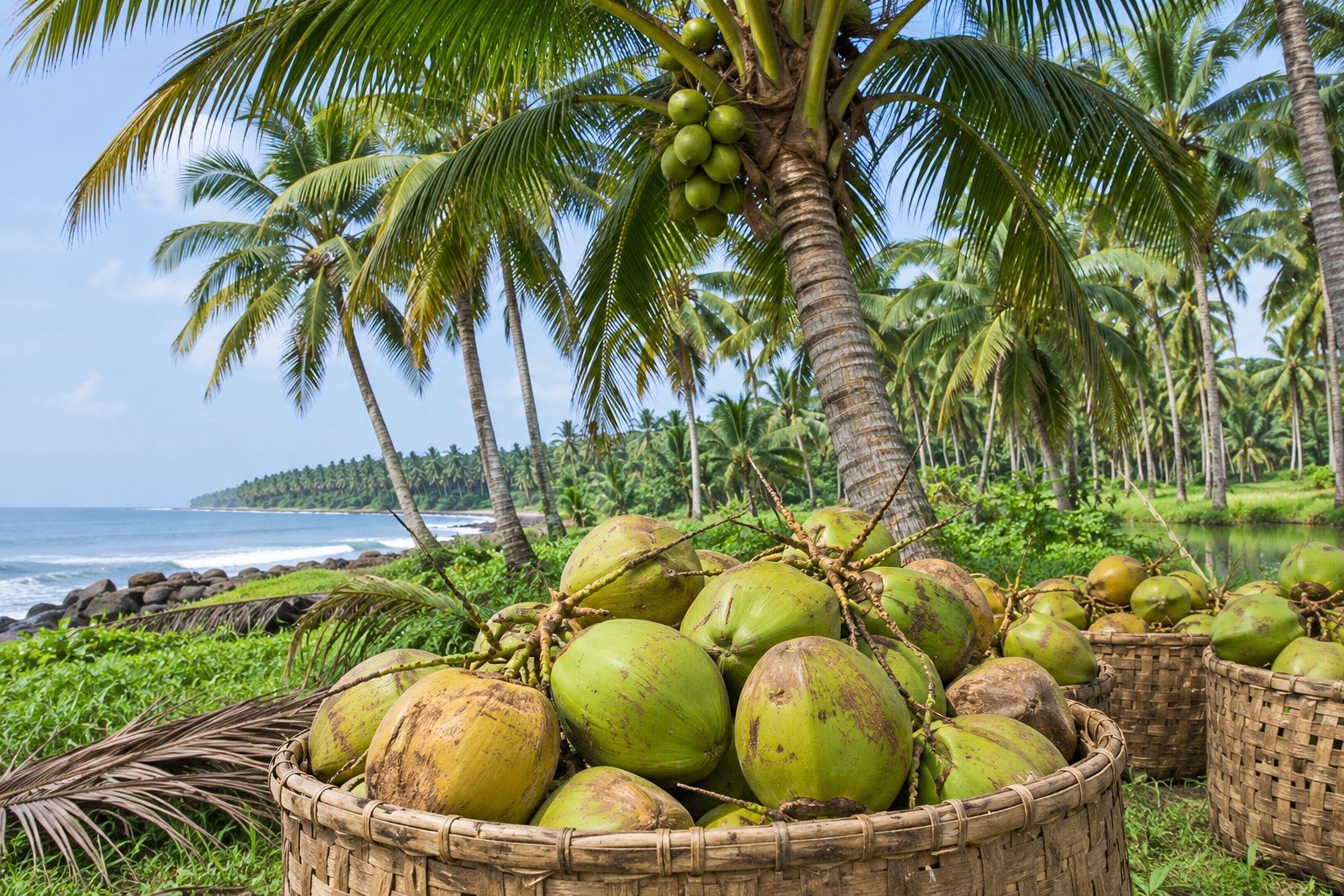
The International Coconut Community (ICC) is an inter-governmental organisation of coconut-producing countries. It was set up in 1969 under the aegis of UN-ESCAP, is based in Jakarta and counts India among its 21 members. India's Coconut Development Board (CDB) co-organises the ICC's 62nd Session and Ministerial Meeting. It runs at Kochi, Kerala, from 17 to 20 November 2026.
Syllabus: Prelims · Current Affairs & IR; GS3 · Agriculture & Irrigation; GS2 · Statutory & Regulatory Bodies
Why this matters for UPSC
GS2 international bodies and GS3 plantation crops: the International Coconut Community and the Coconut Development Board. Prelims can ask the ICC's founding year, seat and members; Mains, India's role among coconut producers.
In short
The International Coconut Community is an inter-governmental organisation of coconut-producing countries, founded in 1969 under UN-ESCAP's aegis; India, a member, develops the crop through the statutory Coconut Development Board.
The Community's worth to India lies in shared standards and research; the CDB must turn them into higher productivity and diversified products for smallholders.
Why it matters
A small coconut grower in Kerala, Tamil Nadu or Karnataka feels the work of both bodies. When producing countries agree on common quality standards for coconut products, Indian processors can sell to buyers in other member countries with fewer hurdles, which helps the growers who supply them. Training, shared research and links to donors spread methods across members in Asia, the Pacific, Africa and the Americas. At home, the CDB turns this into advice on the farm, money to plant more area and statistics that guide policy. The larger issue is how a crop raised by many small farmers can stay profitable while facing climate change, pests and diseases, the threats the ICC itself names.
Prelims pointers
- In each member country the ICC acts through National Liaison Officers: senior officials of the coconut agency or, often, the agriculture minister or secretary.
- After the ICC Session approves a member, its Instrument of Accession, signed by the Head of State or Foreign Minister, goes to the UN's Treaty Section.
- ICC functions include working with other international bodies to cut trade barriers and connecting members with potential donor institutions to mobilise resources.
- Look-alikes: the Coconut Development Board Act, 1979 keeps the coir industry, and industries making coconut-oil products, outside 'coconut industry'; coir has its own 1953 law.
- Under the 1979 Act, 'coconut' means the fruit of the palm Cocos nucifera and includes green coconut, ripe coconut and copra.
- Three MPs sit on the CDB, two elected by the Lok Sabha and one by the Rajya Sabha, beside ICAR's Central Plantation Crops Research Institute Director.
- The CDB fixes grades and specifications for coconut products, recommends ways to regulate their imports and exports, and collects and publishes coconut statistics.
- The Centre appoints the CDB's non-executive Chairman; the Board itself elects a Vice-Chairman from among its members.
Practise a UPSC-style question
With reference to the International Coconut Community, consider the following statements:
1. It was established in 1969 under the aegis of the Food and Agriculture Organization (FAO).
2. The Community is an inter-governmental organisation with its seat at Jakarta in Indonesia.
3. An applicant country is admitted by the unanimous decision of existing members at the annual Session and Ministerial Meeting.
Which of the statements given above is/are correct?
- (a) 1 and 2 only
- (b) 2 and 3 only
- (c) 1 and 3 only
- (d) 1, 2 and 3
Show the answer
Answer: (b) 2 and 3 only
Answer: (b) 2 and 3 only. The Community was born under UN-ESCAP, not FAO; its seat and admission rule are stated correctly.
Statement 1: incorrect. PIB says the Community dates from 1969 and was set up under UN-ESCAP's aegis, the UN's Economic and Social Commission for Asia and the Pacific.
Statement 2: correct. PIB and the Community's own site place it in Jakarta, Indonesia, and PIB calls it an inter-governmental organisation of coconut-producing countries.
Statement 3: correct. The Community's membership page says existing members admit an applicant by unanimous decision during the annual Session and Ministerial Meeting.
Eliminate: Statement 1 names the wrong UN body, so every code carrying it goes. Out: (a), (c), (d).
Trap: Swapped attribution. FAO is the UN's food and agriculture agency and may give technical help to projects the Community facilitates, so it sounds like the founder; the aegis was UN-ESCAP's.
Remember: ICC: 1969, under UN-ESCAP, seat Jakarta; new members by unanimous vote at the Session.
More Explainers
- CDRI: India's coalition for disaster-resilient infrastructure Environment
- Pichwai painting of Nathdwara, Rajasthan National
- Kerch Strait: the sea link between the Black Sea and Azov World & IR
- Wind energy in India: potential, offshore wind and the policy push Economy
- Pallikaranai marsh: a Chennai Ramsar site and its zone of influence Environment
- Andaman cobra: India's only island cobra, Endangered and endemic Environment
- Real Estate (Regulation and Development) Act, 2016: how it protects homebuyers Polity
- Open correctional institutions and the Supreme Court's 2026 directions Polity
- ICTP, Trieste: the UNESCO-IAEA centre for physics and mathematics Sci-Tech
- PJ.2.1 and how new Covid variants are classified and tracked Sci-Tech
- Berlin Conference of 1884-85 and the rules for colonising Africa World & IR
- Voyager 1 at one light-day: heliosphere, interstellar space and light units Sci-Tech