
Tholpavakoothu: Kerala's leather shadow-puppet theatre
Why in news: The Palakkad-based Tholpavakoothu Sangam is set to stage a Tholpavakoothu performance in Coimbatore on 28 November 2026.
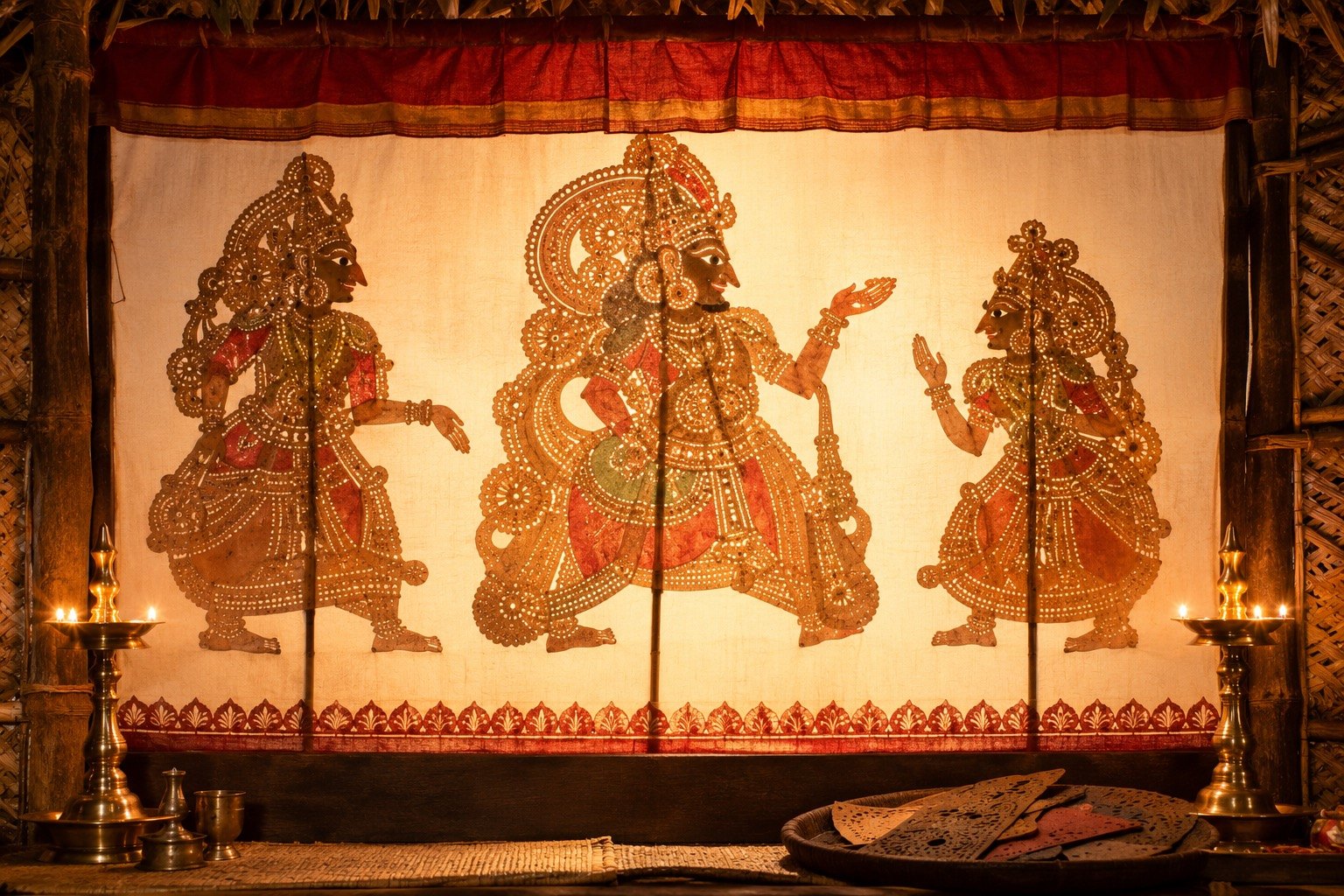
Tholpavakoothu is Kerala's temple shadow-puppet theatre, a ritual of Bhadrakali temples in Palakkad, Thrissur and Malappuram. Hereditary Pulavar families present it: puppeteers move leather figures behind a white screen lit by oil lamps, while singers in front render the Tamil Kamba Ramayanam. The Palakkad-based Tholpavakoothu Sangam is set to stage the form in Coimbatore on 28 November 2026.
Syllabus: GS1 · Art & Culture; Prelims · History & Culture
Why this matters for UPSC
GS1 Indian culture: performing arts and puppetry traditions. Prelims can match Tholpavakoothu to Kerala, its puppet type, its text and instruments.
In short
Tholpavakoothu is Kerala's ritual shadow-puppet theatre, in which leather figures throw shadows on a lit screen to stage the Kamba Ramayanam in Bhadrakali temples.
Tholpavakoothu lives because Pulavar families kept the temple ritual while opening the form to new stages; that lineage needs protecting as much as the shows.
Why it matters
A child born into a Pulavar family in Palakkad learns three languages, the Puranas, puppet making and the night-long songs before taking a place behind the screen. The art lives inside these families, so how many of them keep training decides whether the ritual continues in the temples. Taking the play to public stages and new stories reaches people who never visit a Koothumaadam and draws learners from outside the lineage. The form also shows ordinary viewers how a Tamil epic, Kerala drums and the worship of a goddess came together, a living record of exchange between regions.
Prelims pointers
- Look-alike: the Koothumaadam is the temple hall where the play is staged; the Vilakkumaadam is the set of wooden beams behind the screen.
- Look-alike: the Ezhupara is a cylindrical drum of jackfruit wood and calf skin; the Elathalam is a pair of cymbals.
- The Tholpavakoothu form mixes three strands: Tamil text, Kerala percussion and the goddess worship of Kerala temples.
- Besides the two main instruments, the conch, Chenda, Maddalam, Chengila gong and Kurumkuzhal pipe are added for dramatic effect.
- Puppets stand about 80 cm tall, with movable hands; speaking human figures have fingers shaped into mudras.
- Kerala Tourism describes shadow play as an ancestor of cinema, since both play images on a screen.
Practise a UPSC-style question
With reference to Tholpavakoothu, consider the following statements:
1. It is a string-puppet tradition performed as a ritual in Bhadrakali temples of Kerala.
2. Its script is drawn from the Kamba Ramayanam, a Tamil version of the Ramayana.
Which of the statements given above is/are correct?
- (a) 1 only
- (b) 2 only
- (c) Both 1 and 2
- (d) Neither 1 nor 2
Show the answer
Answer: (b) 2 only
Answer: (b) 2 only. The form is shadow puppetry, and its text is the Tamil Kamba Ramayanam.
Statement 1: incorrect. Tholpavakoothu is shadow puppetry: flat leather figures cast shadows on a lit white screen, not string puppets.
Statement 2: correct. The play uses the Kamba Ramayanam, the Tamil Ramayana of the 12th-century poet Kambar, per Kerala Tourism.
Eliminate: Statement 2 is the surest, since the Tamil text is the form's best-known feature. Out: (a), (d).
Eliminate: Statement 1 names the wrong puppet type, so both cannot be right. Out: (c).
Trap: Swapped attribution. The ritual setting and the State are right, but the puppet type is swapped from shadow to string.
Remember: Tholpavakoothu is Kerala's leather shadow-puppet ritual in Bhadrakali temples.
More Explainers
- New START's end: strategic arms control and the NPT's disarmament duty World & IR
- Gyan Bharatam Mission and the National Mission for Manuscripts National
- The Ahom kingdom and the Battle of Saraighat National
- How a State is renamed: Articles 3 and 4 Polity
- Radiation fog over north India and how it differs from smog Environment
- Submarine cables to India's islands: CANI, KLI and a second route Sci-Tech
- Mercury in cosmetics and the Minamata Convention on Mercury Environment
- How a High Court gets a permanent bench Polity
- BioE3 Policy and the Biotechnology Research and Innovation Council (BRIC) Sci-Tech
- Alchi Chokhor, Ladakh: the Buddhist monastic complex and its protection National
- The four Labour Codes: what they merged and what they changed Economy
- National HPV Vaccination Campaign and cervical cancer prevention National