
Alchi Chokhor, Ladakh: the Buddhist monastic complex and its protection
Why in news: A feature published on 21 November 2026 revisited Alchi Chokhor, its temples and its setting on the Indus.
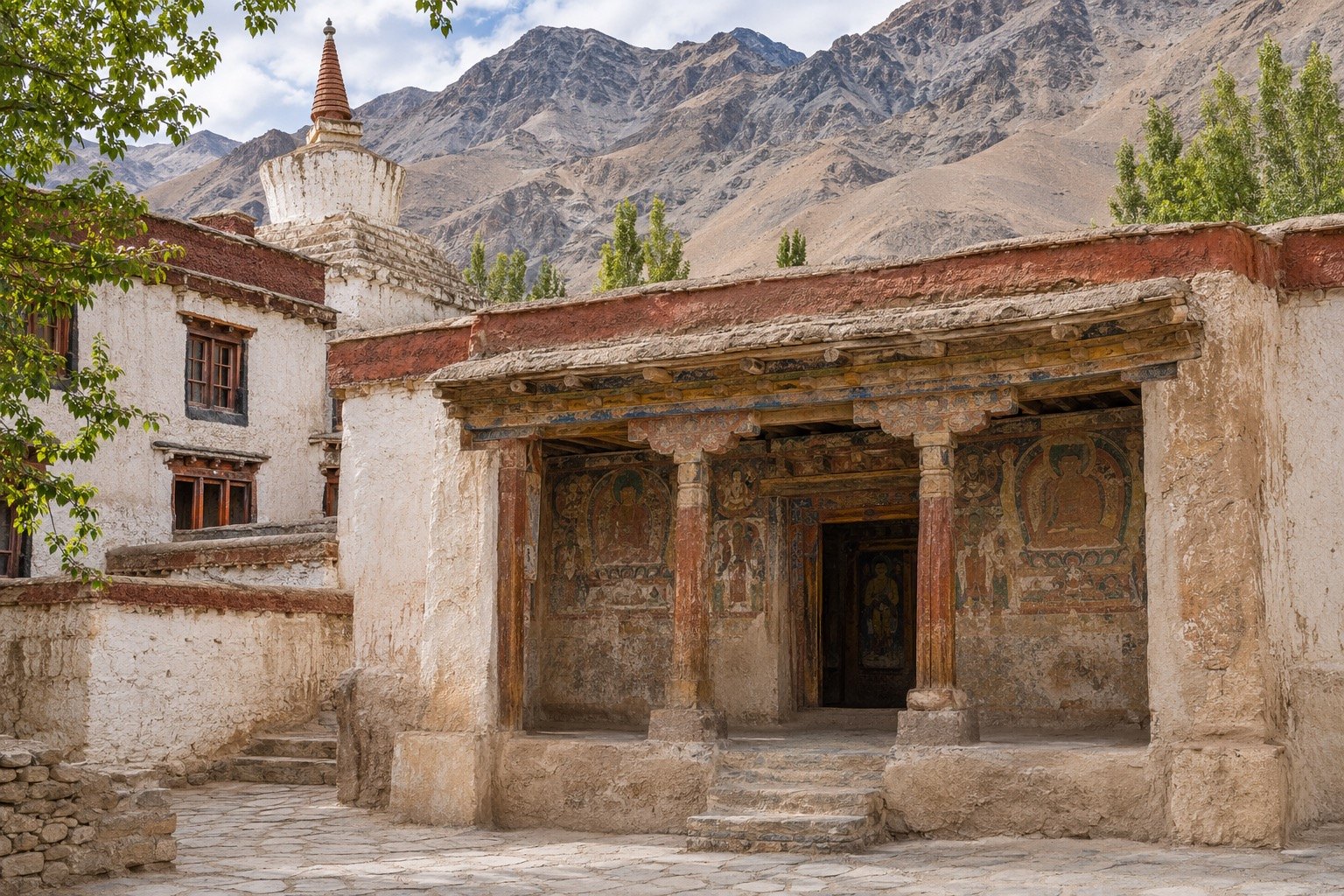
Alchi Chokhor is a Buddhist monastic complex above the Indus in Leh district, Ladakh, set between the Ladakh and Zanskar ranges at about 10,200 ft. Its best-known temples are the Dukhang and the Sumtsek. The Union government protects it through the Archaeological Survey of India. A feature on 21 November 2026 revisited the complex.
Syllabus: GS1 · Art & Culture; Prelims · History & Culture; Prelims · Geography
Why this matters for UPSC
GS1 art and culture: Buddhist heritage of Ladakh and its protection. Prelims can ask Alchi's river and ranges, its temples and its ASI status.
In short
Alchi Chokhor is a Buddhist monastic complex on the Indus in Ladakh, valued for its temples and protected by the Archaeological Survey of India as a central monument.
Alchi shows how a working monastery can also be a national monument; its protection should guard the temples without cutting them off from village life.
Why it matters
A student of Indian art and culture meets Buddhism in Ladakh mostly through names on a list. Alchi turns those names into a place: a village on the Indus whose temples stand amid prayer flags and prayer wheels. Because the ASI protects the complex, its care rests with a national body rather than the village alone, and villagers and visitors share the site with that body. The wider issue is how a living religious site in a fragile high valley is kept safe while it stays part of village life and open to visitors.
Prelims pointers
- Mulbekh's rock-cut four-armed Bodhisattva and the Rangdum Monastery are centrally protected monuments in Kargil district; Lamayuru, Likir, Hemis and Thiksey are in Leh district.
- Jammu and Kashmir's centrally protected monuments come under the ASI's Srinagar Circle; Ladakh's come under the separate Leh Mini-Circle.
- Four Buddhist traditions shape Ladakh, as the Home Minister listed them in 2026: Nyingma, Kagyu, Sakya and Gelug.
- Kharosthi and Brahmi inscriptions in Ladakh were cited by the Home Minister as evidence of Buddhism in the Kushan period.
- Silk Route roads joined Kashmir and Leh with Yarkand, Khotan and Tibet, carrying ideas as well as goods, per the same PIB record.
Practise a UPSC-style question
With reference to Alchi Chokhor, consider the following statements:
1. It lies between the Karakoram Range and the Great Himalayan Range.
2. It stands above the Indus river in the Leh district of Ladakh.
3. The Dukhang and the Sumtsek are among its temples.
Which of the statements given above is/are correct?
- (a) 1 and 2 only
- (b) 2 and 3 only
- (c) 1 and 3 only
- (d) 1, 2 and 3
Show the answer
Answer: (b) 2 and 3 only
Answer: (b) 2 and 3 only. Alchi is on the Indus in Leh district and has the Dukhang and Sumtsek temples, but its flanking ranges are named wrongly.
Statement 1: incorrect. The complex sits between the Ladakh Range and the Zanskar Range, not the Karakoram and the Great Himalaya.
Statement 2: correct. Alchi village and its monastic complex lie above the Indus in Leh district, Union Territory of Ladakh.
Statement 3: correct. The Dukhang and the Sumtsek (also spelt Sumstek) are its best-known temples.
Eliminate: statement 1 names the wrong ranges. Out: (a), (c), (d).
Trap: Look-alike names. Karakoram and Great Himalaya are familiar ranges of the region, swapped in for the Ladakh and Zanskar ranges that actually flank Alchi.
Remember: Alchi: Indus valley, Leh district, between the Ladakh and Zanskar ranges.
More Explainers
- New START's end: strategic arms control and the NPT's disarmament duty World & IR
- Gyan Bharatam Mission and the National Mission for Manuscripts National
- The Ahom kingdom and the Battle of Saraighat National
- How a State is renamed: Articles 3 and 4 Polity
- Radiation fog over north India and how it differs from smog Environment
- Submarine cables to India's islands: CANI, KLI and a second route Sci-Tech
- Mercury in cosmetics and the Minamata Convention on Mercury Environment
- How a High Court gets a permanent bench Polity
- Tholpavakoothu: Kerala's leather shadow-puppet theatre Miscellany
- BioE3 Policy and the Biotechnology Research and Innovation Council (BRIC) Sci-Tech
- The four Labour Codes: what they merged and what they changed Economy
- National HPV Vaccination Campaign and cervical cancer prevention National