
The Standard Model and the Large Hadron Collider: testing a rare decay
Why in news: On 3 November 2026, the LHCb collaboration at CERN reported the first single-experiment evidence of the B0 meson decaying into two muons.
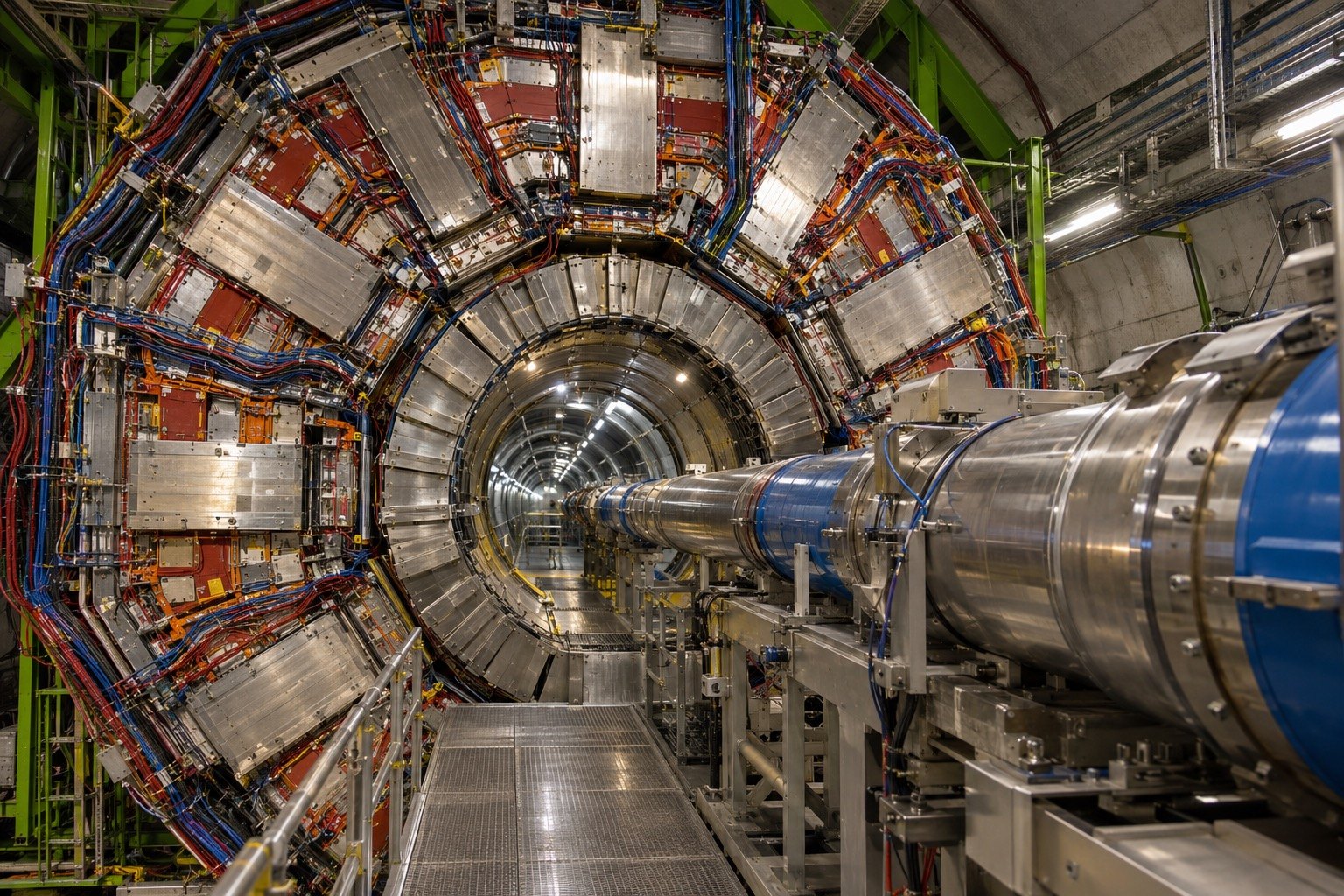
The Standard Model of particle physics is the theory of matter's fundamental particles and three of the four fundamental forces. Gravity lies outside it. CERN's Large Hadron Collider (LHC) tests it by colliding beams of protons or ions. In November 2026, the LHCb collaboration reported evidence that B0 mesons decay into two muons at the rare rate the Model predicts.
Syllabus: Prelims · Science & Technology; GS3 · Science & Technology; GS3 · Indian Achievements in S&T
Why this matters for UPSC
GS3 science and technology: particle physics, CERN and achievements of Indians in science. Prelims can ask particle families, force carriers and LHC experiments; Mains, the value of international big science.
In short
The Standard Model of particle physics is the tested theory of matter's fundamental particles and three of the four fundamental forces; CERN's Large Hadron Collider probes where it may fail.
The Standard Model keeps passing precision tests yet cannot be the final theory; India gains most by deepening its role in CERN's experiments and computing.
Why it matters
Indian scientists have taken part in CERN's work since the early 1960s, and India is now an Associate Member State of CERN, home of the world's most powerful particle accelerator. The Department of Atomic Energy expected this status to bring more young Indians into CERN projects, let Indian industry take part directly, and carry the knowledge back to India's own accelerator programmes. The rare-decay result matters for a different reason. A theory that fits almost every experiment but cannot explain dark matter is incomplete, and each measurement that agrees with it tells physicists where new particles cannot hide. That narrows and steers the next round of searches at the LHC and its upgrades.
Prelims pointers
- The LHC's superconducting magnets are chilled to minus 271.3 degrees Celsius by a liquid helium system, colder than outer space.
- Beams collide at four points of the LHC ring, at the ATLAS, CMS, ALICE and LHCb detectors; nine experiments are installed in all.
- Look-alike experiments: ATLAS and CMS found the Higgs boson; ALICE studies quark-gluon plasma; LHCb measured the rare muon-pair decays of B0 and Bs0 mesons.
- Gravity is the weakest force but has infinite range; the strong force is the strongest and acts only over very short distances.
- Quarks come in three colours and combine only into colourless objects; neutrinos are electrically neutral and have very little mass.
- India's path at CERN: DAE agreement in 1991, Observer status in 2003, Associate Member State from 2017; Pakistan became an associate member in 2015.
- India is a leading partner in ALICE and runs Tier-2 centres of the Worldwide Large Hadron Collider Grid at VECC Kolkata and TIFR Mumbai.
Practise a UPSC-style question
With reference to the Standard Model of particle physics, consider the following statements:
1. It describes the strong, weak and electromagnetic forces but does not include gravity.
2. The muon and the neutrinos are classified as quarks in the Standard Model.
3. All stable matter in the universe is made of first-generation particles.
Which of the statements given above is/are correct?
- (a) 1 and 2 only
- (b) 2 and 3 only
- (c) 1 and 3 only
- (d) 1, 2 and 3
Show the answer
Answer: (c) 1 and 3 only
Answer: (c) 1 and 3 only. Gravity is outside the Model, and the muon and neutrinos are leptons, not quarks.
Statement 1: correct. The Standard Model covers three of the four fundamental forces; fitting gravity into it has not been achieved.
Statement 2: incorrect. The electron, muon and tau and their three neutrinos form the six leptons; the six quarks are up, down, charm, strange, top and bottom.
Statement 3: correct. The first generation (up and down quarks, electron, electron neutrino) is the lightest and most stable, and all stable matter is made of it.
Eliminate: Statement 2 is the surest wrong one, since the muon is a lepton. Out: (a), (b), (d).
Trap: Look-alike names. Quarks and leptons are both matter particles in three generations, so a student can file the muon in the wrong family.
Remember: Matter = 6 quarks + 6 leptons in three generations; gravity is left out.
More Explainers
- CDRI: India's coalition for disaster-resilient infrastructure Environment
- Pichwai painting of Nathdwara, Rajasthan National
- Kerch Strait: the sea link between the Black Sea and Azov World & IR
- Wind energy in India: potential, offshore wind and the policy push Economy
- Pallikaranai marsh: a Chennai Ramsar site and its zone of influence Environment
- Andaman cobra: India's only island cobra, Endangered and endemic Environment
- International Coconut Community and India's Coconut Development Board World & IR
- Real Estate (Regulation and Development) Act, 2016: how it protects homebuyers Polity
- Open correctional institutions and the Supreme Court's 2026 directions Polity
- ICTP, Trieste: the UNESCO-IAEA centre for physics and mathematics Sci-Tech
- PJ.2.1 and how new Covid variants are classified and tracked Sci-Tech
- Berlin Conference of 1884-85 and the rules for colonising Africa World & IR