
The Indus Waters Treaty, 1960: rivers, Commission and disputes
Why in news: On 18 November 2026 at COP31 in Antalya, India said trans-boundary water cooperation cannot rest on archaic mechanisms, without naming the treaty.
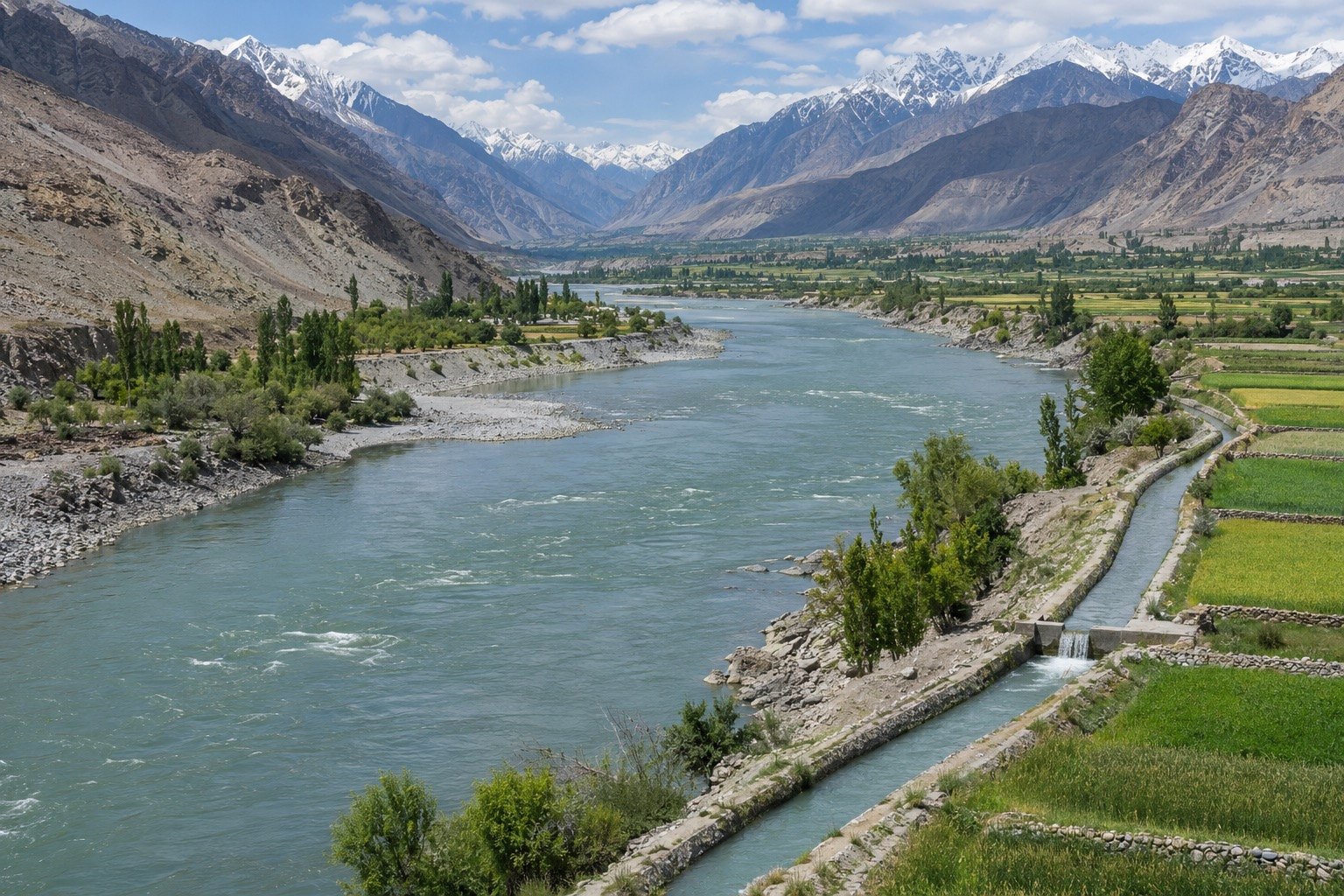
The Indus Waters Treaty, signed at Karachi on 19 September 1960 by India, Pakistan and the International Bank for Reconstruction and Development (IBRD), splits the six rivers of the Indus system. India gets the three Eastern Rivers; Pakistan receives the three Western Rivers, minus limited Indian uses. At COP31 on 18 November 2026, India rejected archaic mechanisms for water cooperation.
Syllabus: Prelims · Current Affairs & IR; Prelims · Geography; GS2 · Groupings & Agreements
Why this matters for UPSC
GS2 international relations: bilateral agreements involving India; GS1 geography: the Indus river system. Prelims can ask which rivers each country gets; Mains, the dispute ladder and India's abeyance.
In short
The Indus Waters Treaty, 1960, signed by India, Pakistan and the IBRD, divides the six Indus system rivers and sets a Commission-led route for settling questions and disputes.
The river split and the dispute ladder remain the treaty's core; any revision must secure India's basin uses and a settlement route both countries accept.
Why it matters
An engineer planning a power station on the Chenab or the Jhelum in Jammu and Kashmir works inside limits set in 1960. The treaty decides which rivers India may use freely and which it must let pass, so Indian projects on the Western Rivers have long had to fit its terms and answer Pakistan's objections. With the treaty in abeyance, India says those duties no longer bind it, and it has pressed ahead with projects in the basin, as press reports describe. Downstream, Pakistan relies heavily on these rivers and accuses India of using water as a weapon. The larger question is whether a sixty-six-year-old bargain can absorb climate change, population growth and new water technology.
Prelims pointers
- The treaty counts the Panjnad as part of the Chenab and treats the Chandra and the Bhaga as tributaries of the Chenab.
- In the treaty, 'Non-Consumptive Use' covers navigation, floating timber, flood control and fishing, provided the water stays in or returns to the same river.
- In the treaty, 'Agricultural Use' means irrigation, except household and public recreational gardens; watering those gardens counts as Domestic Use.
- The Commission meets at least once a year, alternately in India and Pakistan, and makes a general inspection tour of the rivers once in five years.
- A Neutral Expert (Annexure F) deals with a 'difference'; a Court of Arbitration (Annexure G) settles a 'dispute'. Arbitration steps pause while a Neutral Expert handles a difference.
- The treaty's Transition Period began on 1 April 1960 and had to end by 31 March 1973; Pakistan then lost any claim to Eastern River releases.
Practise a UPSC-style question
With reference to the Indus Waters Treaty, 1960, consider the following statements:
1. The Sutlej, the Beas and the Ravi are the Eastern Rivers, available for India's unrestricted use.
2. The Chenab is counted among the Eastern Rivers under the treaty.
3. India may store water of the Western Rivers only to the extent the treaty's annexures permit.
Which of the statements given above is/are correct?
- (a) 1 and 2 only
- (b) 2 and 3 only
- (c) 1 and 3 only
- (d) 1, 2 and 3
Show the answer
Answer: (c) 1 and 3 only
Answer: (c) 1 and 3 only. The Chenab is a Western River, so statement 2 fails.
Statement 1: correct. Article II makes all waters of the Sutlej, Beas and Ravi, the Eastern Rivers, available for India's unrestricted use.
Statement 2: incorrect. The treaty groups the Chenab with the Indus and the Jhelum as a Western River, and counts the Panjnad as part of the Chenab.
Statement 3: correct. Article III bars India from storing Western River water or building storage works except as Annexures D and E provide.
Eliminate: statement 2 is false, which removes every option that contains 2. Out: (a), (b), (d).
Trap: Look-alike names. The six rivers are often recalled as one list; the question moves the Chenab into the wrong group.
Remember: East to India (Sutlej, Beas, Ravi); West to Pakistan (Indus, Jhelum, Chenab).
More Explainers
- New START's end: strategic arms control and the NPT's disarmament duty World & IR
- Gyan Bharatam Mission and the National Mission for Manuscripts National
- The Ahom kingdom and the Battle of Saraighat National
- How a State is renamed: Articles 3 and 4 Polity
- Radiation fog over north India and how it differs from smog Environment
- Submarine cables to India's islands: CANI, KLI and a second route Sci-Tech
- Mercury in cosmetics and the Minamata Convention on Mercury Environment
- How a High Court gets a permanent bench Polity
- Tholpavakoothu: Kerala's leather shadow-puppet theatre Miscellany
- BioE3 Policy and the Biotechnology Research and Innovation Council (BRIC) Sci-Tech
- Alchi Chokhor, Ladakh: the Buddhist monastic complex and its protection National
- The four Labour Codes: what they merged and what they changed Economy