
Silent Valley National Park and the Nilgiri Biosphere Reserve
Why in news: A three-day survey to map butterflies began in Silent Valley National Park on 13 November 2026, across 14 locations.
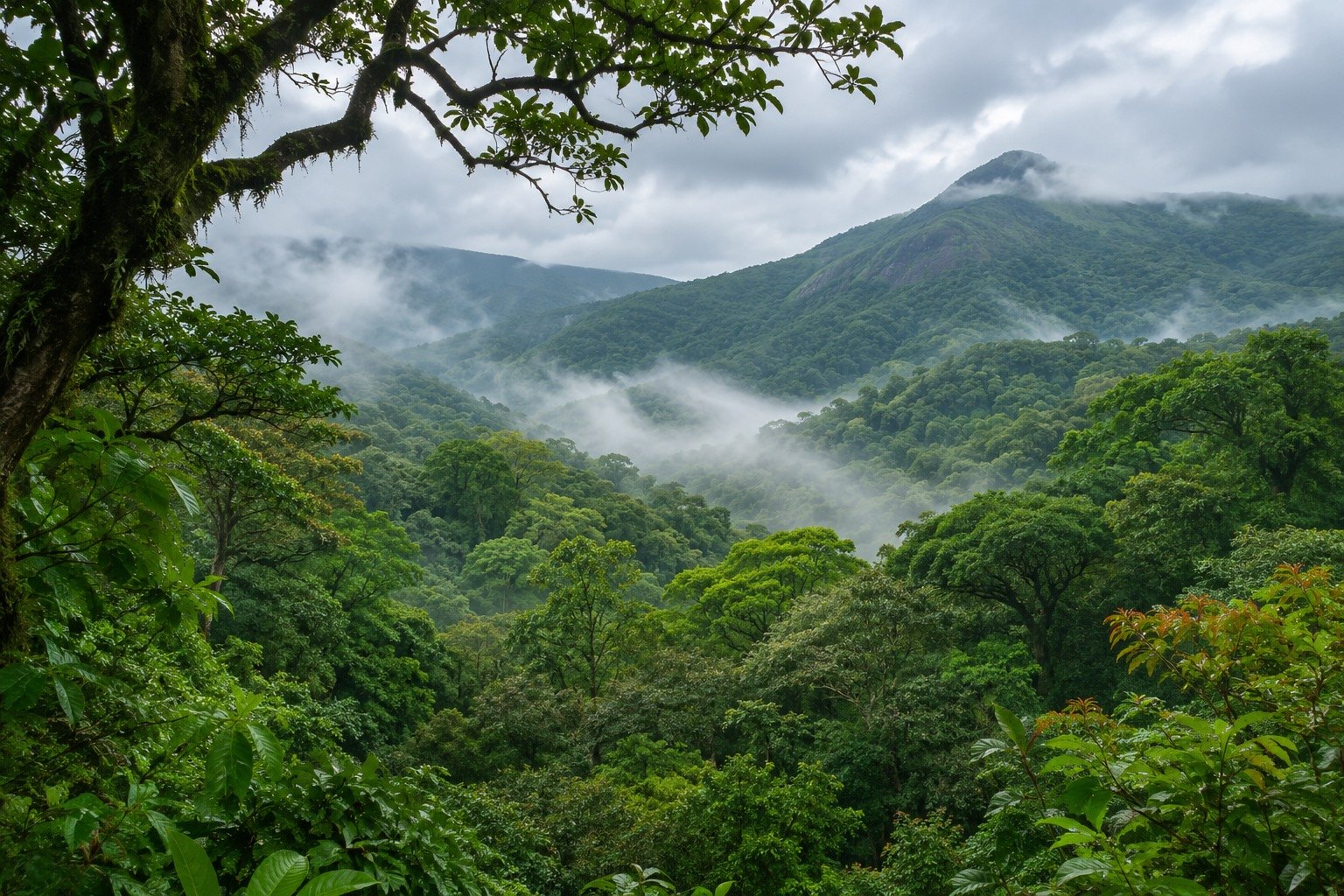
Silent Valley National Park lies in the Nilgiri Hills of Palakkad district, Kerala, in the Western Ghats. Its 89.52 sq km core, declared a national park in 1984 after a hydel project was dropped, became part of the Nilgiri Biosphere Reserve's core area in 1986. A three-day butterfly survey began there on 13 November 2026.
Syllabus: Prelims · Geography; Prelims · Environment & Ecology; GS3 · Environment & Conservation
Why this matters for UPSC
GS3 environment and Prelims geography: protected areas, biosphere reserves and the Western Ghats. Prelims asks the park's State, river and species; Mains, development against conservation.
In short
Silent Valley National Park is a protected rain forest plateau in Palakkad, Kerala, in the Western Ghats, saved from a hydel dam by science, law and a people's movement.
Silent Valley proves a protected core lasts when science, law and public pressure align; its buffer and three-State reserve now need the same care.
Why it matters
Families of the Irula, Kurumba, Muduga and Kattunaikkar communities live inside Silent Valley, so national-park rules decide how they use the forest: produce taken out may meet their personal needs but cannot be sold. For the rest of Kerala the valley is a lesson in choices. A dam that would have brought power was given up, and in return the State kept an intact rain forest that shelters the lion-tailed macaque and feeds a perennial river. The same choice returns whenever a road, a power line or a reservoir is planned near a protected area in the Western Ghats. Once a forest is cleared for a project, it cannot be put back.
Prelims pointers
- Rivers look-alike: the Kunthipuzha drains Silent Valley into the Bharathapuzha, while the Bhavani, rising in the Nilgiris, is a tributary of the Cauvery.
- Anginda peak, at 2,383 m, is the highest point of Silent Valley; the park's plateau lies north of Mannarkkad.
- Per PIB (November 2025), the Nilgiri Biosphere Reserve (1986) is India's oldest biosphere reserve and Panna (2011) the newest; Great Rann of Kutch is the largest.
- PIB (2025) counts 18 notified biosphere reserves in India, 13 of them in UNESCO's World Network of Biosphere Reserves (WNBR).
- Under the Wild Life (Protection) Act, 1972, livestock may not graze in a national park and may enter it only as a vehicle for an authorised person.
- Forest produce removed from a national park may serve the personal bona fide needs of people living in and around it, never commercial use.
- Silent Valley and the adjoining Nilgiri Biosphere Reserve forests record 8 of the 17 lesser carnivores reported from the Western Ghats, among them the Nilgiri marten and the rusty-spotted cat.
Practise a UPSC-style question
With reference to Silent Valley National Park, consider the following statements:
1. It lies in Palakkad district of Kerala, in the Nilgiri Hills.
2. The Kunthipuzha, which flows through the park, is a tributary of the Cauvery.
3. The Bhavani river, which flows near the park, is a tributary of the Cauvery.
Which of the statements given above is/are correct?
- (a) 1 and 2 only
- (b) 2 and 3 only
- (c) 1 and 3 only
- (d) 1, 2 and 3
Show the answer
Answer: (c) 1 and 3 only
Answer: (c) 1 and 3 only. The Kunthipuzha joins the Bharathapuzha; the Bhavani is the Cauvery tributary.
Statement 1: correct. The park sits in the Nilgiri Hills in Palakkad district of Kerala, part of the Western Ghats.
Statement 2: incorrect. The perennial Kunthipuzha runs north to south through the park and empties into the Bharathapuzha.
Statement 3: correct. The Bhavani drains the south slope of the Nilgiris, enters Kerala and is a tributary of the Cauvery.
Eliminate: statement 2 is wrong, so any option with 2 goes. Out: (a), (b), (d).
Trap: Swapped attribution. Two rivers drain the same hills; the question pins the Bhavani's parent river on the Kunthipuzha.
Remember: Kunthipuzha to Bharathapuzha; Bhavani to Cauvery.
More Explainers
- CDRI: India's coalition for disaster-resilient infrastructure Environment
- Pichwai painting of Nathdwara, Rajasthan National
- Kerch Strait: the sea link between the Black Sea and Azov World & IR
- Wind energy in India: potential, offshore wind and the policy push Economy
- Pallikaranai marsh: a Chennai Ramsar site and its zone of influence Environment
- Andaman cobra: India's only island cobra, Endangered and endemic Environment
- International Coconut Community and India's Coconut Development Board World & IR
- Real Estate (Regulation and Development) Act, 2016: how it protects homebuyers Polity
- Open correctional institutions and the Supreme Court's 2026 directions Polity
- ICTP, Trieste: the UNESCO-IAEA centre for physics and mathematics Sci-Tech
- PJ.2.1 and how new Covid variants are classified and tracked Sci-Tech
- Berlin Conference of 1884-85 and the rules for colonising Africa World & IR