
Reusable launch vehicles: how rockets return and where ISRO stands
Why in news: On 14 November 2026, launch-tower arms in Texas caught SpaceX's returning Starship upper stage, reported as the first such catch.
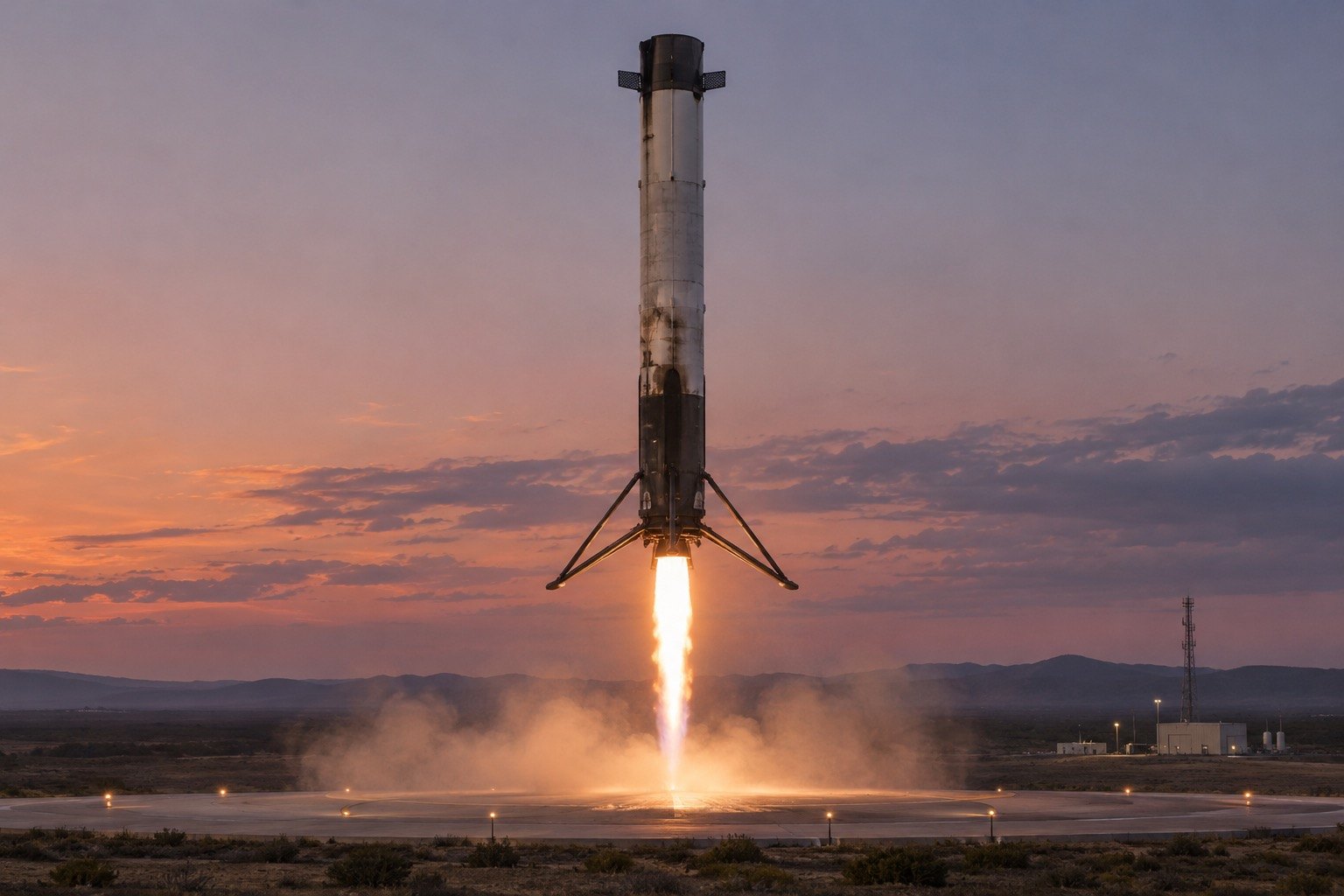
A reusable launch vehicle recovers its stages to fly them again, aiming at cheaper access to space. ISRO tested a winged design in the RLV-TD flight of 2016 and the RLV LEX landing of 2023. The NGLV, cleared in 2024, will have a reusable first stage. On 14 November 2026, tower arms caught Starship's returning upper stage.
Syllabus: Prelims · Current Affairs & IR; GS3 · Indian Achievements in S&T; GS3 · IT, Space, Biotech & IPR
Why this matters for UPSC
GS3 science and technology: space, indigenous launch vehicles and reusability. Prelims can ask what RLV-TD, RLV LEX and NGLV each tested or offer.
In short
A reusable launch vehicle recovers its stages after flight to fly them again, cutting the cost of each launch; ISRO is pursuing this through winged demonstrators and the NGLV.
India's winged trials and the NGLV's reusable first stage must mature into routine, repeated recoveries, with industry building hardware, before reuse really cuts launch costs.
Why it matters
A satellite operator, a weather agency or a farmer relying on space-based data pays, in the end, for every rocket thrown away after one flight. If the costly lower part of a rocket can land and fly again, each launch needs less new hardware, so putting a satellite in orbit becomes cheaper and launches can happen more often. For India, this decides whether ISRO can build a space station, send crews to the Moon and win commercial launch business without an unaffordable bill. It also opens work for Indian industry, which is expected to manufacture the new rocket. The larger issue is self-reliance in space transport at a price the country can sustain.
Prelims pointers
- RLV-TD carries a fuselage, nose cap, double delta wings and twin vertical tails, with elevons and a rudder as active control surfaces.
- RLV-TD objectives: hypersonic aerothermodynamic study of the wing body, autonomous navigation, guidance and control, integrated flight management, and thermal protection evaluation.
- ISRO plans to scale RLV-TD up into the first stage of a reusable two-stage orbital launch vehicle.
- HEX (2016) tested re-entry and ended on a notional runway over the Bay of Bengal; LEX (2023) tested the precise autonomous runway landing that HEX left out.
- RLV LEX used a pseudolite-based local navigation system, a Ka-band radar altimeter, a NavIC receiver, an indigenous landing gear and a brake parachute.
- PIB (2024) puts India's present launch capability at 10 tonnes to Low Earth Orbit and 4 tonnes to Geo-synchronous Transfer Orbit, through PSLV, GSLV, LVM3 and SSLV.
- RLV-TD is a winged technology demonstrator; the NGLV is a planned operational rocket whose first stage is to be reusable.
Practise a UPSC-style question
With reference to ISRO's Reusable Launch Vehicle Technology Demonstrator (RLV-TD), consider the following statements:
1. It is a winged vehicle configured as a flying test bed for hypersonic flight and autonomous landing.
2. In its 2016 flight it was boosted to Mach 5 by a liquid-fuelled booster stage.
3. ISRO intends to scale it up into the first stage of a reusable two-stage orbital launch vehicle.
Which of the statements given above is/are correct?
- (a) 1 and 2 only
- (b) 2 and 3 only
- (c) 1 and 3 only
- (d) 1, 2 and 3
Show the answer
Answer: (c) 1 and 3 only
Answer: (c) 1 and 3 only. RLV-TD is a winged test bed meant to grow into a reusable first stage.
Statement 1: correct. ISRO describes RLV-TD as a winged, aircraft-like flying test bed for hypersonic flight, autonomous landing and powered cruise flight.
Statement 2: incorrect. A conventional solid booster, HS9, designed for a low burn rate, took RLV-TD to Mach 5 in 2016.
Statement 3: correct. ISRO plans to enlarge the vehicle into the lower stage of a two-stage orbital rocket that India could reuse.
Eliminate: statement 2 swaps the solid HS9 booster for a liquid one. Out: (a), (b), (d).
Trap: Swapped attribution. The propulsion type is switched from solid to liquid, a detail a student who only remembers Mach 5 may not check.
Remember: RLV-TD reached Mach 5 on the solid HS9 booster in the 2016 HEX flight.
More Explainers
- CDRI: India's coalition for disaster-resilient infrastructure Environment
- Pichwai painting of Nathdwara, Rajasthan National
- Kerch Strait: the sea link between the Black Sea and Azov World & IR
- Wind energy in India: potential, offshore wind and the policy push Economy
- Pallikaranai marsh: a Chennai Ramsar site and its zone of influence Environment
- Andaman cobra: India's only island cobra, Endangered and endemic Environment
- International Coconut Community and India's Coconut Development Board World & IR
- Real Estate (Regulation and Development) Act, 2016: how it protects homebuyers Polity
- Open correctional institutions and the Supreme Court's 2026 directions Polity
- ICTP, Trieste: the UNESCO-IAEA centre for physics and mathematics Sci-Tech
- PJ.2.1 and how new Covid variants are classified and tracked Sci-Tech
- Berlin Conference of 1884-85 and the rules for colonising Africa World & IR