
National Chambal Sanctuary, its gharials and the sand-mining threat
Why in news: The Supreme Court's Central Empowered Committee has asked Uttar Pradesh, Madhya Pradesh and Rajasthan for proof of action against illegal sand mining (reported November 2026).
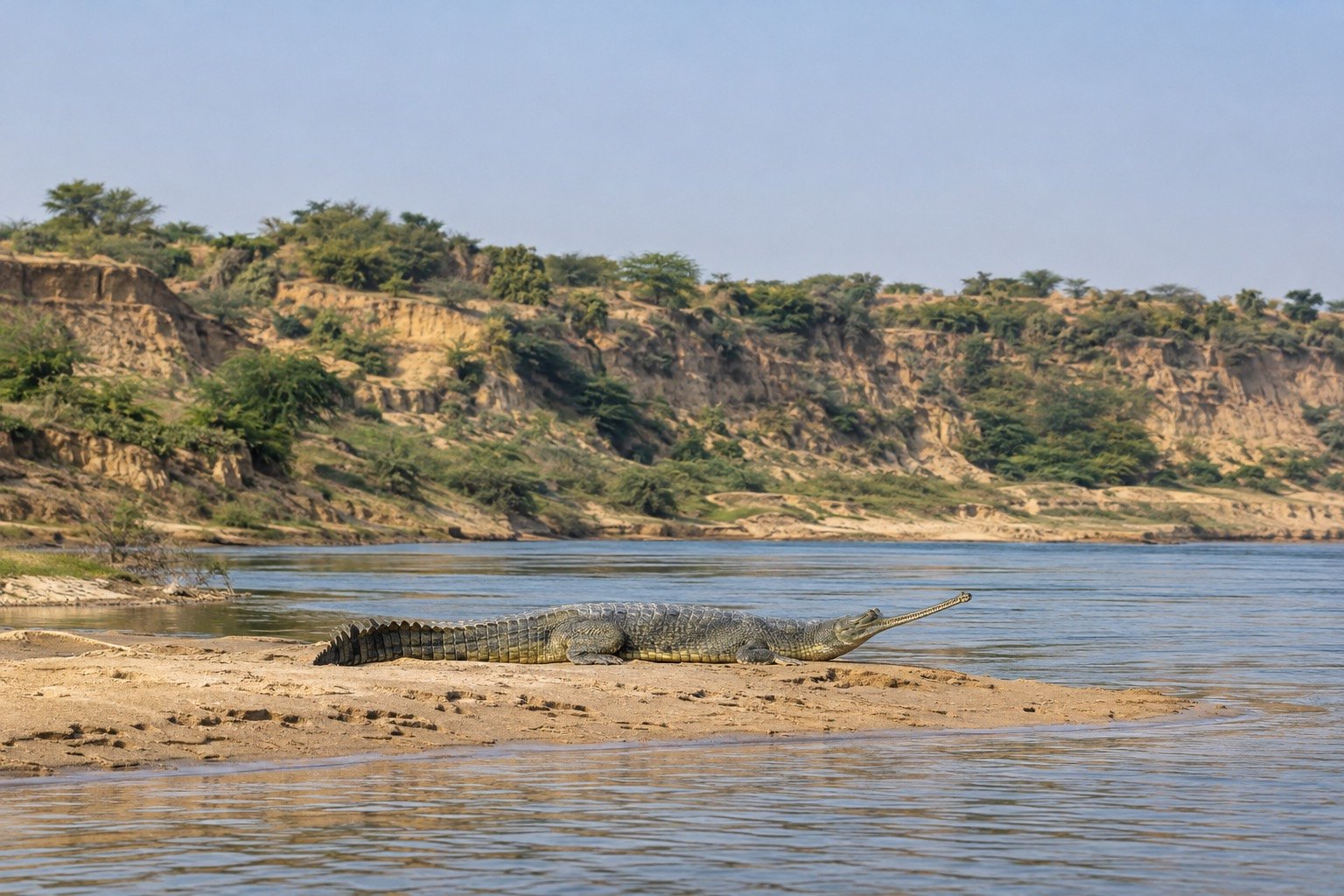
The National Chambal Sanctuary protects a stretch of the Chambal river and its ravines where Madhya Pradesh, Rajasthan and Uttar Pradesh meet. Covering about 5,400 sq km, it was notified in the late 1970s mainly for the critically endangered gharial. The Supreme Court's Central Empowered Committee has asked the three States to prove action against illegal sand mining.
Syllabus: Prelims · Geography; Prelims · Environment & Ecology; GS3 · Environment & Conservation
Why this matters for UPSC
GS3 environment: protected areas, wildlife law and species conservation. Prelims can ask the sanctuary's States, river and gharial status; Mains, enforcement against illegal sand mining.
In short
The National Chambal Sanctuary, shared by Madhya Pradesh, Rajasthan and Uttar Pradesh, guards the Chambal river and the critically endangered gharial under the Wild Life (Protection) Act, 1972.
The sanctuary's legal shield is adequate; its test is enforcement, so the three States must guard the river as one unit with verified, working measures.
Why it matters
For forest staff on the Chambal, the committee's demand shifts the measure of success from plans on file to checkposts and control rooms that actually run. For the gharial, the stake is habitat: the sanctuary shields the river and its sandy banks, and sand is what illegal miners remove. Because one river runs through three States, a lapse in one State can undo the effort of the other two. The case also tests whether court oversight can push governments from promises to results, a question that now reaches sand mining across India.
Prelims pointers
- The Chambal is a tributary of the Yamuna, which it joins at Bhareh in Uttar Pradesh; the sanctuary starts below the Kota barrage in Rajasthan, per the Uttar Pradesh board.
- Zoning: the river channel is the sanctuary's core zone, while the sandy banks and surrounding land make up its buffer zone, per the Uttar Pradesh Eco Tourism Board.
- Under the Wild Life (Protection) Act, 1972, a State Government declares a sanctuary by notification, and the notification may use roads, rivers or ridges as boundaries.
- Permit and authorisation: the Chief Wild Life Warden issues a permit to remove wildlife or alter habitat in a sanctuary, but only after the State Government authorises it.
- Besides the gharial, the Uttar Pradesh board records smooth-coated otters, eight turtle species and the Gangetic dolphin, which it calls threatened.
- Look-alike species: the sanctuary was notified for the gharial, not the mugger crocodile, though WII records the mugger there too.
Practise a UPSC-style question
With reference to the National Chambal Sanctuary, consider the following statements:
1. It lies on the Chambal river where the borders of Madhya Pradesh, Rajasthan and Uttar Pradesh meet.
2. The Chambal leaves the sanctuary by joining the Ganga at Bhareh in Uttar Pradesh.
3. Its Uttar Pradesh part falls in the Agra and Etawah districts.
Which of the statements given above is/are correct?
- (a) 1 and 2 only
- (b) 2 and 3 only
- (c) 1 and 3 only
- (d) 1, 2 and 3
Show the answer
Answer: (c) 1 and 3 only
Answer: (c) 1 and 3 only. The sanctuary is tri-State, but the Chambal's confluence at Bhareh is with the Yamuna.
Statement 1: correct. The sanctuary sits on the Chambal where Uttar Pradesh, Madhya Pradesh and Rajasthan meet.
Statement 2: incorrect. The Uttar Pradesh Eco Tourism Board ends the sanctuary at the meeting of the Chambal and the Yamuna at Bhareh.
Statement 3: correct. The board places the 635 sq km Uttar Pradesh part in Agra and Etawah districts, headquartered at Agra.
Eliminate: statement 2 is the surest; Bhareh is the Chambal-Yamuna confluence. Out: (a), (b), (d).
Trap: Swapped attribution. The right place, Bhareh, is paired with the wrong river, the Ganga instead of the Yamuna, to catch a student who knows the confluence town but not the river.
Remember: The Chambal joins the Yamuna at Bhareh; the sanctuary is shared by three States.
More Explainers
- CDRI: India's coalition for disaster-resilient infrastructure Environment
- Pichwai painting of Nathdwara, Rajasthan National
- Kerch Strait: the sea link between the Black Sea and Azov World & IR
- Wind energy in India: potential, offshore wind and the policy push Economy
- Pallikaranai marsh: a Chennai Ramsar site and its zone of influence Environment
- Andaman cobra: India's only island cobra, Endangered and endemic Environment
- International Coconut Community and India's Coconut Development Board World & IR
- Real Estate (Regulation and Development) Act, 2016: how it protects homebuyers Polity
- Open correctional institutions and the Supreme Court's 2026 directions Polity
- ICTP, Trieste: the UNESCO-IAEA centre for physics and mathematics Sci-Tech
- PJ.2.1 and how new Covid variants are classified and tracked Sci-Tech
- Berlin Conference of 1884-85 and the rules for colonising Africa World & IR