
Musi: the Krishna tributary through Hyderabad and its rejuvenation
Why in news: On 11 November 2026, Telangana's Chief Minister said work on the first phase of reviving the Musi would start soon.
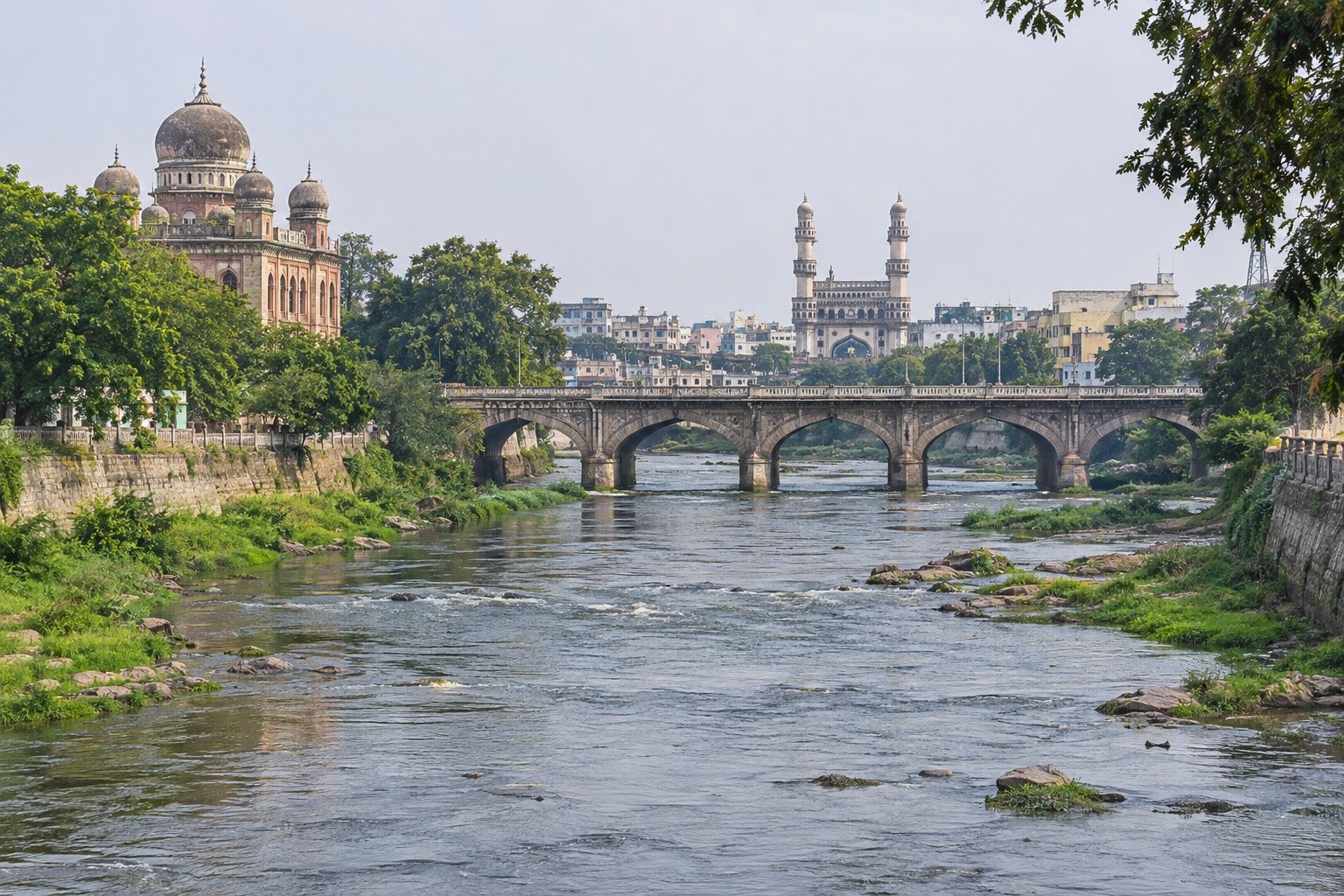
The Musi, a tributary of the Krishna, divides Hyderabad between its historic Old City and newer areas. The Central Pollution Control Board (CPCB) placed the Musi's polluted stretch in Priority I, its most polluted class, in 2022. Telangana's Chief Minister said on 11 November 2026 that rejuvenation will begin shortly.
Syllabus: Prelims · Geography; GS1 · Geophysical Phenomena; GS3 · Environment & Conservation
Why this matters for UPSC
GS1 geography and GS3 environment: Indian rivers, urban water bodies and pollution control. Prelims can ask the Musi's parent basin and the CPCB's priority classes; Mains, urban river rejuvenation.
In short
The Musi, a Krishna tributary rising in the Anantagiri Hills, carries Hyderabad's history and its waste; the CPCB's 2022 report put its polluted stretch in the most polluted class.
The Musi's revival should be judged by water quality and flow, not promenades; sewage treatment and fair rehabilitation must come before any riverfront.
Why it matters
A resident of Nalgonda district, downstream of Hyderabad, lives with what the city sends into the Musi; the Chief Minister said in November 2026 that the river's pollution was causing hardship there. A family in Hyderabad's Old City lives beside a riverbed that is nearly dry yet still used for washing, grazing and growing crops. Cleaning the river means treating the city's sewage before it reaches the water, which helps people downstream most. A riverfront, though, can push out those who use the bed; the Chief Minister has said the government will ensure that no one suffers losses. The Musi tests whether an Indian city can revive a river, not merely decorate its banks.
Prelims pointers
- Telangana's vision document lists the Bhima, Musi, Dindi and Tungabhadra among Krishna tributaries; the Manjira, Pranahita, Indravati, Kinnerasani and Kadem feed the Godavari.
- The CPCB sorts polluted river stretches into five priority classes by the highest BOD observed; the stretches with the worst readings fall in Priority I.
- In CPCB usage, two or more polluted monitoring locations in a continuous sequence on one river make a polluted river stretch.
- The CPCB's 2022 assessment covered 603 rivers and found 311 polluted stretches on 279 rivers; 46 stretches were in Priority I.
- As of 2022, the CPCB monitored water quality with State Pollution Control Boards and Pollution Control Committees at 4,484 locations in 28 States and 7 Union Territories.
- Of Telangana's nine polluted rivers in the 2022 report, the Godavari fell in Priority II and the Krishna in Priority V; the Musi alone was in Priority I.
Practise a UPSC-style question
With reference to the Musi river, consider the following statements:
1. It rises in the Anantagiri Hills and flows through Hyderabad.
2. It is a tributary of the Godavari, which it joins after leaving Hyderabad.
3. It is formed where the Esi and the Musa streams meet at Bapu Ghat in Hyderabad.
Which of the statements given above is/are correct?
- (a) 1 and 2 only
- (b) 2 and 3 only
- (c) 1 and 3 only
- (d) 1, 2 and 3
Show the answer
Answer: (c) 1 and 3 only
Answer: (c) 1 and 3 only. The Musi rises in the Anantagiri Hills and forms at Bapu Ghat, but it belongs to the Krishna basin.
Statement 1: correct. MRDCL and the Telangana vision document both place the Musi's origin in the Anantagiri Hills, from where it flows through Hyderabad.
Statement 2: incorrect. The Telangana vision document lists the Musi among the Krishna's tributaries, with the Bhima, Dindi and Tungabhadra.
Statement 3: correct. MRDCL says the Esi and the Musa merge at Bapu Ghat in Hyderabad to form the river.
Eliminate: statement 2 is the surest, since the Musi feeds the Krishna. Out: (a), (b), (d).
Trap: Swapped attribution. Both the Krishna and the Godavari flow through Telangana, so the question pins the Musi on the wrong main river.
Remember: Musi: Anantagiri Hills, Esi and Musa at Bapu Ghat, a Krishna tributary.
More Explainers
- CDRI: India's coalition for disaster-resilient infrastructure Environment
- Pichwai painting of Nathdwara, Rajasthan National
- Kerch Strait: the sea link between the Black Sea and Azov World & IR
- Wind energy in India: potential, offshore wind and the policy push Economy
- Pallikaranai marsh: a Chennai Ramsar site and its zone of influence Environment
- Andaman cobra: India's only island cobra, Endangered and endemic Environment
- International Coconut Community and India's Coconut Development Board World & IR
- Real Estate (Regulation and Development) Act, 2016: how it protects homebuyers Polity
- Open correctional institutions and the Supreme Court's 2026 directions Polity
- ICTP, Trieste: the UNESCO-IAEA centre for physics and mathematics Sci-Tech
- PJ.2.1 and how new Covid variants are classified and tracked Sci-Tech
- Berlin Conference of 1884-85 and the rules for colonising Africa World & IR