
Khajuraho Group of Monuments: the Chandela temples and the Nagara style
Why in news: Reported 18 October 2026: the ASI's chief said the Javari Vishnu idol's missing head, found in an ASI store, will be reattached after expert examination.
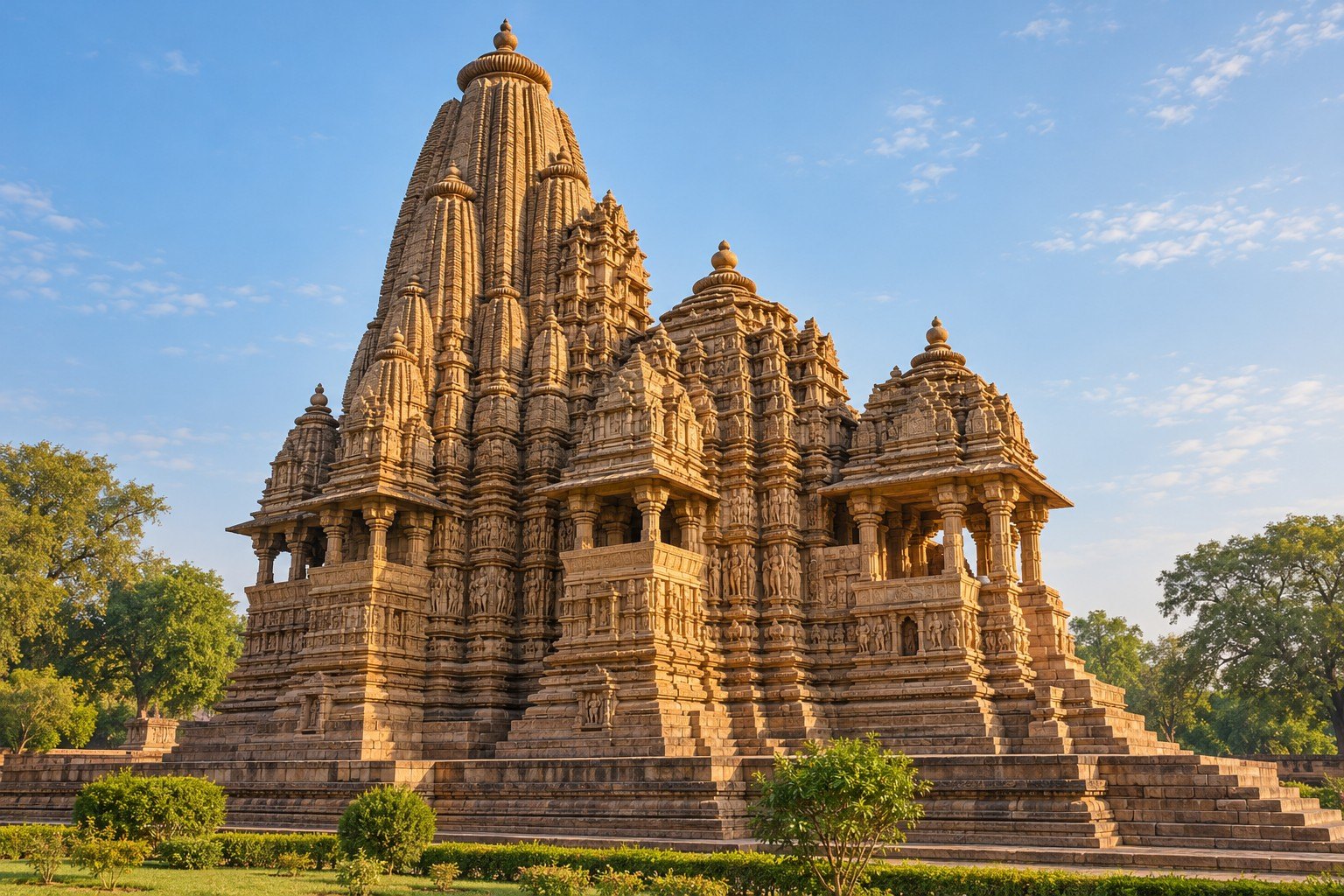
The Khajuraho Group of Monuments in Madhya Pradesh is a cluster of Hindu and Jain temples built under the Chandela dynasty, mostly in the 10th-11th centuries, and a UNESCO World Heritage Site since 1986. Its sandstone shrines mark the Nagara style's peak. The Archaeological Survey of India now plans to refix the Javari temple's Vishnu idol head.
Syllabus: GS1 · Art & Culture; Prelims · History & Culture
Why this matters for UPSC
GS1 art and culture: Prelims asks Nagara temple features, the Chandela dynasty and World Heritage Sites; Mains asks how Khajuraho shows the mature Nagara style and how the ASI should conserve such sites.
In short
The Khajuraho Group of Monuments in Madhya Pradesh is a Chandela-era complex of Hindu and Jain temples, built mostly in the 10th-11th centuries, showing the Nagara style at its height.
Khajuraho is the benchmark of mature Nagara design; protecting it means guarding original stone and its setting, not only the famous western group.
Why it matters
A visitor at Khajuraho can read a medieval kingdom in stone: who ruled, what they believed and how people lived, from dancers and teachers to soldiers and couples. When a broken image gets its original head back, the repair is judged on whether the old stone is kept and nothing new is passed off as old. Protection rules decide whether a family near the temples may add a floor, and airport vibration and dust are watched as threats. Tourism here supports guides, hotels and craftsmen, so conservation and livelihoods rise or fall together. The larger issue is how India protects about two dozen survivors of a much bigger temple town without freezing the town around them.
Prelims pointers
- Nagara temple: built on a stone platform, usually without the high boundary walls and gateways (gopurams) of Dravida temples.
- Latina or rekha-prasada shikhara: square at the base, its walls curving inward to a point; phamsana roofs rise on a straight incline instead.
- Valabhi type: a rectangular Nagara building with a wagon-vaulted roof, recalling wooden bullock wagons and rock-cut chaitya halls.
- Shrine types (NCERT): sandhara has a pradakshinapatha, nirandhara has none, sarvatobhadra opens on all four sides.
- Deogarh's Dashavatara temple (Lalitpur, Uttar Pradesh, early sixth century) is an early panchayatana Nagara temple with a curvilinear latina shikhara.
- Chausath Yogini temple, Khajuraho: predates the 10th century; small square shrines of rough granite, unlike the sandstone of the main temples.
- AMASR Act, 1958, as amended in 2010: a prohibited area up to 100 m from a protected monument, then a regulated area a further 200 m beyond it.
- Alexander Cunningham became the first Archaeological Surveyor in December 1861 and the ASI's Director General in February 1871 (ASI).
Practise a UPSC-style question
With reference to the Nagara style of temple architecture, consider the following statements:
1. The amalaka is a pot-shaped finial placed above the kalasha at the top of the shikhara.
2. The garbhagriha is located directly beneath the tallest tower of the temple.
Which of the statements given above is/are correct?
- (a) 1 only
- (b) 2 only
- (c) Both 1 and 2
- (d) Neither 1 nor 2
Show the answer
Answer: (b) 2 only
Answer: (b) 2 only. The sanctum sits under the tallest tower, but the order of the crowning parts is reversed in statement 1.
Statement 1: incorrect. The amalaka is a fluted disc that crowns the shikhara, and the kalasha, the pot finial, sits on top of it (NCERT, Lakshmana temple).
Statement 2: correct. In a Nagara temple the garbhagriha is always placed directly under the tallest tower (NCERT).
Eliminate: statement 2 is the surest, a basic Nagara rule. Out: (a), (d).
Eliminate: statement 1 swaps the amalaka and the kalasha. Out: (c).
Trap: Reversed direction. The two crowning elements are both real, but their order is turned upside down.
Remember: Nagara top = shikhara, then amalaka (fluted disc), then kalasha (pot).
More Explainers
- Who is an accredited journalist? PIB rules, Press Council, PRP Act Polity
- Financial Stability and Development Council: who sits on it, what it does Economy
- NATO: its 32 members, Articles 4 and 5, and the eastern flank World & IR
- Special Executive Magistrates under BNSS section 15: appointment and powers Polity
- Indo-Pacific Oceans Initiative (IPOI): India's seven-pillar plan for the Indo-Pacific World & IR
- Gig and platform workers under the Code on Social Security, 2020 Economy
- Bureau of Indian Standards Act, 2016: Standard Mark, QCOs and hallmarking Economy
- Kittur revolt of 1824: early resistance to the East India Company National
- Polio eradication: wild and vaccine-derived poliovirus, OPV and IPV, India's certification Sci-Tech
- International law and the UN Charter: sources, force and the ICJ World & IR
- Himalayan earthquakes and India's seismic zone map Environment
- Amur falcon: migration, protection and community conservation Environment