
India's defence exports: how they are licensed and why they grew
Why in news: On 23 October 2026 the Defence Secretary cited exports of Rs 38,424 crore and a Bloomberg report ranking India third among arms exporters to Europe.
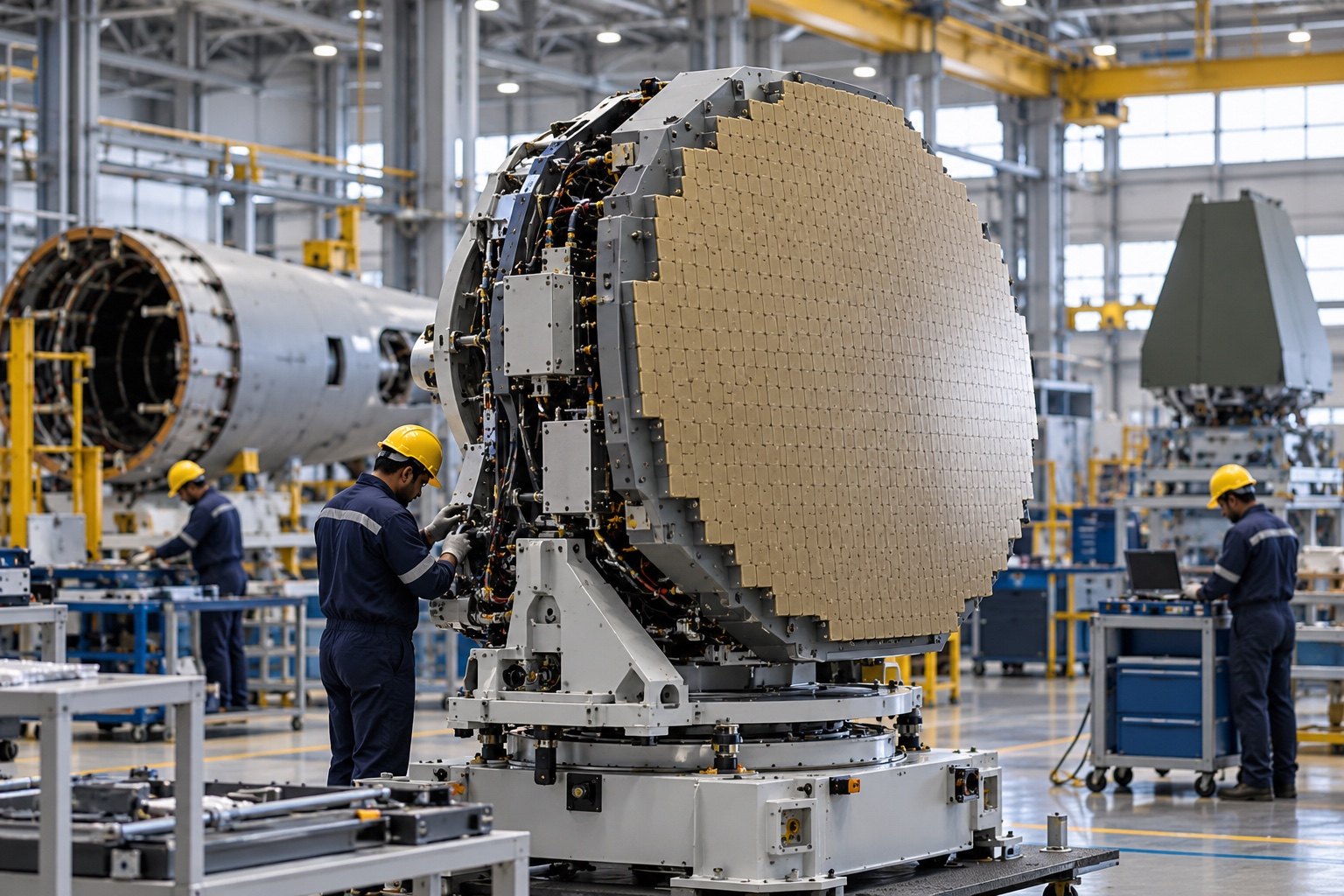
Defence exports are Indian-made weapons, ammunition, systems and components sold to foreign buyers by state-owned and private companies. Exports of Munitions List items need authorisation from the Defence Ministry's Department of Defence Production. On 23 October 2026 the Defence Secretary highlighted their record level and cited a report on Indian arms sales to Europe.
Syllabus: Prelims · Current Affairs & IR; GS3 · Liberalisation & Industry; GS3 · Indian Achievements in S&T
Why this matters for UPSC
GS III asks about indigenisation of technology and defence production; GS II about export controls and the Wassenaar Arrangement. Prelims can ask who licenses SCOMET Category 6, what an OGEL is and how SIPRI measures arms transfers.
In short
Defence exports are Indian-made arms, systems and parts sold abroad under a licensing regime, SCOMET Category 6, run by the Ministry of Defence, balancing trade growth against proliferation risk.
Exports have grown fast, but self-reliance needs complete platforms, steady production and strict end-use controls, so that India sells more weapons than it buys.
Why it matters
When India sells weapons and parts abroad, its factories run longer production lines, which lowers the cost of equipment for its own forces and keeps skilled jobs at home. Small firms that once supplied only the Indian Army can now sell to foreign buyers, so a fall in domestic orders hurts them less. Exports also make other countries depend on India for spares and training, which gives India a voice in their security choices. Yet India still buys a large share of its major weapons abroad, so the real test of self-reliance is whether exports grow into complete systems rather than parts and ammunition alone.
Prelims pointers
- SCOMET Category 6 is titled the 'Munitions List'; its export licensing authority is the Department of Defence Production, Ministry of Defence, under DGFT's Public Notice 4/2015-20.
- India has notified three OGELs: for parts and components, for transfer of technology, and for major platforms and equipment.
- FDI in the defence sector: up to 74% through the automatic route and up to 100% through the government route.
- SIPRI's Arms Transfers Database leaves out small arms (except portable guided missiles), artillery under 100-mm calibre, ammunition and most components.
- SIPRI's data show Russia's share of India's arms imports falling from 70% (2011-15) to 51% (2016-20) and 40% (2021-25), with France, Israel and the USA rising.
- Two Defence Industrial Corridors exist: one in Uttar Pradesh and one in Tamil Nadu.
- India is a participating state of the Wassenaar Arrangement; Indian rules ease some exports of parts and engineering services to Wassenaar countries.
Practise a UPSC-style question
With reference to the licensing of defence exports from India, consider the following statements:
1. An Open General Export Licence requires the exporter to seek a separate export authorisation for every consignment during its validity.
2. The Department of Defence Production, Ministry of Defence, is the licensing authority for exports of items in Category 6 of the SCOMET list.
Which of the statements given above is/are correct?
- (a) 1 only
- (b) 2 only
- (c) Both 1 and 2
- (d) Neither 1 nor 2
Show the answer
Answer: (b) 2 only
Answer: (b) 2 only. The DDP licenses SCOMET Category 6 exports; an OGEL removes the need for per-deal authorisation.
Statement 1: incorrect. An OGEL is a one-time licence that lets industry export specified items to specified destinations without seeking export authorisation while it is valid.
Statement 2: correct. DGFT's Public Notice 4/2015-20 of 24 April 2017 notified the Department of Defence Production as licensing authority for SCOMET Category 6 (Munitions List).
Eliminate: Statement 2 is the surer one, since the 2017 public notice named the DDP. Out: (a), (d).
Eliminate: Statement 1 reverses what an OGEL does. Out: (c).
Trap: Reversed direction. Statement 1 takes the one feature of an OGEL, freedom from fresh authorisation, and turns it into its opposite.
Remember: OGEL = one licence, listed items, listed countries, no fresh authorisation; DDP licenses Category 6.
More Explainers
- Who is an accredited journalist? PIB rules, Press Council, PRP Act Polity
- Financial Stability and Development Council: who sits on it, what it does Economy
- NATO: its 32 members, Articles 4 and 5, and the eastern flank World & IR
- Special Executive Magistrates under BNSS section 15: appointment and powers Polity
- Indo-Pacific Oceans Initiative (IPOI): India's seven-pillar plan for the Indo-Pacific World & IR
- Gig and platform workers under the Code on Social Security, 2020 Economy
- Bureau of Indian Standards Act, 2016: Standard Mark, QCOs and hallmarking Economy
- Kittur revolt of 1824: early resistance to the East India Company National
- Polio eradication: wild and vaccine-derived poliovirus, OPV and IPV, India's certification Sci-Tech
- International law and the UN Charter: sources, force and the ICJ World & IR
- Himalayan earthquakes and India's seismic zone map Environment
- Amur falcon: migration, protection and community conservation Environment