
Indian Red Cross Society: the 1920 Act and the Red Cross Movement
Why in news: On 12 November 2026, Jammu and Kashmir's Lieutenant Governor gave fire-hit Jammu traders Rs 1 lakh each through the Red Cross, citing no relief funds.
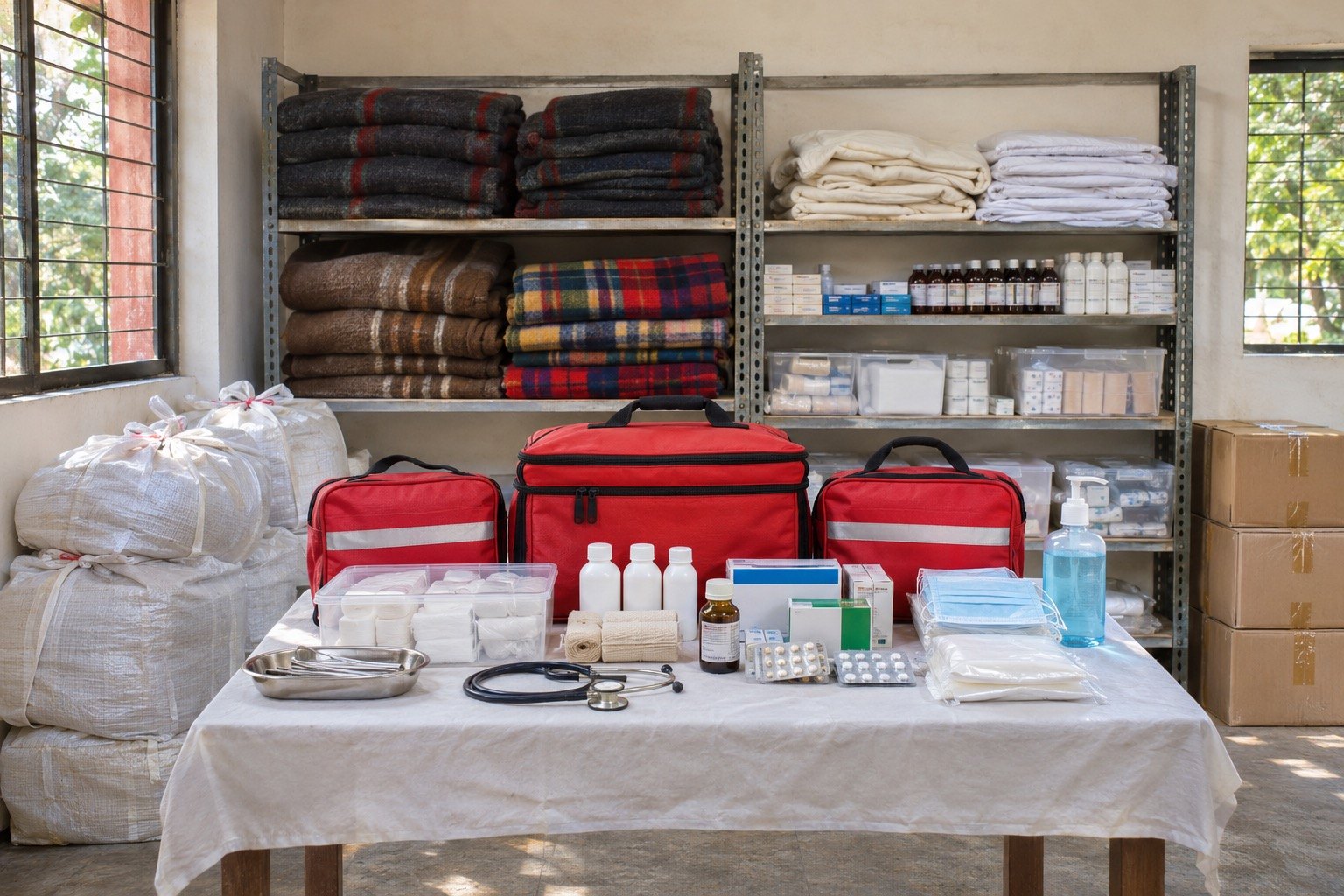
The Indian Red Cross Society (IRCS) is a statutory relief society formed under a 1920 law. The President of India is its President. It is India's National Society in the International Red Cross and Red Crescent Movement. In November 2026, Jammu and Kashmir's Lieutenant Governor used it to aid traders hit by two Jammu market fires.
Syllabus: GS2 · Statutory & Regulatory Bodies; GS2 · NGOs, SHGs & Civil Society; GS3 · Disaster Management
Why this matters for UPSC
GS2 covers statutory bodies and international institutions; GS3, disaster relief. Prelims can ask who heads the IRCS, the Movement's parts and principles; Mains, voluntary relief beside the State.
In short
The Indian Red Cross Society is a statutory voluntary relief body under the Indian Red Cross Society Act, 1920, and India's member of the Red Cross and Red Crescent Movement.
The IRCS gives India a nationwide relief arm; keeping it independent of official influence while making its aid transparent is the task ahead.
Why it matters
A shopkeeper whose stall burns down, or a family cut off by a flood, needs help within days, and the State's relief often moves through fixed procedures. A body like the Red Cross can step in quickly because it holds donated money and a volunteer network that reaches the district level. Its help is modest and bound by its own rules, so it softens a loss without replacing insurance or government compensation. The arrangement also raises a governance question: the Society is led by high constitutional office-holders, yet the Movement asks every National Society to stay neutral and independent. How that balance is kept decides whether aid reaches people by need or by influence.
Prelims pointers
- The ICRC first met in Geneva in February 1863; Henry Dunant, author of 'A Memory of Solferino', was among its five founders.
- The ICRC, from 1863, protects and assists victims of armed conflict; the IFRC began in 1919 as the League of Red Cross Societies, founded by National Societies.
- The ICRC's main mandate in armed conflict comes from the four Geneva Conventions of 1949; two Additional Protocols followed in 1977.
- Under the unity principle, a country may have only one Red Cross or Red Crescent Society, open to all and working across its territory.
- The first Geneva Convention of August 1864 obliged armies to care for wounded soldiers of any side and introduced the red cross on white.
- The red crescent, first used by the Ottoman Empire, was accepted in the 1929 Geneva Conventions; the red crystal was adopted in 2005.
- The 1920 Act names the IRCS the recognised auxiliary of the Armed Forces Medical Services, aiding sick and wounded soldiers under the 1949 Geneva Conventions.
Practise a UPSC-style question
With reference to the Indian Red Cross Society, consider the following statements:
1. The President of India is the President of the Society under the Indian Red Cross Society Act, 1920.
2. The Chairman of its Managing Body is elected by the State and Union Territory branches.
3. Twelve members of its Managing Body are elected by the State and Union Territory branches for two years.
Which of the statements given above is/are correct?
- (a) 1 and 2 only
- (b) 2 and 3 only
- (c) 1 and 3 only
- (d) 1, 2 and 3
Show the answer
Answer: (c) 1 and 3 only
Answer: (c) 1 and 3 only. The President heads the Society, and branches elect twelve Managing Body members.
Statement 1: correct. The 1920 Act, as amended, makes the President of India the President of the Society.
Statement 2: incorrect. The President of India nominates the Chairman; by practice the Union Health Minister holds the post.
Statement 3: correct. Twelve of the 18 Managing Body members are elected by State and Union Territory branches for two years; six are nominated.
Eliminate: Statement 2 is wrong because the Chairman is nominated, not elected. Out: (a), (b), (d).
Trap: Swapped attribution. The election that fills twelve seats is pinned on the Chairman, whom the President nominates.
Remember: IRCS Chairman nominated by the President; twelve members elected, six nominated.
More Explainers
- CDRI: India's coalition for disaster-resilient infrastructure Environment
- Pichwai painting of Nathdwara, Rajasthan National
- Kerch Strait: the sea link between the Black Sea and Azov World & IR
- Wind energy in India: potential, offshore wind and the policy push Economy
- Pallikaranai marsh: a Chennai Ramsar site and its zone of influence Environment
- Andaman cobra: India's only island cobra, Endangered and endemic Environment
- International Coconut Community and India's Coconut Development Board World & IR
- Real Estate (Regulation and Development) Act, 2016: how it protects homebuyers Polity
- Open correctional institutions and the Supreme Court's 2026 directions Polity
- ICTP, Trieste: the UNESCO-IAEA centre for physics and mathematics Sci-Tech
- PJ.2.1 and how new Covid variants are classified and tracked Sci-Tech
- Berlin Conference of 1884-85 and the rules for colonising Africa World & IR