
Gravitational waves and LIGO-India: how India joins the detector network
Why in news: A catalogue of candidate gravitational-wave events, released on 26 May 2026, favours merging black holes over neutron stars as their sources.
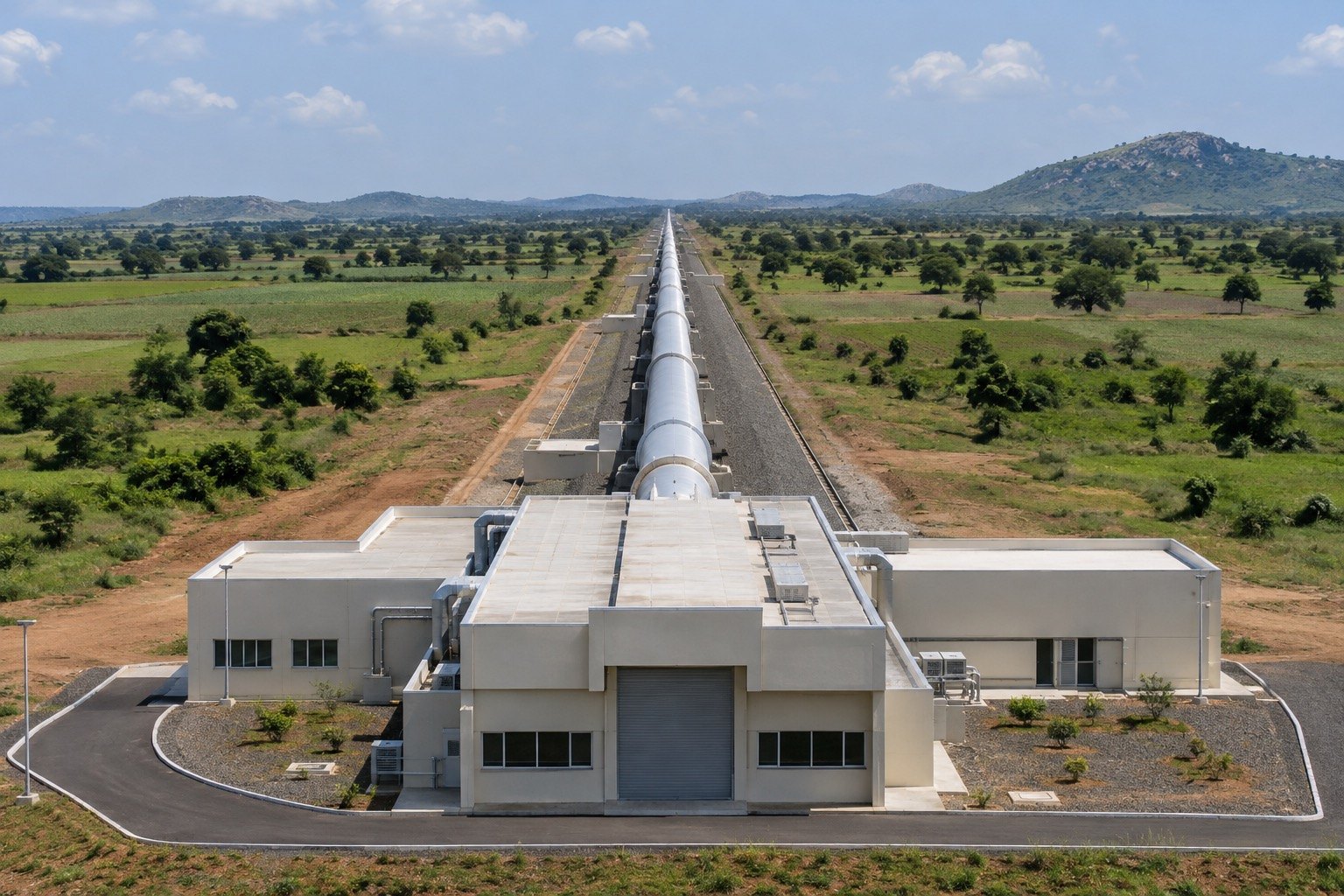
Gravitational waves are ripples in spacetime that accelerating masses, such as merging black holes, send out at light speed. Albert Einstein predicted them in 1916, and LIGO's twin US detectors first observed them directly in 2015. A May 2026 catalogue lets scientists study black-hole mergers in bulk, and a third LIGO detector, LIGO-India, is to come up at Hingoli, Maharashtra.
Syllabus: Prelims · Science & Technology; GS3 · Science & Technology; GS3 · Indian Achievements in S&T
Why this matters for UPSC
GS3 science and technology: gravitational waves, laser interferometers and India's mega-science projects. Prelims can ask how LIGO detects the waves and where LIGO-India is sited; Mains, its value for Indian science.
In short
Gravitational waves, foreseen by Einstein in 1916, are travelling distortions of spacetime from violent cosmic events; ground-based laser interferometers such as LIGO have recorded them directly since 2015.
LIGO-India's worth depends on finishing on time: a more southerly node would sharpen the whole network's aim and give Indian science its own instrument.
Why it matters
A physics student in India who wants to work on colliding black holes will, once LIGO-India runs, have one of the world's handful of such observatories at home. Indian firms that build its ultra-high-vacuum beam tube gain work in frontier technology. Astronomers everywhere gain too. A detector far to the south of the others shrinks the patch of sky where a signal began. Telescopes can then search sooner for any matching flash of light, as they did after the 2017 neutron-star merger. Over time, such data turn gravitational waves from a test of Einstein's theory into a working tool for tracing how black holes are born.
Prelims pointers
- Einstein set out the general theory of relativity in 1915 and predicted gravitational waves from it in 1916; LIGO's direct detection came a century after the theory.
- LIGO was proposed in the 1980s by Rainer Weiss, Kip Thorne and Ronald Drever; its initial funding, from the US National Science Foundation, was approved in 1992.
- LIGO can measure a change in arm length smaller than one ten-thousandth of a proton's diameter, about 10⁻¹⁹ metre.
- Detectors now operating: LIGO at Hanford (Washington) and Livingston (Louisiana), Virgo near Pisa (Italy), KAGRA (Japan) and GEO600 (Germany); LIGO-India in Maharashtra would be the sixth.
- Hulse and Taylor's binary pulsar, found in 1974 with the Arecibo radio observatory, gave indirect evidence and the 1993 Physics Nobel; LIGO's 2015 signal was the first direct detection.
- LIGO is ground-based; the European Space Agency's LISA will place three spacecraft in orbit around the Sun to catch lower-frequency waves, with launch planned for 2035.
- A merger of two neutron stars, recorded by LIGO in 2017, also gave off a bright flash of light for telescopes to observe; black-hole mergers seldom do.
- LIGO-India's two 4-km arms need an 8-km beam tube held at ultra-high vacuum on levelled ground, with Indian industry engaged to build it.
Practise a UPSC-style question
With reference to gravitational waves, consider the following statements:
1. They travel through space at about half the speed of light.
2. Albert Einstein predicted them in 1916 from his general theory of relativity.
3. Two neutron stars orbiting each other can give rise to them.
Which of the statements given above is/are correct?
- (a) 1 and 2 only
- (b) 2 and 3 only
- (c) 1 and 3 only
- (d) 1, 2 and 3
Show the answer
Answer: (b) 2 and 3 only
Answer: (b) 2 and 3 only. The waves move at the speed of light, so statement 1 is the one that fails.
Statement 1: incorrect. Gravitational waves travel at the speed of light; nearly half that speed is how fast the two black holes of 2015 collided.
Statement 2: correct. Einstein predicted the waves in 1916 using his general theory of relativity, as the LIGO Laboratory notes.
Statement 3: correct. Massive accelerating objects, such as neutron stars or black holes orbiting each other, send out gravitational waves.
Eliminate: Be sure of statement 1 first: the waves move at light speed, so it is incorrect and every option containing it goes. Out: (a), (c), (d).
Trap: Near-miss figure. Half the speed of light does appear in the account of the first detection, but as the speed of the colliding black holes, not of the waves.
Remember: Gravitational waves: predicted in 1916, travel at the speed of light.
More Explainers
- CDRI: India's coalition for disaster-resilient infrastructure Environment
- Pichwai painting of Nathdwara, Rajasthan National
- Kerch Strait: the sea link between the Black Sea and Azov World & IR
- Wind energy in India: potential, offshore wind and the policy push Economy
- Pallikaranai marsh: a Chennai Ramsar site and its zone of influence Environment
- Andaman cobra: India's only island cobra, Endangered and endemic Environment
- International Coconut Community and India's Coconut Development Board World & IR
- Real Estate (Regulation and Development) Act, 2016: how it protects homebuyers Polity
- Open correctional institutions and the Supreme Court's 2026 directions Polity
- ICTP, Trieste: the UNESCO-IAEA centre for physics and mathematics Sci-Tech
- PJ.2.1 and how new Covid variants are classified and tracked Sci-Tech
- Berlin Conference of 1884-85 and the rules for colonising Africa World & IR