
Deep Ocean Mission: Samudrayaan and the Matsya-6000 submersible
Why in news: On 13 November 2026 the Ministry of Earth Sciences' Secretary said Matsya-6000's first 500-metre trial dive is planned for early 2027.
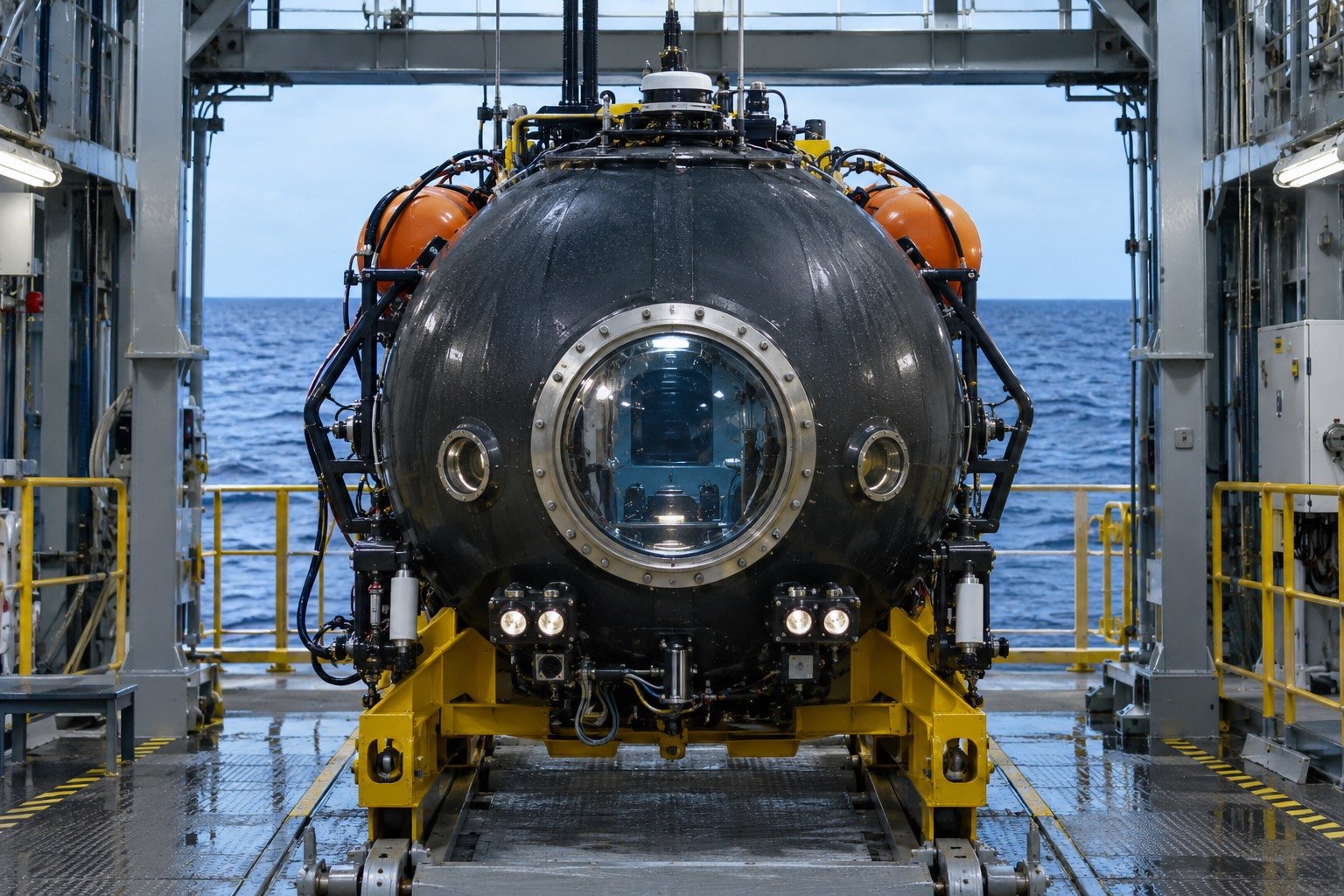
The Deep Ocean Mission is the Ministry of Earth Sciences' programme to explore seabed resources and build deep-sea technology. Under its Samudrayaan project, the National Institute of Ocean Technology is building Matsya-6000, a submersible to take three people 6,000 metres down. The Ministry's Secretary says its first 500-metre trial dive is planned for early 2027.
Syllabus: GS1 · Resources & Industry Location; GS3 · Science & Technology; GS3 · Indian Achievements in S&T
Why this matters for UPSC
GS3 science and technology: indigenisation and the blue economy through the Deep Ocean Mission. Prelims asks Matsya-6000's builder, depth and crew; Mains, the promise and risks of deep-sea mining.
In short
The Deep Ocean Mission, approved in 2021 under the Ministry of Earth Sciences, seeks deep-sea resources and technology; its Samudrayaan project aims to take three people 6,000 metres down.
Matsya-6000 tests India's indigenous engineering; deep-sea mining should follow environmental evidence and ISA rules, not deadlines.
Why it matters
An engineer designing batteries for electric cars needs nickel, copper and cobalt. Nodules on the floor of the Indian Ocean hold these metals, but they lie far below the reach of divers or ordinary ships. A crewed submersible lets scientists see the seabed for themselves, collect samples and judge both the ore and the living things around it before anyone decides to mine. Building such a vehicle also trains Indian engineers and firms in pressure hulls, heavy welding and life support, skills that carry over to offshore work and to human spaceflight. The larger question is how a coastal nation draws wealth from the ocean without destroying ecosystems it has barely studied.
Prelims pointers
- Polymetallic nodules contain nickel, copper, cobalt and manganese; polymetallic sulphides contain copper, zinc, lead, iron, silver, gold and platinum.
- India's three ISA exploration contracts: nodules in the Central Indian Ocean Basin (2002), sulphides on the Central and South West Indian Ridge (2016) and the Carlsberg Ridge (2025).
- Samudrayaan (Ministry of Earth Sciences, NIOT) sends people into the deep sea; Gaganyaan (ISRO) sends them to space. Both need human-rated systems that supply oxygen and remove carbon dioxide.
- NIOT has an MoU with France's IFREMER, which runs Nautile, a crewed scientific submersible also rated for 6,000 metres.
- Matsya-6000's DNV-certified life-support system holds oxygen at 20 per cent and carbon dioxide below 1,000 ppmv; three weight-drop mechanisms let it rise in an emergency.
- The United Nations declared 2021-2030 the Decade of Ocean Science for Sustainable Development.
Practise a UPSC-style question
With reference to the Deep Ocean Mission, consider the following statements:
1. The Ministry of Earth Sciences is the nodal ministry implementing it.
2. It was approved by the Cabinet Committee on Economic Affairs in 2021.
3. One of its components searches for hydrothermal sulphide sites along the Indian Ocean's mid-oceanic ridges.
Which of the statements given above is/are correct?
- (a) 1 and 2 only
- (b) 2 and 3 only
- (c) 1 and 3 only
- (d) 1, 2 and 3
Show the answer
Answer: (d) 1, 2 and 3
Answer: (d) 1, 2 and 3. Each statement matches the mission as the 2021 Cabinet release describes it.
Statement 1: correct. The Ministry of Earth Sciences is the nodal ministry of this multi-institutional mission (PIB, 2021).
Statement 2: correct. The Cabinet Committee on Economic Affairs cleared it in 2021 at an estimated Rs 4,077 crore for five years.
Statement 3: correct. Its Deep Ocean Survey and Exploration component seeks multi-metal hydrothermal sulphide sites on the Indian Ocean's mid-oceanic ridges.
Eliminate: Statement 3 is correct, so the only option leaving it out goes. Out: (a).
Eliminate: Statement 1 is correct as well, which removes the option without it. Out: (b).
Eliminate: Statement 2 is correct too, so all three stand together. Out: (c).
Trap: Swapped attribution. A student may expect ISRO or the Ministry of Science and Technology to lead a crewed vehicle programme, and doubt statement 1.
Remember: Deep Ocean Mission: Ministry of Earth Sciences, CCEA approval 2021, Rs 4,077 crore over five years.
More Explainers
- CDRI: India's coalition for disaster-resilient infrastructure Environment
- Pichwai painting of Nathdwara, Rajasthan National
- Kerch Strait: the sea link between the Black Sea and Azov World & IR
- Wind energy in India: potential, offshore wind and the policy push Economy
- Pallikaranai marsh: a Chennai Ramsar site and its zone of influence Environment
- Andaman cobra: India's only island cobra, Endangered and endemic Environment
- International Coconut Community and India's Coconut Development Board World & IR
- Real Estate (Regulation and Development) Act, 2016: how it protects homebuyers Polity
- Open correctional institutions and the Supreme Court's 2026 directions Polity
- ICTP, Trieste: the UNESCO-IAEA centre for physics and mathematics Sci-Tech
- PJ.2.1 and how new Covid variants are classified and tracked Sci-Tech
- Berlin Conference of 1884-85 and the rules for colonising Africa World & IR