
Buxa Tiger Reserve and the reintroduction of tigers
Why in news: A tigress moved from Valmiki to Buxa strayed into Assam, was recaptured on 3 November 2026 and later left her enclosure.
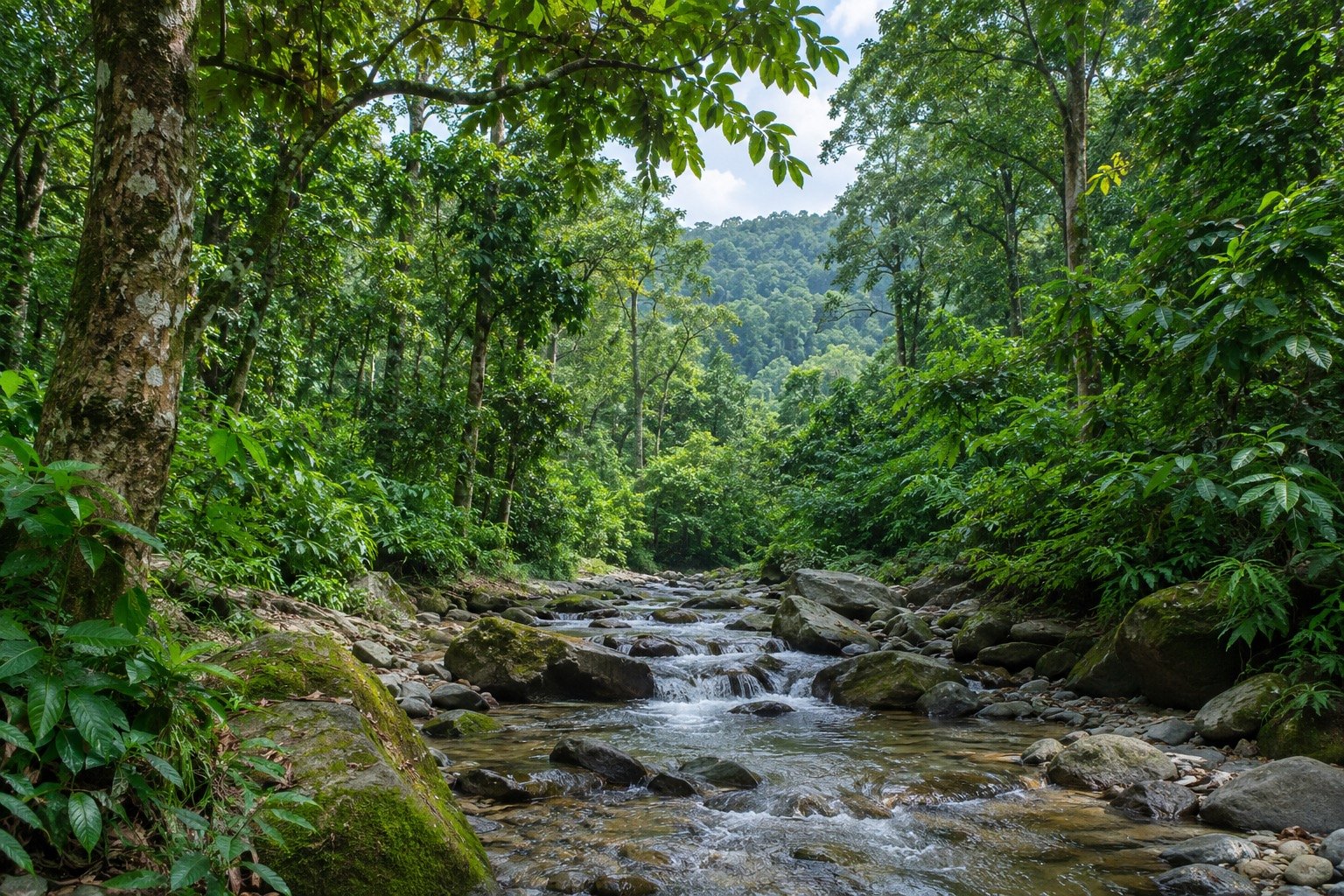
Buxa Tiger Reserve is a 757.90 sq km protected forest in northern West Bengal, bordering Bhutan on the north and Assam on the east. Notified in 1982-83, it recorded no tigers in the 2018 national estimation. A tigress moved there from Bihar's Valmiki Tiger Reserve strayed into Assam and was recaptured on 3 November.
Syllabus: Prelims · Geography; Prelims · Environment & Ecology; GS3 · Environment & Conservation
Why this matters for UPSC
GS3 conservation and Prelims environment: Buxa Tiger Reserve under the Wild Life (Protection) Act, 1972. Prelims can ask its neighbours and status years; Mains, how tiger reintroduction should work.
In short
Buxa Tiger Reserve is a protected forest on West Bengal's border with Bhutan, notified as a tiger reserve in 1982-83 and now chosen to receive relocated tigers.
Buxa can reconnect tiger habitat between Bhutan, Assam and north Bengal only if animal welfare, secure enclosures and consenting villagers come before speed.
Why it matters
For families in north Bengal's forest villages, a returning tiger brings new risk to people and livestock; a Buxa forest official expects villages such as Jayanti to be relocated. For the reserve, a forest with no breeding tigers cannot refill itself, so moving healthy animals from crowded reserves is the way to restart it. If the effort works, the project's lead scientist says Buxa and the north Bengal forests could link tiger populations to the east and west. If it is rushed, an injured or stressed animal may stray into villages and farmland, turning a conservation effort into conflict and costing public trust.
Prelims pointers
- Buxa lies in northern West Bengal; the Sinchula hill range runs along its northern boundary, which is also India's border with Bhutan.
- Bhutan's Phipsu Wildlife Sanctuary adjoins Buxa on the north and Manas Tiger Reserve lies to its east, making Buxa an India-Bhutan elephant corridor.
- The NTCA includes three Members of Parliament, two elected by the House of the People and one by the Council of States, besides experts and secretaries.
- The NTCA, constituted under Section 38L of the Wild Life (Protection) Act, 1972, is chaired by the Union Minister in charge of environment and forests.
- Core or critical tiger habitat is kept inviolate for tigers; a buffer gets lesser protection and promotes co-existence, its limits set with the Gram Sabha and an Expert Committee.
- Kaziranga and Orang are the NE Cluster I sources of dispersing tigers; Namdapha and Dibang form a separate cluster whose tigers stay within that region.
- Buxa's forest types range from riverine, sal and mixed forests to semi-evergreen, evergreen, hill and savannah forests, with historic teak plantations.
- Buxa Fort, about 2,600 feet above sea level inside the reserve, has historical links to the independence movement.
Practise a UPSC-style question
With reference to Buxa Tiger Reserve, consider the following statements:
1. Its northern boundary runs along the international border with Bhutan.
2. Manas Tiger Reserve lies to the west of Buxa Tiger Reserve.
3. Phipsu Wildlife Sanctuary of Bhutan adjoins the reserve on its northern side.
Which of the statements given above is/are correct?
- (a) 1 and 2 only
- (b) 2 and 3 only
- (c) 1 and 3 only
- (d) 1, 2 and 3
Show the answer
Answer: (c) 1 and 3 only
Answer: (c) 1 and 3 only. Buxa touches Bhutan on the north, while Manas lies to its east.
Statement 1: correct. The NTCA profile places the reserve's northern border along Bhutan's international border, with the Sinchula hills running along it.
Statement 2: incorrect. Manas Tiger Reserve lies east of Buxa, and the reserve's eastern border is shared with Assam.
Statement 3: correct. Bhutan's Phipsu Wildlife Sanctuary borders Buxa to the north, which lets elephants move between the two countries.
Eliminate: statement 2 is the surest; Manas is to the east, not the west. Out: (a), (b), (d).
Trap: Reversed direction. The right neighbour is named but placed on the wrong side of the reserve, so a student who knows the name but not the map is caught.
Remember: Buxa has Bhutan and Phipsu to the north and Assam and Manas to the east.
More Explainers
- CDRI: India's coalition for disaster-resilient infrastructure Environment
- Pichwai painting of Nathdwara, Rajasthan National
- Kerch Strait: the sea link between the Black Sea and Azov World & IR
- Wind energy in India: potential, offshore wind and the policy push Economy
- Pallikaranai marsh: a Chennai Ramsar site and its zone of influence Environment
- Andaman cobra: India's only island cobra, Endangered and endemic Environment
- International Coconut Community and India's Coconut Development Board World & IR
- Real Estate (Regulation and Development) Act, 2016: how it protects homebuyers Polity
- Open correctional institutions and the Supreme Court's 2026 directions Polity
- ICTP, Trieste: the UNESCO-IAEA centre for physics and mathematics Sci-Tech
- PJ.2.1 and how new Covid variants are classified and tracked Sci-Tech
- Berlin Conference of 1884-85 and the rules for colonising Africa World & IR