
Bhadra Tiger Reserve and voluntary relocation from tiger cores
Why in news: On 14 November 2026, about 30 families were reported living inside Bhadra Wildlife Sanctuary with no road, school or hospital.
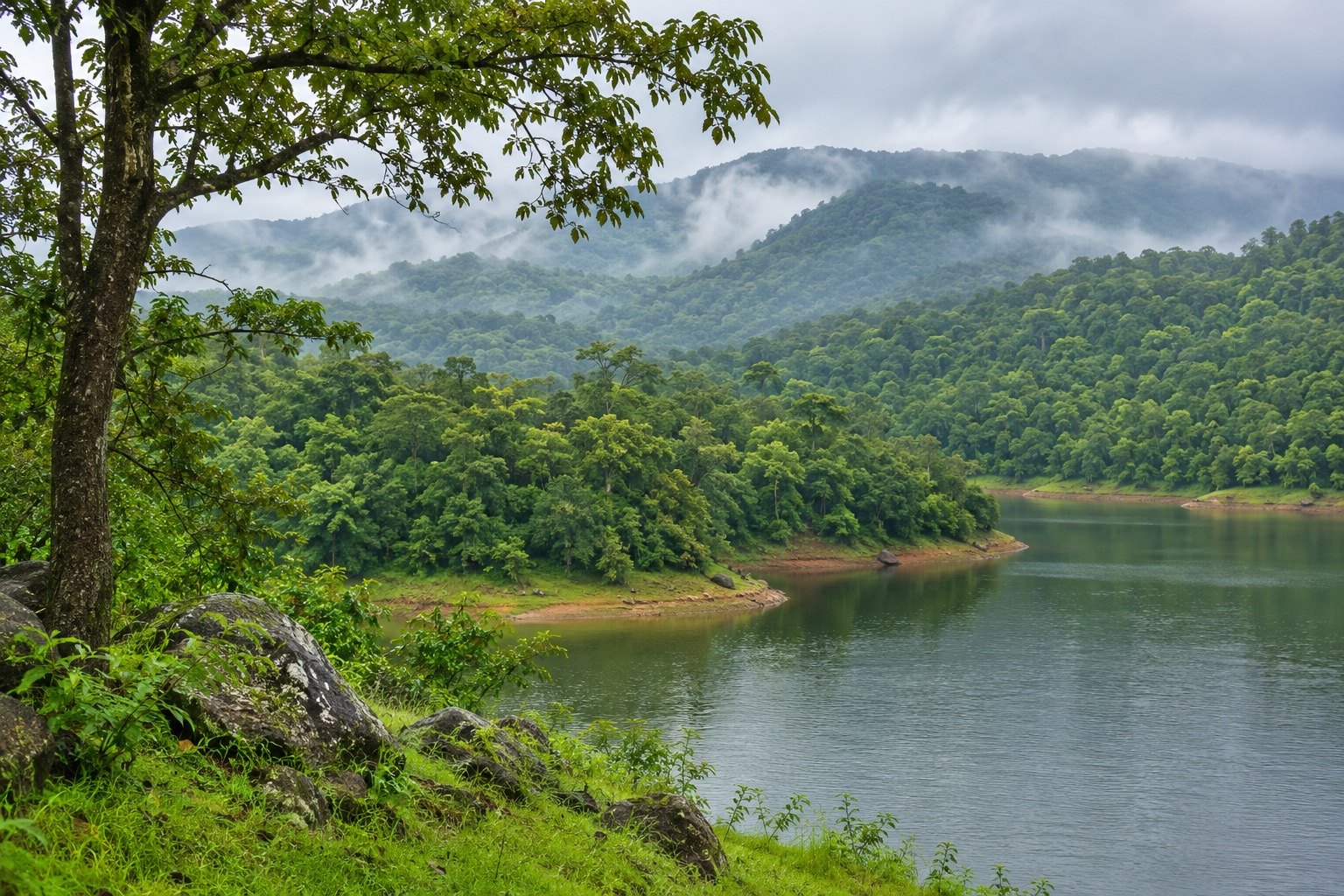
Bhadra Tiger Reserve, named after the Bhadra river, spreads over 571.84 sq km in Karnataka. It lies in Chikkamagaluru and Shivamogga districts. The Wildlife (Protection) Act, 1972 wants its core kept inviolate. Villages inside may leave only by choice, with consent and a package. About 30 families still live inside the sanctuary without a road, school or hospital.
Syllabus: Prelims · Environment & Ecology; GS2 · Welfare of Vulnerable Sections; GS3 · Environment & Conservation
Why this matters for UPSC
GS3 conservation and GS2 tribal rights: tiger reserves, forest rights and resettlement. Prelims asks Bhadra's location and history; Mains weighs conservation against forest dwellers' rights.
In short
Voluntary relocation clears settlements from a tiger reserve's core under the Wildlife (Protection) Act, 1972. Bhadra in Karnataka shows how it can succeed, and whom it can leave behind.
Bhadra proves that consent-based relocation can free a tiger core; its credibility now rests on fair, complete packages for every family still inside.
Why it matters
A family living inside a tiger core faces a hard choice. If it stays, it lives far from roads, schools and clinics: children study away from home, and every illness means a long journey. If it leaves, it needs farmland, a house and a new way to earn, and the law makes the family's own consent decisive. Tigers, for their part, need large stretches of forest without people, which is why the State wants cores cleared. When relocation is fair and complete, both gain. When some households are missed or the package falls short, they are left in a forest that the State will not develop and that they will not leave.
Prelims pointers
- Bhadra sits in Karnataka's Malnad hill districts; the Bhadra river gives the reserve its name, and a large reservoir lies within its northern forests.
- Bhadra's habitats: bamboo is common; dry deciduous forest in the north, moist deciduous in the south, shola evergreen in the east; teak and rosewood grow there.
- Bhadra's forerunner was the Jagara Valley Game Sanctuary, declared by the State of Mysore in 1951.
- 'Core or critical tiger habitat' appears only in the Wildlife (Protection) Act, 1972; 'critical wildlife habitat' is defined only in the Forest Rights Act, 2006, and serves other species.
- Option II (2008) splits the Rs 10 lakh: 35% farmland (2 ha) and its development, 30% settling rights, 20% house site and house, 5% incentive, 10% community facilities.
- The 2006 amendment, made on the Tiger Task Force's advice, also provides for Tiger Conservation Plans, State-level Steering Committees and a Tiger Conservation Foundation.
- States must set up monitoring committees at the district and State levels to oversee relocation from tiger cores.
Practise a UPSC-style question
With reference to Bhadra Tiger Reserve, consider the following statements:
1. It was first declared a wildlife sanctuary by the Government of Karnataka in 1998.
2. It lies in the Malnad districts of Chikkamagaluru and Shivamogga in Karnataka.
Which of the statements given above is/are correct?
- (a) 1 only
- (b) 2 only
- (c) Both 1 and 2
- (d) Neither 1 nor 2
Show the answer
Answer: (b) 2 only
Answer: (b) 2 only. Bhadra sits in Karnataka's Malnad, but it became a sanctuary in 1974, not 1998.
Statement 1: incorrect. The Government of Karnataka declared Bhadra Wildlife Sanctuary in 1974; 1998 is the year it became part of the Project Tiger area.
Statement 2: correct. The Karnataka Forest Department places the reserve in the Malnad districts of Chikmagalur (Chikkamagaluru) and Shimoga (Shivamogga).
Eliminate: statement 1 is wrong on the year. Out: (a), (c).
Eliminate: statement 2 is right on the districts. Out: (d).
Trap: Near-miss figure. The year 1998 is real in Bhadra's history, but it marks Project Tiger, not the sanctuary.
Remember: Bhadra: sanctuary 1974, Project Tiger 1998, tiger reserve 2007.
More Explainers
- CDRI: India's coalition for disaster-resilient infrastructure Environment
- Pichwai painting of Nathdwara, Rajasthan National
- Kerch Strait: the sea link between the Black Sea and Azov World & IR
- Wind energy in India: potential, offshore wind and the policy push Economy
- Pallikaranai marsh: a Chennai Ramsar site and its zone of influence Environment
- Andaman cobra: India's only island cobra, Endangered and endemic Environment
- International Coconut Community and India's Coconut Development Board World & IR
- Real Estate (Regulation and Development) Act, 2016: how it protects homebuyers Polity
- Open correctional institutions and the Supreme Court's 2026 directions Polity
- ICTP, Trieste: the UNESCO-IAEA centre for physics and mathematics Sci-Tech
- PJ.2.1 and how new Covid variants are classified and tracked Sci-Tech
- Berlin Conference of 1884-85 and the rules for colonising Africa World & IR