
Agricultural marketing in India: from APMC mandis to e-NAM
Why in news: A PIB backgrounder of 13 April 2026 put e-NAM at 1,656 integrated mandis across 23 States and 4 Union Territories by March 2026.
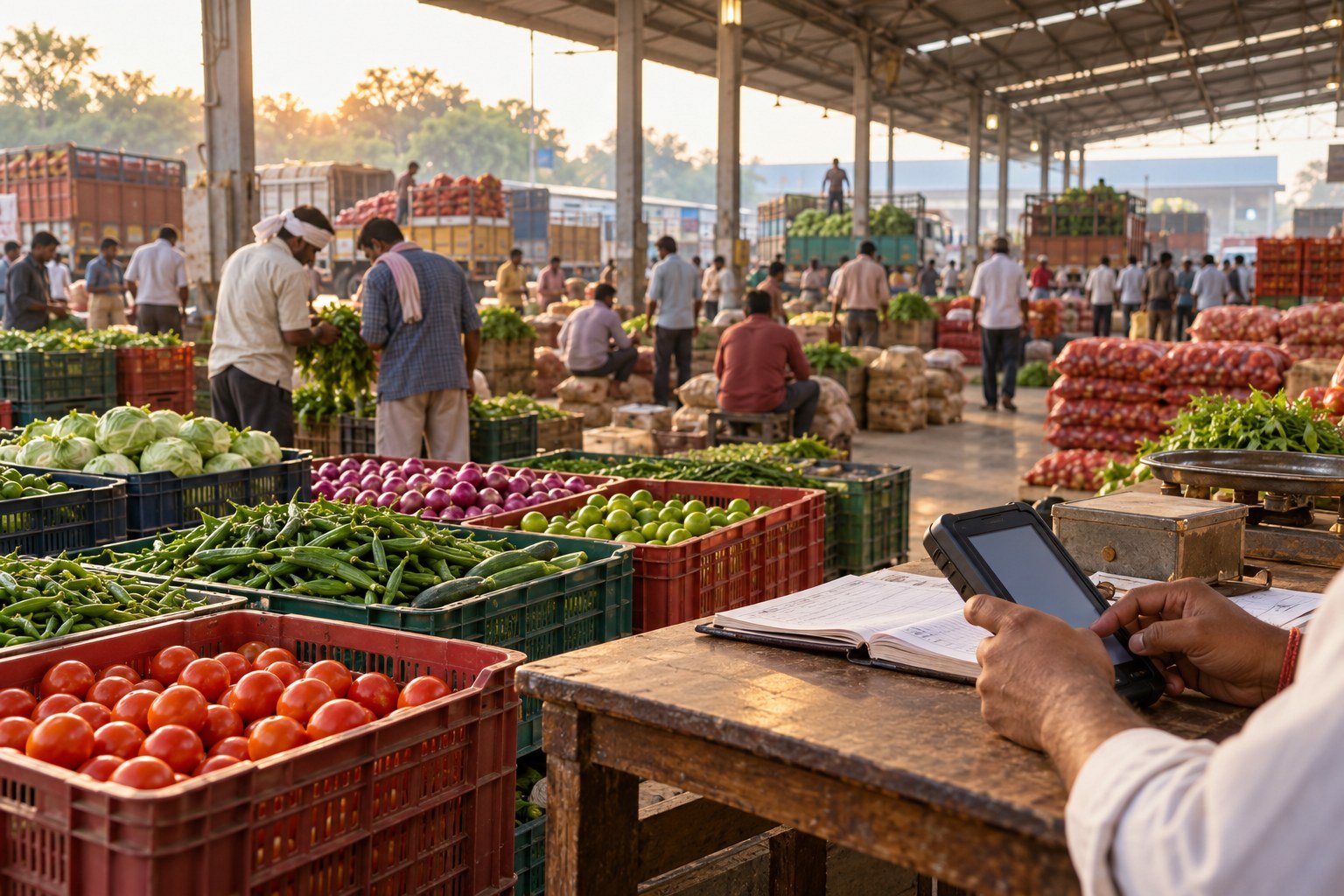
Agricultural marketing is a State subject: each State's APMC Act regulates wholesale farm trade through notified mandis. The Centre's Model APLM Act, 2017 offers States one unified market with private yards and direct marketing, while e-NAM links mandis online. A PIB backgrounder of 13 April 2026 counted 1,656 mandis on e-NAM.
Syllabus: GS2 · Federalism & Local Government; GS3 · Agriculture & Irrigation; GS3 · MSP, Subsidies & Food Security
Why this matters for UPSC
Agricultural marketing is GS3 on storage, transport and marketing of farm produce. Prelims asks about e-NAM, the Model APLM Act and Entry 28 of the State List; Mains asks why APMC mandis need reform.
In short
Agricultural marketing moves produce from farm to buyer. As markets and fairs are Entry 28 of the State List, States regulate it through APMC Acts and notified mandis.
Mandi reform should widen farmers' choice of buyers while keeping mandis funded and States on board; consent and infrastructure will set its pace.
Why it matters
A wheat grower who can sell only to the few licensed traders of the nearest mandi has little power over the price; if those traders act together, the grower takes what is offered or carries the crop home. Opening more buyers to the same lot, online or through private yards, gives the farmer a real choice and a better chance at a fair price, paid straight into a bank account. The same reforms worry States that fund mandis, roads and storage from market fees, and farmers who see the mandi as the backbone of assured procurement. The larger question is how far a State subject can be reformed from the Centre without breaking trust.
Prelims pointers
- Seventh Schedule, State List: Entry 28 is 'Markets and fairs'; Entry 66 lets States levy fees on State List matters, except fees taken in any court.
- Model APLM Act, 2017: covers livestock, poultry, fisheries, fruits and vegetables besides field crops; provides for a Market Yard of National Importance (MNI).
- e-NAM design: one trader licence valid across a State, single point levy of market fee on the first wholesale purchase, and assaying in every market.
- Electronic Negotiable Warehouse Receipt: issued under the Warehousing (Development and Regulation) Act, 2007 for goods in WDRA-accredited warehouses; usable as loan collateral.
- Agri-Market Infrastructure Fund: subsidised loans to State and UT governments through NABARD; GrAMs' basic infrastructure is built with MGNREGA and other schemes.
- Minimum Support Price: fixed for 22 mandated crops on the Commission for Agricultural Costs and Prices' recommendations; PM-AASHA covers pulses, oilseeds and copra.
- Model Contract Farming Act, 2018: released by the Agriculture Ministry for States and UTs; covers the chain from pre-production to post-harvest marketing.
Practise a UPSC-style question
With reference to the Model Agricultural Produce and Livestock Marketing (Promotion & Facilitation) Act, 2017, consider the following statements:
1. It provides for declaring the whole State or Union Territory as a single unified market area.
2. It provides for a separate trading licence for each market yard within a State.
3. It allows private market yards and farmer-consumer market yards besides government-run market yards.
Which of the statements given above is/are correct?
- (a) 1 and 2 only
- (b) 2 and 3 only
- (c) 1 and 3 only
- (d) 1, 2 and 3
Show the answer
Answer: (c) 1 and 3 only
Answer: (c) 1 and 3 only. The Model Act unifies the State market and opens it to private and farmer-consumer yards.
Statement 1: correct. Section 4 of the Model APLM Act, 2017 declares the whole State or UT one unified market area.
Statement 2: incorrect. The Model Act provides a unified single trading licence valid across the State, not one licence per yard.
Statement 3: correct. It provides for private market yards and farmer-consumer market yards alongside the committee's yards.
Eliminate: statement 2 contradicts the Act's unified single trading licence. Out: (a), (b), (d).
Trap: Reversed direction. The old APMC practice of yard-by-yard licences is pinned on the Act that was written to end it.
Remember: Model APLM Act, 2017 = one State market, one trader licence, private and farmer-consumer yards.
More Explainers
- Who is an accredited journalist? PIB rules, Press Council, PRP Act Polity
- Financial Stability and Development Council: who sits on it, what it does Economy
- NATO: its 32 members, Articles 4 and 5, and the eastern flank World & IR
- Special Executive Magistrates under BNSS section 15: appointment and powers Polity
- Indo-Pacific Oceans Initiative (IPOI): India's seven-pillar plan for the Indo-Pacific World & IR
- Gig and platform workers under the Code on Social Security, 2020 Economy
- Bureau of Indian Standards Act, 2016: Standard Mark, QCOs and hallmarking Economy
- Kittur revolt of 1824: early resistance to the East India Company National
- Polio eradication: wild and vaccine-derived poliovirus, OPV and IPV, India's certification Sci-Tech
- International law and the UN Charter: sources, force and the ICJ World & IR
- Himalayan earthquakes and India's seismic zone map Environment
- Amur falcon: migration, protection and community conservation Environment