
Supreme Court's Central Empowered Committee seeks river sand phase-out, dam desilting
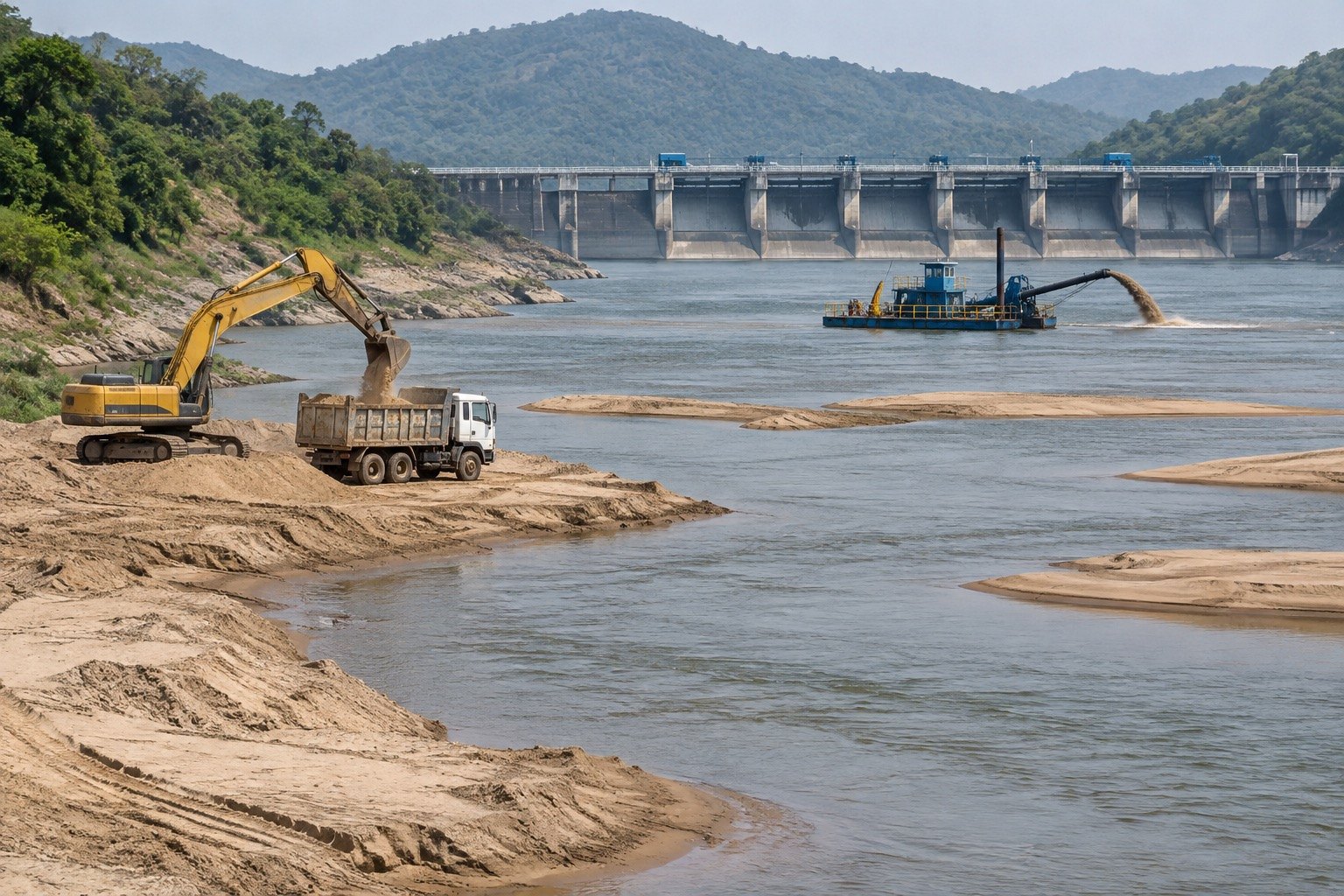
The Supreme Court's Central Empowered Committee (CEC) wants India to phase out unsustainable sand mining in active river channels within three years. Its November 2026 report came in the suo motu case on illegal mining in the National Chambal Sanctuary. It proposes dam desilting and manufactured sand to meet building demand. The court has yet to act on it.
Syllabus: GS2 · Federalism & Local Government; Prelims · Environment & Ecology; GS1 · Resources & Industry Location
Why this matters for UPSC
GS3 environment: river sand mining, dam sedimentation and minor minerals. Prelims can ask about the CEC, M-sand and the Chambal Sanctuary; Mains, sustainable sand supply.
Why it matters
A builder in a growing town needs river sand for concrete, while villagers downstream need a riverbed that is not dug out faster than floods refill it. When bans choke legal supply, illegal mining fills the gap, eroding banks, threatening bridges and destroying habitats such as the gharial's in the Chambal. Taking sand out of silted reservoirs could ease both problems at once: dams would hold more water, and builders would get a lawful source. Tracking each load from permit to site would make theft harder to hide. The open question is scale and cost, because nobody yet knows how much usable sand the reservoirs hold.
Prelims pointers
- The Mines and Minerals (Development and Regulation) Act, 1957 empowers State governments to make rules preventing illegal mining, transport and storage of minerals.
- MoEFCC's Sustainable Sand Mining Management Guidelines, 2016 tie extraction to a river's replenishment rate and prefer abandoned channels and inactive floodplains over active channels.
- Under the 2016 guidelines, desilting of reservoirs and dredging to maintain structures are not treated as mining for environmental clearance.
- MoEFCC's Enforcement and Monitoring Guidelines for Sand Mining, 2020 provide for replenishment studies, drones, GPS-fitted vehicles, CCTV weighbridges and electronic transit permits.
- The gharial and the crocodile are listed in Schedule I of the Wild Life (Protection) Act, 1972, the highest degree of protection.
- The Central Empowered Committee reports to the Supreme Court and only recommends; the Central Water Commission is an attached office of the Ministry of Jal Shakti.
Practise a UPSC-style question
With reference to sand mining in India, consider the following statements:
1. River sand is classified as a minor mineral, and its mining is regulated by State governments.
2. Sand and water are both subjects placed in the Union List of the Constitution.
3. The Mines and Minerals (Development and Regulation) Act, 1957 lets State governments make rules to prevent illegal mining.
Which of the statements given above is/are correct?
- (a) 1 and 2 only
- (b) 2 and 3 only
- (c) 1 and 3 only
- (d) 1, 2 and 3
Show the answer
Answer: (c) 1 and 3 only
Answer: (c) 1 and 3 only. Sand is a minor mineral run by States; sand and water are State subjects, not Union subjects.
Statement 1: correct. Sand is a minor mineral, and the States frame and enforce the rules for mining it.
Statement 2: incorrect. Sand, as a minor mineral, and water are State subjects, which is why the States regulate sand mining.
Statement 3: correct. The Mines and Minerals (Development and Regulation) Act, 1957 empowers State governments to make rules against illegal mining, transport and storage of minerals.
Eliminate: statement 2 is the surest to judge, since sand and water are State subjects. Out: (a), (b), (d).
Trap: Wrong scope. Statement 2 moves a State subject into the Union List, betting that a national debate on sand suggests central control.
Remember: Sand is a minor mineral and a State subject; the 1957 mining law lets States make anti-illegal-mining rules.
More from the 12 November 2026 edition
- Swachh Survekshan 2025-26 awards: 4,751 cities assessed, Swachh Shehar Jodi added National
- MHA trims visa categories to nine; Tourist Visa becomes Visitor Visa National
- First BIMSTEC Health Ministers' Meeting adopts regional public health action plan World & IR
- Finance Ministry makes electric vehicles the default for central staff cars Environment
- Cabinet approves Yuge Yugeen Bharat Museum in North and South Blocks National
- Cabinet extends Stand-Up India and Mudra guarantee fund to 2031 Economy
- Cabinet approves Nutrient Based Subsidy rates for Rabi 2026-27: Rs 62,370 crore National
- DGFT prohibits export of lithium-ion battery black mass Economy
- DGTR opens suo motu anti-dumping probe into aluminium extrusion imports Economy
- Downstream alliance sets 10-day deadline for Dibang dam safeguards Environment
- M. John Harrison wins Booker Prize 2026, its oldest winner at 81 Miscellany
- Centre extends PLI scheme for medical devices to 2035-36, invites applications Economy