
Swachh Survekshan 2025-26 awards: 4,751 cities assessed, Swachh Shehar Jodi added
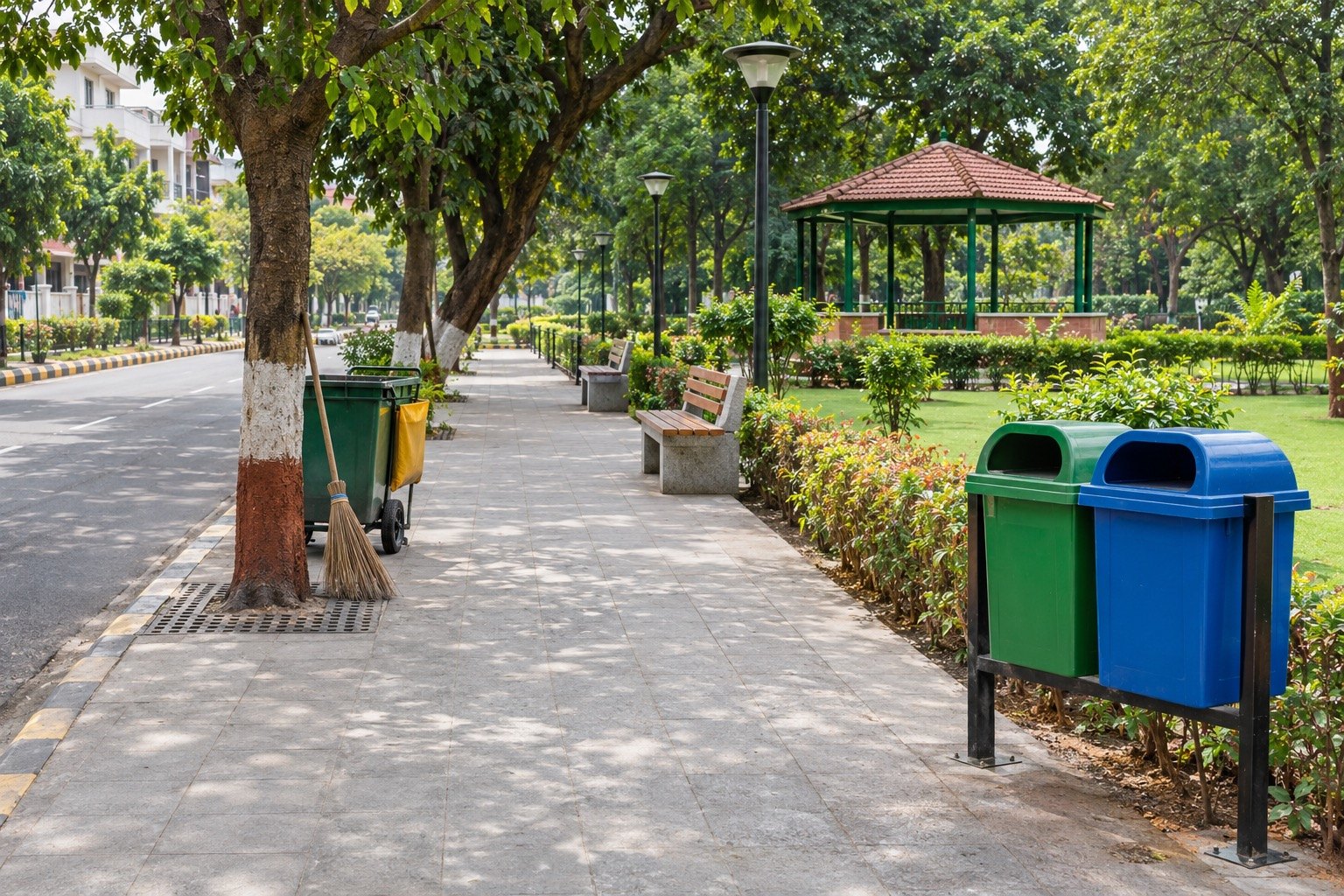
President Droupadi Murmu presented the Swachh Survekshan 2025-26 awards on 11 November 2026. The tenth round of the Housing and Urban Affairs Ministry's survey covered 4,751 cities on 43 indicators, by the ministry's count. A new Swachh Shehar Jodi award ranked mentor and mentee cities on their joint score. Navi Mumbai, Surat and Vijayawada led the Super Swachh League.
Syllabus: Prelims · Current Affairs & IR; GS1 · Women, Population & Urbanisation; GS2 · Government Policies
Why this matters for UPSC
GS2 governance and GS3 environment: urban sanitation and solid waste management. Prelims can ask about Swachh Survekshan and SBM-U 2.0; Mains, ranking as a tool for municipal performance.
Why it matters
A household in a small municipality gains when its council is judged on whether waste is picked up at the door, sorted and processed, and not dumped at the town's edge. Because citizens' own feedback and field checks count, a council cannot win on paperwork alone; overstated claims cost marks. The pairing of a strong city with a weak one lets a struggling town copy methods that already work next door. Scoring the welfare of sanitation workers and the use of machines for emptying septic tanks pushes councils toward safer work. The larger issue is whether ranking and public comparison can lift the capacity of local governments that run India's cities.
Prelims pointers
- MoHUA began Swachh Survekshan in 2016 to evaluate and encourage improvement in urban sanitation; ULBs are ranked within population categories.
- In the 2025-26 toolkit, certifications carry 2,000 of 12,500 marks: 1,000 for ODF, ODF+, ODF++ and Water+, and 1,000 for Garbage Free Cities.
- SBM-U 2.0 aims at garbage-free cities; AMRUT 2.0, launched alongside it, aims at water-secure cities with universal water supply in about 4,800 statutory towns.
- Swachh Survekshan ranks cities under SBM-U, while Pey Jal Survekshan is the competition among cities on water under AMRUT 2.0.
- Under SBM-U 2.0, used water and faecal sludge are to be safely contained, transported, processed and disposed of in cities with under one lakh population.
- SBM-U 2.0 also seeks a phased reduction in the use of single-use plastic.
Practise a UPSC-style question
With reference to Swachh Survekshan, consider the following statements:
1. The Ministry of Housing and Urban Affairs began the survey in 2016 to evaluate urban sanitation.
2. Urban local bodies compete within categories based on their population.
Which of the statements given above is/are correct?
- (a) 1 only
- (b) 2 only
- (c) Both 1 and 2
- (d) Neither 1 nor 2
Show the answer
Answer: (c) Both 1 and 2
Answer: (c) Both 1 and 2. The survey is a MoHUA tool from 2016 and groups ULBs by population.
Statement 1: correct. The 2025-26 toolkit says MoHUA initiated Swachh Survekshan in 2016; its first round covered 73 cities.
Statement 2: correct. ULBs compete within five population categories, from under 20,000 people to over 10 lakh.
Eliminate: statement 1 is correct, since the survey sits with MoHUA, the ministry for urban missions. Out: (b), (d).
Eliminate: statement 2 is correct, since awards are given in population categories. Out: (a).
Trap: Swapped attribution. A cleanliness survey tempts a student to credit it to a ministry other than MoHUA, which runs the urban missions.
Remember: Swachh Survekshan is MoHUA's survey, started in 2016.
More from the 12 November 2026 edition
- MHA trims visa categories to nine; Tourist Visa becomes Visitor Visa National
- First BIMSTEC Health Ministers' Meeting adopts regional public health action plan World & IR
- Finance Ministry makes electric vehicles the default for central staff cars Environment
- Cabinet approves Yuge Yugeen Bharat Museum in North and South Blocks National
- Cabinet extends Stand-Up India and Mudra guarantee fund to 2031 Economy
- Cabinet approves Nutrient Based Subsidy rates for Rabi 2026-27: Rs 62,370 crore National
- DGFT prohibits export of lithium-ion battery black mass Economy
- DGTR opens suo motu anti-dumping probe into aluminium extrusion imports Economy
- Downstream alliance sets 10-day deadline for Dibang dam safeguards Environment
- M. John Harrison wins Booker Prize 2026, its oldest winner at 81 Miscellany
- Centre extends PLI scheme for medical devices to 2035-36, invites applications Economy
- Supreme Court's Central Empowered Committee seeks river sand phase-out, dam desilting Environment