
DGFT prohibits export of lithium-ion battery black mass
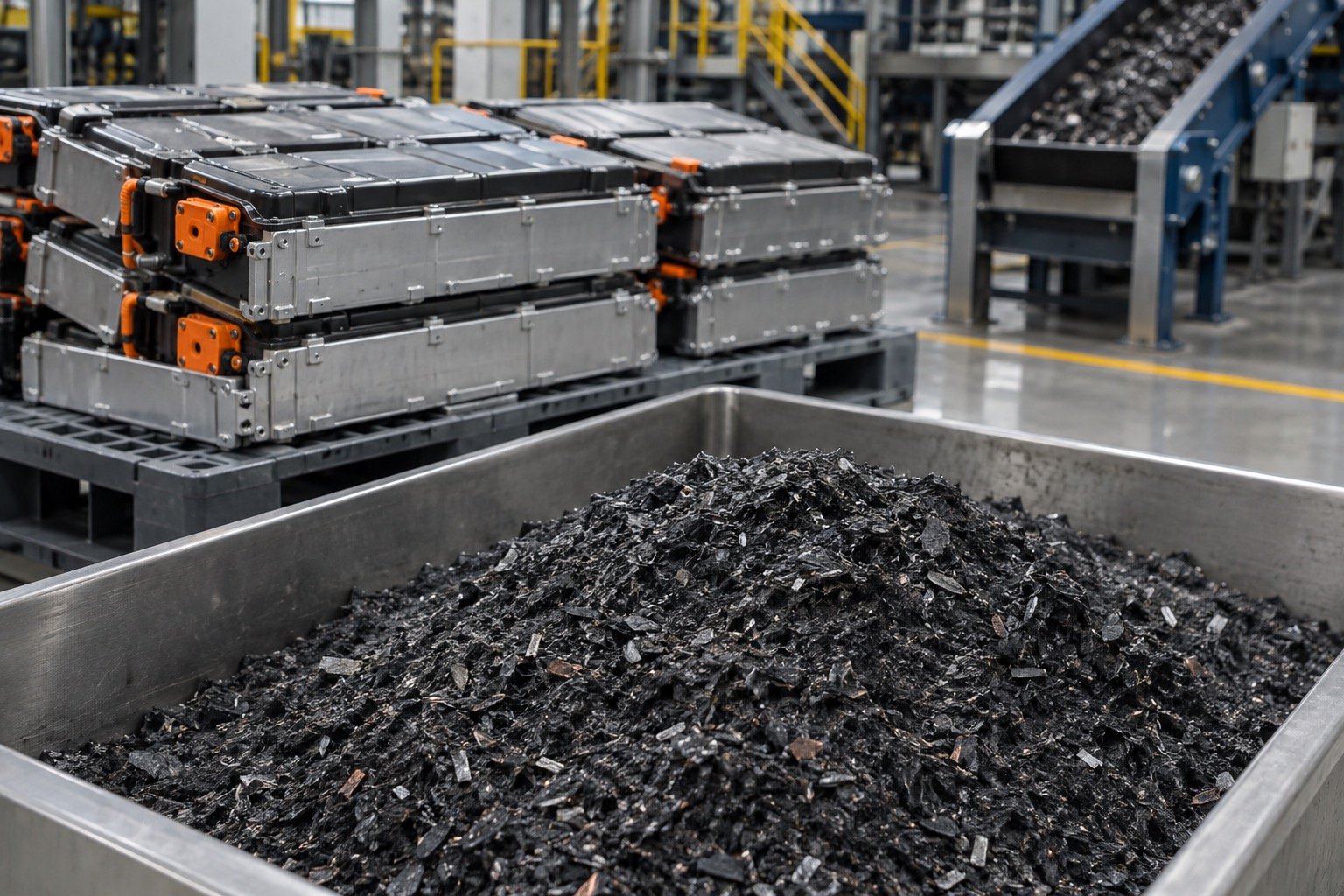
The Directorate General of Foreign Trade (DGFT) on 10 November 2026 moved the export of unsorted lithium-ion battery waste and scrap, called black mass, from 'Free' to 'Prohibited'. The ban took effect at once and stays until further orders. The Department of Commerce acted under the Foreign Trade (Development and Regulation) Act, 1992.
Syllabus: GS3 · Indian Economy & Growth; GS2 · Government Policies; GS3 · Environment & Conservation
Why this matters for UPSC
GS3 economy and environment: export policy and battery recycling. Prelims can ask about the 1992 trade Act, EPR and black mass; Mains, critical mineral security.
Why it matters
A battery recycler in India can no longer be outbid by buyers abroad for unsorted black mass, because the powder may not leave the country. The lithium, cobalt and nickel in it stay at home, where they can be refined into inputs for new batteries. A trader who shipped black mass overseas loses that market overnight and must sell to Indian processors instead. The government's critical mineral mission seeks a supply chain that is harder to disrupt, and its recycling scheme counts battery scrap as a source of these minerals. Old batteries thus become a second mine, the idea behind a circular economy, in which waste is recovered and put back to use.
Prelims pointers
- The Foreign Trade (Development and Regulation) Act, 1992 lets the Centre, by Order, prohibit, restrict or otherwise regulate imports and exports in all or specified classes of cases.
- Goods covered by an Order under the 1992 Act are deemed prohibited goods under the Customs Act, 1962, so customs law enforces the curb.
- The 1992 Act lets the Centre formulate, announce and amend the export and import policy by notification in the Official Gazette.
- Orders made under the Imports and Exports (Control) Act, 1947 continue under the 1992 Act where they are consistent with it.
- The Battery Waste Management Rules, 2022 replaced the Batteries (Management and Handling) Rules, 2001 and cover electric vehicle, portable, automotive and industrial batteries.
- EPR under the battery rules is an environment-ministry duty on producers to collect and recycle; an export prohibition under the 1992 Act is a Commerce Department curb at the border.
- The NCMM recycling scheme runs from 2025-26 to 2030-31; its feedstock is e-waste, lithium-ion battery scrap and scrap such as catalytic converters from end-of-life vehicles.
Practise a UPSC-style question
With reference to the change in India's export policy for lithium-ion battery black mass in November 2026, consider the following statements:
1. The change bars the export of every type of battery and battery-related material.
2. The export policy of unsorted lithium-ion battery black mass was moved from 'Free' to 'Prohibited'.
3. The notification was issued by the Directorate General of Foreign Trade under the Department of Commerce.
Which of the statements given above is/are correct?
- (a) 1 and 2 only
- (b) 2 and 3 only
- (c) 1 and 3 only
- (d) 1, 2 and 3
Show the answer
Answer: (b) 2 and 3 only
Answer: (b) 2 and 3 only. The change covers one class of unsorted battery scrap, and the DGFT issued it.
Statement 1: incorrect. The amendment applies to unsorted battery waste and scrap free of lead, cadmium and mercury; it is not a blanket ban on all batteries.
Statement 2: correct. The DGFT notification of 10 November 2026 amended the policy for this black mass from 'Free' to 'Prohibited', with immediate effect.
Statement 3: correct. The DGFT, under the Department of Commerce in the Ministry of Commerce and Industry, issued the notification.
Eliminate: Statement 1 is wrong in scope, so every option with 1 goes. Out: (a), (c), (d).
Trap: Wrong scope. A ban on one narrow class of battery scrap is stretched to cover every battery and battery material.
Remember: Unsorted black mass free of lead, cadmium and mercury moved to 'Prohibited'.
More from the 12 November 2026 edition
- Swachh Survekshan 2025-26 awards: 4,751 cities assessed, Swachh Shehar Jodi added National
- MHA trims visa categories to nine; Tourist Visa becomes Visitor Visa National
- First BIMSTEC Health Ministers' Meeting adopts regional public health action plan World & IR
- Finance Ministry makes electric vehicles the default for central staff cars Environment
- Cabinet approves Yuge Yugeen Bharat Museum in North and South Blocks National
- Cabinet extends Stand-Up India and Mudra guarantee fund to 2031 Economy
- Cabinet approves Nutrient Based Subsidy rates for Rabi 2026-27: Rs 62,370 crore National
- DGTR opens suo motu anti-dumping probe into aluminium extrusion imports Economy
- Downstream alliance sets 10-day deadline for Dibang dam safeguards Environment
- M. John Harrison wins Booker Prize 2026, its oldest winner at 81 Miscellany
- Centre extends PLI scheme for medical devices to 2035-36, invites applications Economy
- Supreme Court's Central Empowered Committee seeks river sand phase-out, dam desilting Environment