
Downstream alliance sets 10-day deadline for Dibang dam safeguards
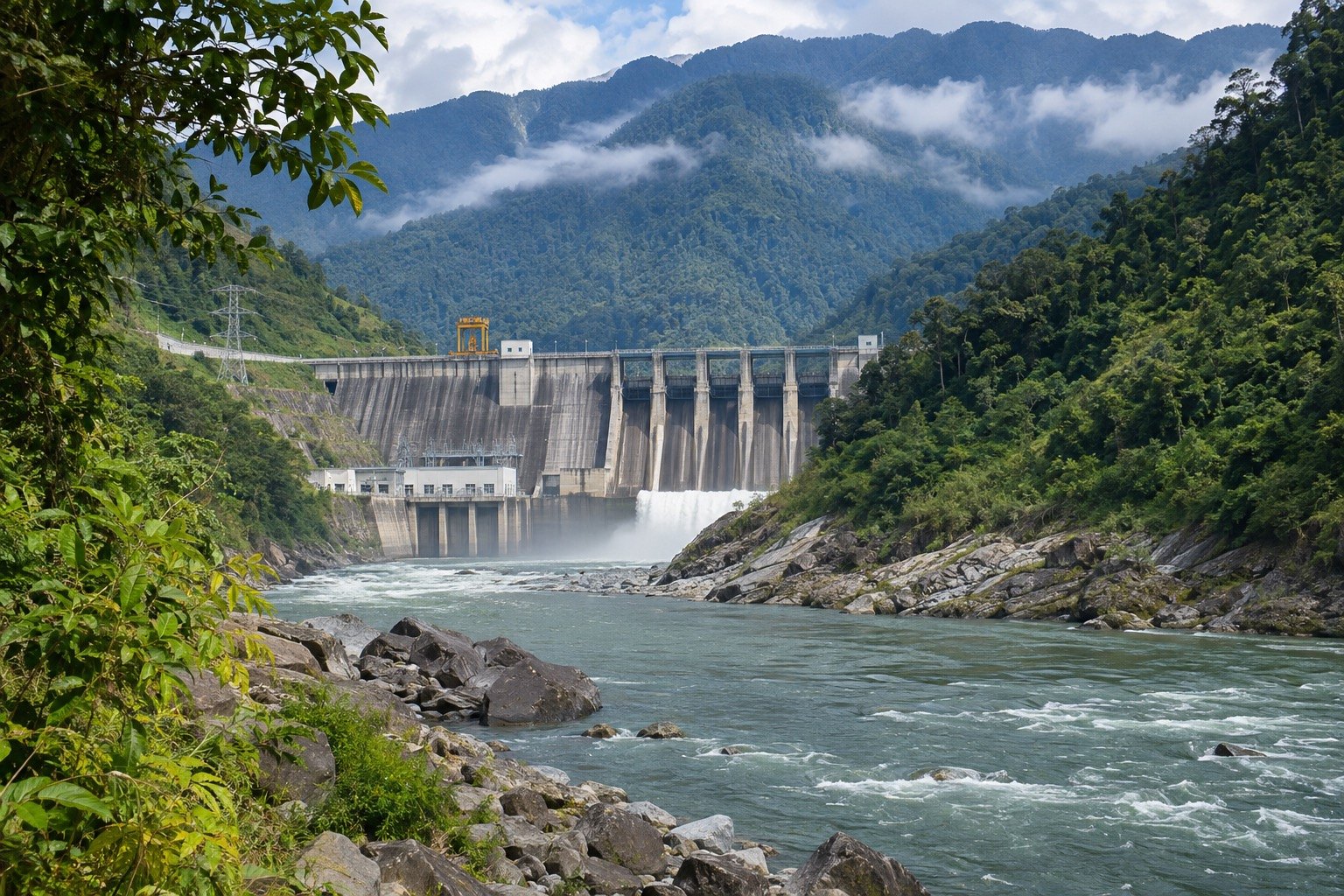
The Dibang Dam Assam-Arunachal Downstream Action Alliance on 9 November 2026 gave Assam and Arunachal Pradesh 10 days to act on the 2,880 MW Dibang Multipurpose Project. It seeks rehabilitation, public hearings and flood-protection works for people below the dam. It has threatened to stop construction material reaching the site.
Syllabus: Prelims · Geography; GS3 · Infrastructure; GS1 · Geophysical Phenomena
Why this matters for UPSC
GS3 infrastructure and disaster management: big dams and flood moderation in the Brahmaputra basin. Prelims can ask the Brahmaputra's tributaries and storage projects; Mains, downstream safeguards.
Why it matters
A farming family in Tinsukia or Dibrugarh lives with the river below a dam it had no say in. If the reservoir holds back monsoon peaks, that family's fields flood less often. If water is released suddenly, or the structure fails, the same family takes the first hit. Project Affected Family status would bring such households into compensation and rehabilitation, which today reach mainly those whose land the project takes. The quarrel belongs to a larger question across the North-East. How can big dams be built in a flood-prone basin while the people downstream get a voice, a share of the benefits and protection from the risks?
Prelims pointers
- The Brahmaputra rises in the Kailash ranges and flows about 2,900 km through Tibet (China), India and Bangladesh before joining the Ganga, per the Central Water Commission.
- The Central Water Commission lists the Dibang, Lohit, Subansiri, Manas, Tista, Dhansiri and Champamati as the Brahmaputra's principal tributaries in India.
- The Brahmaputra sub-basin's hydropower potential is assessed at 31,012 MW at 60% load factor, almost 37% of India's total, per the Central Water Commission.
- A storage project keeps a large reservoir and can moderate floods; a run-of-river project keeps little storage and passes the river's flow through its turbines.
- Forest land for a project is cleared in two stages: Stage-I, then Stage-II after payments such as Net Present Value and Compensatory Afforestation are made.
Practise a UPSC-style question
With reference to the Brahmaputra river system, consider the following statements:
1. The Dibang is listed by the Central Water Commission among the principal tributaries of the Brahmaputra in India.
2. The Manas and the Dhansiri are also listed among the Brahmaputra's principal tributaries in India.
3. The Brahmaputra sub-basin holds about one-tenth of India's assessed hydropower potential.
Which of the statements given above is/are correct?
- (a) 1 and 2 only
- (b) 2 and 3 only
- (c) 1 and 3 only
- (d) 1, 2 and 3
Show the answer
Answer: (a) 1 and 2 only
Answer: (a) 1 and 2 only. Both tributary statements hold; the hydropower share is far larger than one-tenth.
Statement 1: correct. The Central Water Commission names the Dibang, Lohit, Subansiri, Manas, Tista, Dhansiri and Champamati as principal Indian tributaries.
Statement 2: correct. The Manas and the Dhansiri both stand in the Central Water Commission's list of principal tributaries in India.
Statement 3: incorrect. The sub-basin's potential is 31,012 MW at 60% load factor, almost 37% of the country's total, per the Central Water Commission.
Eliminate: statement 3 is false, so every option carrying 3 goes. Out: (b), (c), (d).
Trap: Near-miss figure. A small share sounds plausible for one basin, but the Brahmaputra sub-basin holds over a third of India's hydropower potential.
Remember: Brahmaputra sub-basin: about 37% of India's hydropower potential.
More from the 12 November 2026 edition
- Swachh Survekshan 2025-26 awards: 4,751 cities assessed, Swachh Shehar Jodi added National
- MHA trims visa categories to nine; Tourist Visa becomes Visitor Visa National
- First BIMSTEC Health Ministers' Meeting adopts regional public health action plan World & IR
- Finance Ministry makes electric vehicles the default for central staff cars Environment
- Cabinet approves Yuge Yugeen Bharat Museum in North and South Blocks National
- Cabinet extends Stand-Up India and Mudra guarantee fund to 2031 Economy
- Cabinet approves Nutrient Based Subsidy rates for Rabi 2026-27: Rs 62,370 crore National
- DGFT prohibits export of lithium-ion battery black mass Economy
- DGTR opens suo motu anti-dumping probe into aluminium extrusion imports Economy
- M. John Harrison wins Booker Prize 2026, its oldest winner at 81 Miscellany
- Centre extends PLI scheme for medical devices to 2035-36, invites applications Economy
- Supreme Court's Central Empowered Committee seeks river sand phase-out, dam desilting Environment