
Finance Ministry makes electric vehicles the default for central staff cars
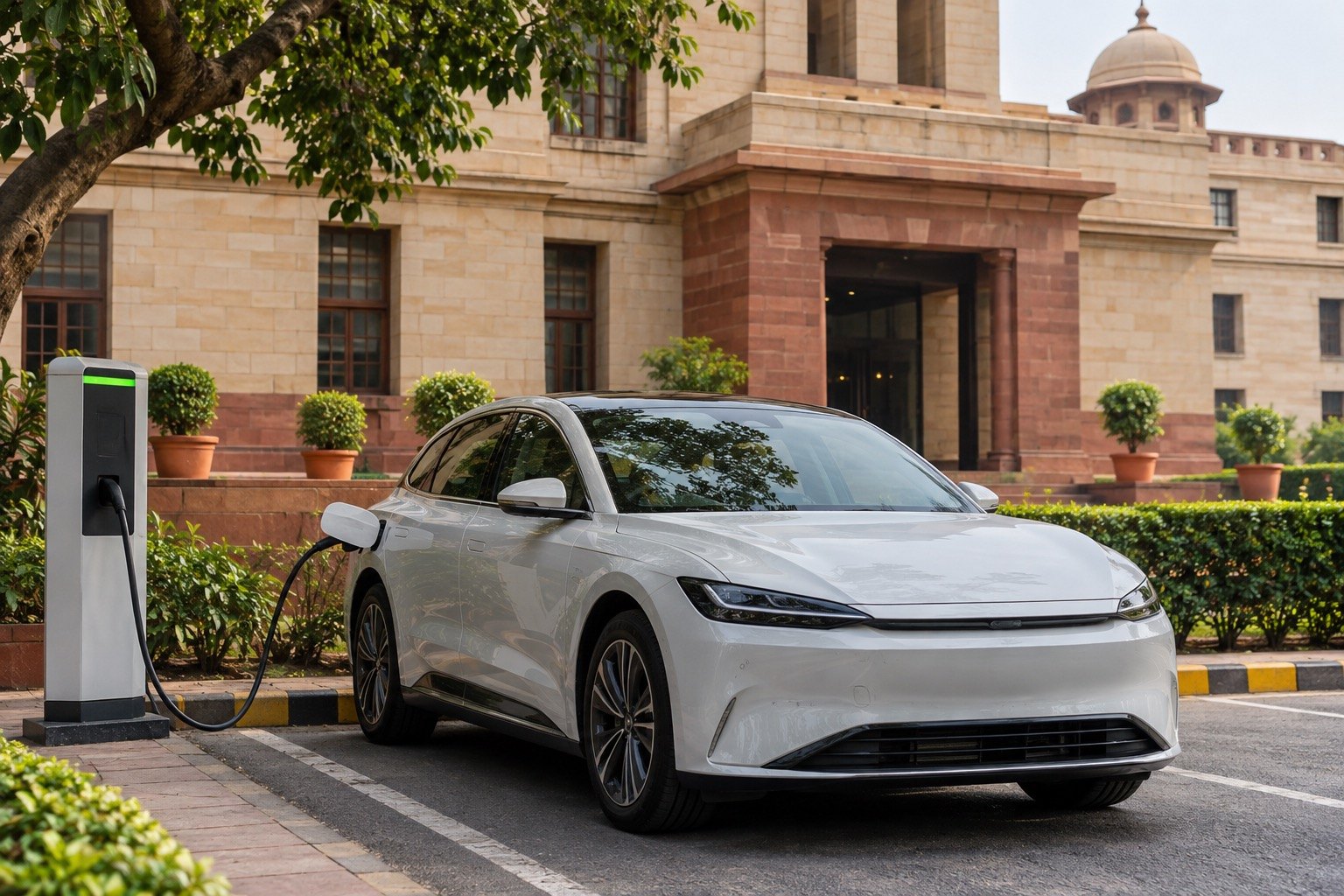
The Department of Expenditure has made electric vehicles (EVs) the default choice for central ministries' staff cars. Under its office memorandum of 10 November 2026, ministries are to buy EVs when they replace petrol or diesel cars. The Net Dealer Price ceiling, Rs 6 lakh since 2022, rises to Rs 20 lakh for EVs. Other cars get Rs 10 lakh.
Syllabus: Prelims · Environment & Ecology; GS3 · Infrastructure; GS2 · Government Policies
Why this matters for UPSC
GS3 environment and infrastructure: e-mobility and green public procurement. Prelims can ask PM E-DRIVE's ministry, outlay and parts; Mains, government demand as a lever for clean transport.
Why it matters
A ministry official replacing an ageing official car will now order an electric one unless a case for petrol or diesel is argued all the way up to the Department of Expenditure. Repeated across ministries and their offices, that turns the government into a regular EV customer, giving carmakers and charging providers a buyer they can plan around. The higher ceilings let officials pick from the cars actually on sale, and judging a car over its whole life counts the fuel and upkeep saved, not just the purchase bill. Fewer fuel-burning official cars also mean less petrol and diesel burnt on city roads. The step adds the state's own purchasing to the subsidies already offered to private EV buyers.
Prelims pointers
- PM E-DRIVE is run by the Ministry of Heavy Industries; rules on buying staff cars for central ministries come from the Department of Expenditure, Ministry of Finance.
- PM E-DRIVE was notified on 29 September 2024 for two years with Rs 10,900 crore; in 2025 it was extended to 31 March 2028 with no rise in outlay.
- PM E-DRIVE is fund-limited: once its outlay or a component's share is spent before the end date, that part closes to new claims.
- Buyers under PM E-DRIVE claim the demand incentive through an Aadhaar-authenticated e-voucher generated on the scheme portal at purchase.
- Under PM E-DRIVE, CESL aggregates demand for e-buses in nine cities above 40 lakh population; e-truck incentives require a scrapping certificate from an approved centre.
- The Department of Expenditure's 2022 staff-car compendium was a master office memorandum that consolidated and superseded all earlier staff-car instructions.
Practise a UPSC-style question
With reference to the Centre's revised instructions on staff cars for its ministries, consider the following statements:
1. Electric vehicles are to be the default choice when an existing petrol or diesel staff car is replaced.
2. Hybrid cars are treated as electric vehicles for the purpose of the purchase price ceiling.
3. Buying an internal combustion engine staff car needs case-by-case relaxation from the Department of Expenditure.
Which of the statements given above is/are correct?
- (a) 1 and 2 only
- (b) 2 and 3 only
- (c) 1 and 3 only
- (d) 1, 2 and 3
Show the answer
Answer: (c) 1 and 3 only
Answer: (c) 1 and 3 only. EVs are the default; hybrids are grouped with ICE cars, not EVs.
Statement 1: correct. The Department of Expenditure's office memorandum of 10 November 2026 makes EVs the default and preferred choice when ICE staff cars are condemned or replaced.
Statement 2: incorrect. The order places hybrids with petrol and diesel vehicles under the ICE ceiling of Rs 10 lakh; the EV ceiling is Rs 20 lakh.
Statement 3: correct. A ministry wanting an ICE car sends a justified proposal to the Department of Expenditure, which relaxes the rule case by case.
Eliminate: Statement 2 is wrong, so every option carrying it goes. Out: (a), (b), (d).
Trap: Look-alike names. A hybrid has an electric motor, so it sounds like an EV, but the order counts it as an internal combustion engine vehicle.
Remember: Hybrids fall under the ICE cap, not the EV cap.
More from the 12 November 2026 edition
- Swachh Survekshan 2025-26 awards: 4,751 cities assessed, Swachh Shehar Jodi added National
- MHA trims visa categories to nine; Tourist Visa becomes Visitor Visa National
- First BIMSTEC Health Ministers' Meeting adopts regional public health action plan World & IR
- Cabinet approves Yuge Yugeen Bharat Museum in North and South Blocks National
- Cabinet extends Stand-Up India and Mudra guarantee fund to 2031 Economy
- Cabinet approves Nutrient Based Subsidy rates for Rabi 2026-27: Rs 62,370 crore National
- DGFT prohibits export of lithium-ion battery black mass Economy
- DGTR opens suo motu anti-dumping probe into aluminium extrusion imports Economy
- Downstream alliance sets 10-day deadline for Dibang dam safeguards Environment
- M. John Harrison wins Booker Prize 2026, its oldest winner at 81 Miscellany
- Centre extends PLI scheme for medical devices to 2035-36, invites applications Economy
- Supreme Court's Central Empowered Committee seeks river sand phase-out, dam desilting Environment