
Global Carbon Project releases Global Carbon Budget 2026 at COP31
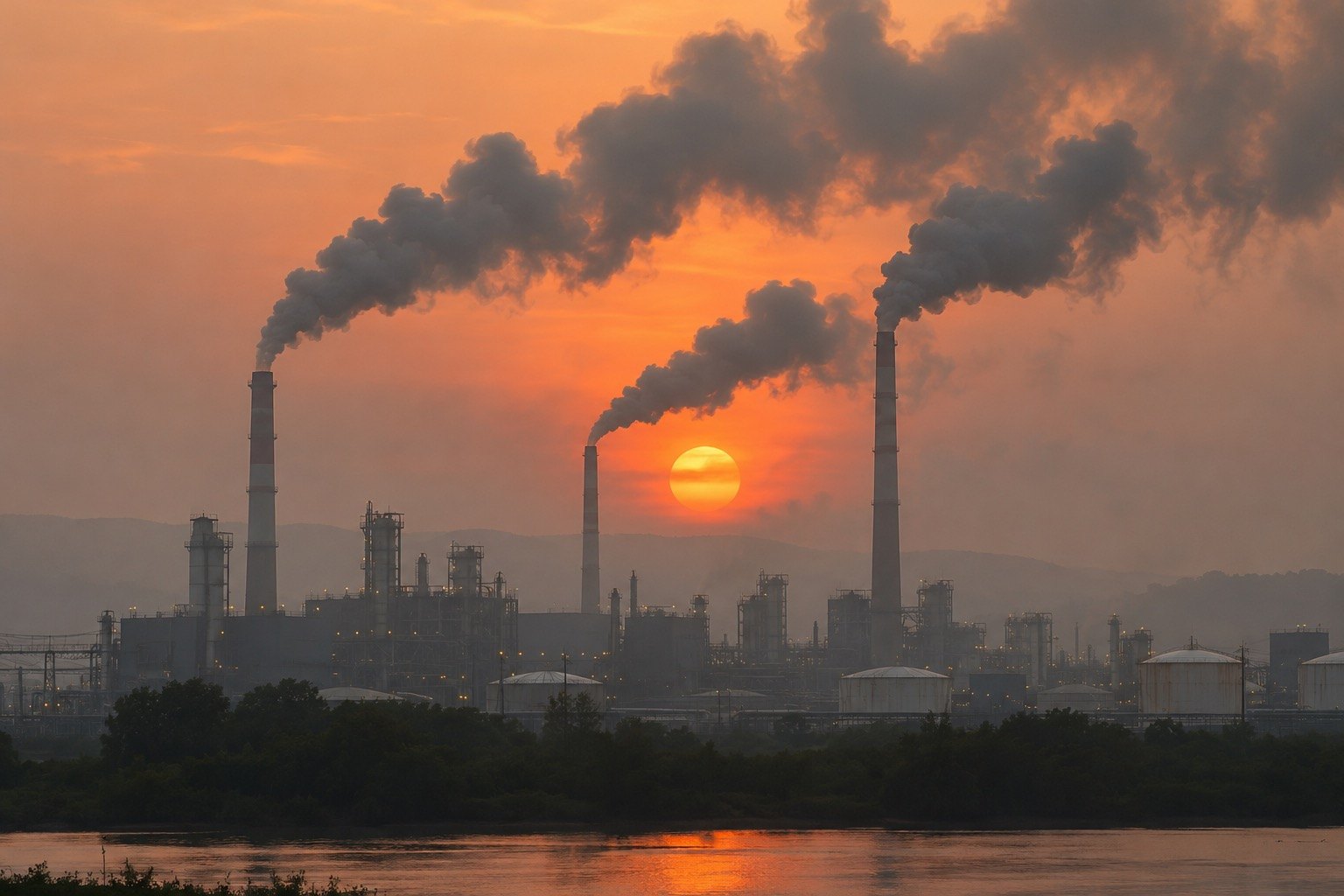
The Global Carbon Project released the Global Carbon Budget 2026, its 21st annual edition, at the COP31 climate conference in Antalya, Turkey, on 10 November 2026. It projects global fossil CO2 emissions at 38.2 billion tonnes, 0.4% below 2025. India's emissions are projected to rise 4.4%, while China, the US, the EU and Japan decline.
Syllabus: Prelims · Current Affairs & IR; Prelims · Environment & Ecology; GS3 · Environment & Conservation
Why this matters for UPSC
GS3 environment: the global carbon cycle, carbon sinks and climate change. Prelims can ask who publishes the Global Carbon Budget and its parts; Mains, India's emissions path.
Why it matters
For a family in an Indian city, a hotter and drier season means running fans and air-conditioners for longer, and India's coal emissions are rising strongly to meet such demand. That is why India's emissions are climbing while most large economies are cutting theirs. The room left to hold warming near the Paris Agreement goal is almost used up, so every extra tonne now counts. India will face sharper questions at climate talks about how fast it shifts to clean power. Its answer will shape how much coal its power plants burn and how quickly cleaner electricity reaches homes and factories.
Prelims pointers
- The Global Carbon Budget is the Global Carbon Project's report; the State of the Climate report is an annual publication of the World Meteorological Organization.
- The global carbon budget has five components: fossil CO2 emissions, land-use change emissions, atmospheric CO2 growth, the ocean sink and the land sink.
- The Global Carbon Budget measures warming against the 1850-1900 level and takes pre-industrial atmospheric CO2 as about 278 ppm, the 1750 level.
- The 1.5°C limit on warming above pre-industrial levels is a target set in the Paris Agreement, adopted under the UNFCCC.
- India's updated NDC (Cabinet, August 2022) targets a 45% cut in emissions intensity of GDP by 2030 from 2005 and about 50% non-fossil power capacity.
- India's 2015 NDC had targeted 33-35% lower emissions intensity, 40% non-fossil capacity and an extra carbon sink of 2.5-3 billion tonnes CO2 equivalent by 2030.
- India's long-term goal is net-zero by 2070; the updated NDC turns the 'Panchamrit' announced at COP26 in Glasgow into targets.
Practise a UPSC-style question
With reference to the Global Carbon Budget, consider the following statements:
1. It is prepared by Working Group I of the Intergovernmental Panel on Climate Change.
2. It is produced by the Global Carbon Project, a research partner of the World Climate Research Programme.
3. Its data are released as a living data collection in the journal Earth System Science Data.
Which of the statements given above is/are correct?
- (a) 1 and 2 only
- (b) 2 and 3 only
- (c) 1 and 3 only
- (d) 1, 2 and 3
Show the answer
Answer: (b) 2 and 3 only
Answer: (b) 2 and 3 only. The Global Carbon Project, not the IPCC, prepares the yearly budget.
Statement 1: incorrect. The Global Carbon Budget is the annual update of the Global Carbon Project, begun in 2006; the IPCC does not prepare it.
Statement 2: correct. The Global Carbon Project is a research project within the Future Earth initiative and a research partner of the World Climate Research Programme.
Statement 3: correct. The 2026 budget is the 15th edition whose data appear as a living data collection in Earth System Science Data.
Eliminate: statement 1 is false, so every option carrying 1 goes. Out: (a), (c), (d).
Trap: Swapped attribution. The IPCC is the best-known climate science body, so a student may credit it with every global climate assessment.
Remember: Global Carbon Budget: Global Carbon Project (Future Earth; WCRP partner), every year since 2006.
More from the 12 November 2026 edition
- Swachh Survekshan 2025-26 awards: 4,751 cities assessed, Swachh Shehar Jodi added National
- MHA trims visa categories to nine; Tourist Visa becomes Visitor Visa National
- First BIMSTEC Health Ministers' Meeting adopts regional public health action plan World & IR
- Finance Ministry makes electric vehicles the default for central staff cars Environment
- Cabinet approves Yuge Yugeen Bharat Museum in North and South Blocks National
- Cabinet extends Stand-Up India and Mudra guarantee fund to 2031 Economy
- Cabinet approves Nutrient Based Subsidy rates for Rabi 2026-27: Rs 62,370 crore National
- DGFT prohibits export of lithium-ion battery black mass Economy
- DGTR opens suo motu anti-dumping probe into aluminium extrusion imports Economy
- Downstream alliance sets 10-day deadline for Dibang dam safeguards Environment
- M. John Harrison wins Booker Prize 2026, its oldest winner at 81 Miscellany
- Centre extends PLI scheme for medical devices to 2035-36, invites applications Economy