
CAQM direction: buses entering Delhi must be BS-VI, CNG or electric
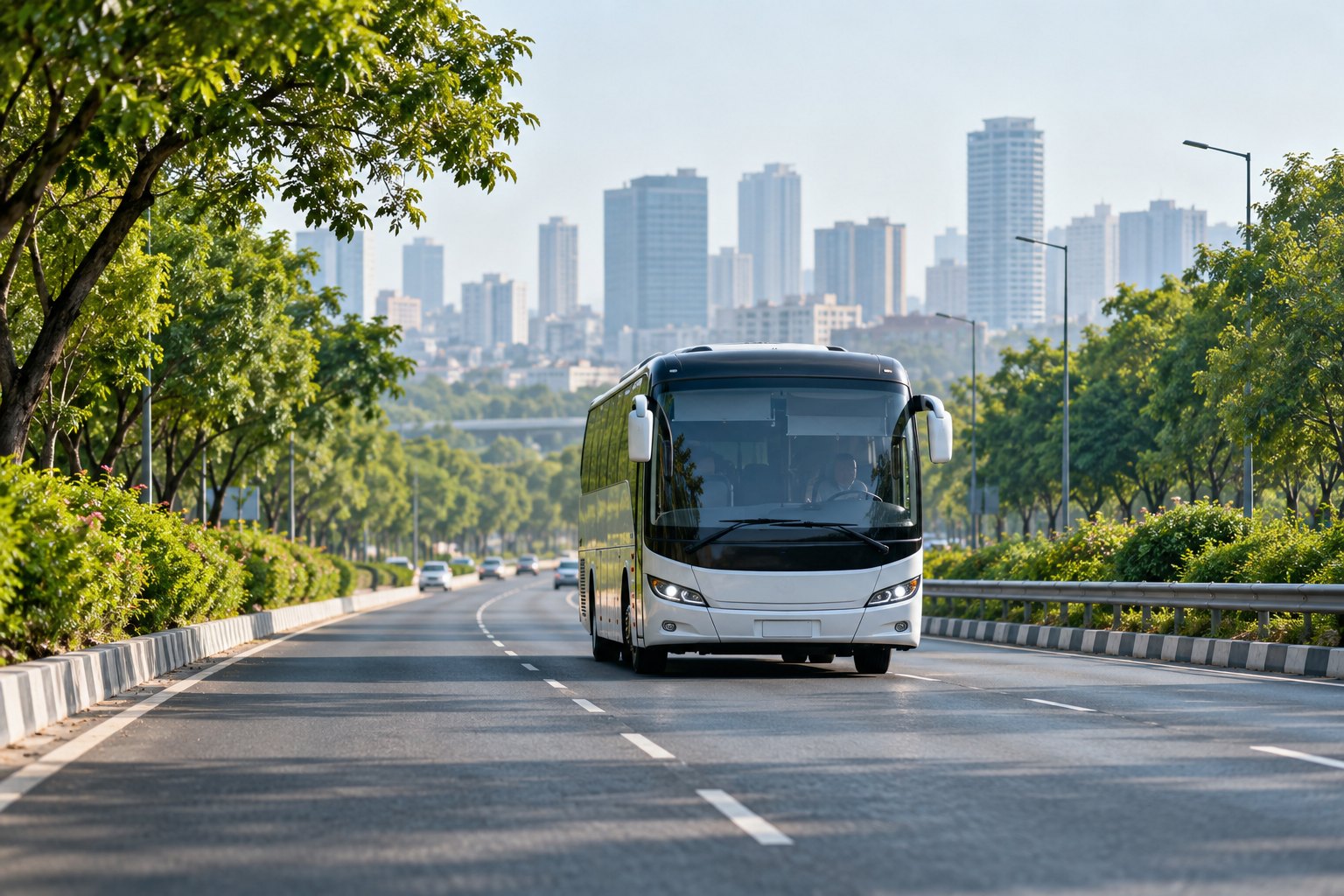
From 1 November 2026, buses entering Delhi on contract carriage, school bus, All India Tourist and similar permits must run on BS-VI diesel, CNG or electric power. The rule is Direction No. 93 of the Commission for Air Quality Management (CAQM). Buses registered in Delhi are exempt. Outside goods vehicles face a similar rule, Direction No. 88.
Syllabus: Prelims · Environment & Ecology; GS2 · Statutory & Regulatory Bodies; GS3 · Environment & Conservation
Why this matters for UPSC
GS3, environmental pollution and statutory bodies. Prelims can ask what Section 12 of the CAQM Act, 2021 empowers, how GRAP stages are invoked and when India moved to BS-VI; Mains, about curbing vehicular pollution across the NCR.
Why it matters
A tour operator in a neighbouring State who runs an older diesel coach can no longer drive it into Delhi from November. Passengers may have to switch to a cleaner bus at the border, and school trips and hired coaches from nearby towns face the same choice. For people living in Delhi, fewer old diesel engines on the roads in the smoggy months means less exhaust at street level, where children, older people and outdoor workers breathe it. The rule also tests whether a central commission's order can work through the city's own transport staff, cameras and tags at the border, without long queues or traffic slipping in by smaller roads.
Prelims pointers
- Directions under Section 12 of the CAQM Act, 2021 bind the Delhi government, NCR State governments, pollution control boards, urban local bodies and Central departments within their jurisdictions.
- GRAP stages are invoked by the CAQM's Sub-Committee on GRAP, often in advance on forecasts; curbs of earlier stages continue when a higher stage is invoked.
- GRAP has four stages keyed to Delhi's AQI: Stage I Poor (201-300), Stage II Very Poor (301-400), Stage III Severe (401-450), Stage IV Severe+ (above 450).
- India moved straight from BS-IV to BS-VI emission norms with effect from 1 April 2020, skipping BS-V; the Auto Fuel Policy had recommended BS-VI by 2024.
- BS-VI fuel allows at most 10 ppm sulphur, against 50 ppm under BS-IV, which lets vehicles use diesel particulate filters and selective catalytic reduction systems.
- India's National Air Quality Index, launched in October 2014, has six categories and covers eight pollutants; the worst pollutant's sub-index sets the overall AQI.
Practise a UPSC-style question
With reference to the Commission for Air Quality Management in National Capital Region and Adjoining Areas (CAQM), consider the following statements:
1. Section 12 of its parent Act empowers it to issue directions to protect and improve air quality in its region.
2. It was constituted under the Air (Prevention and Control of Pollution) Act, 1981.
3. The GRAP schedule it enforces was approved by the Supreme Court in M.C. Mehta v. Union of India.
Which of the statements given above is/are correct?
- (a) 1 and 2 only
- (b) 2 and 3 only
- (c) 1 and 3 only
- (d) 1, 2 and 3
Show the answer
Answer: (c) 1 and 3 only
Answer: (c) 1 and 3 only. The Commission rests on its own 2021 Act, not on the Air Act of 1981.
Statement 1: correct. Section 12 of the CAQM Act, 2021 lets the Commission take measures and issue directions to protect and improve air quality in the NCR and adjoining areas.
Statement 2: incorrect. The Commission was constituted under the Commission for Air Quality Management in National Capital Region and Adjoining Areas Act, 2021.
Statement 3: correct. In M.C. Mehta v. Union of India, the Supreme Court approved the modified GRAP schedule on 12 December 2024 and directed its implementation.
Eliminate: Statement 2 is false, because the Commission has its own 2021 Act. Out: (a), (b), (d).
Trap: Swapped attribution. Statement 2 pins the Commission on the Air Act, 1981, a familiar pollution law, to catch a student who knows only that both deal with air.
Remember: CAQM: its own Act of 2021, with directions under Section 12.
More from the 29 October 2026 edition
- Cabinet approves Khelo India Sports Goods Manufacturing Scheme with manufacturing zones Economy
- Cabinet approves PM Viksit Gram Swaraj Yojana to strengthen Panchayat governance Polity
- Cabinet approves Rs 10,000 crore Container Manufacturing Promotion Scheme Economy
- DRI seizes 55,000 e-cigarettes banned under 2019 Act at Kolkata port National
- India, Mexico sign Terms of Reference launching Preferential Trade Agreement talks World & IR
- Lancet Countdown finds climate's health harms outpacing action, urges emergency declaration Environment
- Central Empowered Committee seeks carrying capacity studies for Himachal's tourist hubs Environment
- Karnataka's final electoral roll after SIR: 4.55 crore electors, 17.92% fewer Polity