
Cabinet approves Rs 10,000 crore Container Manufacturing Promotion Scheme
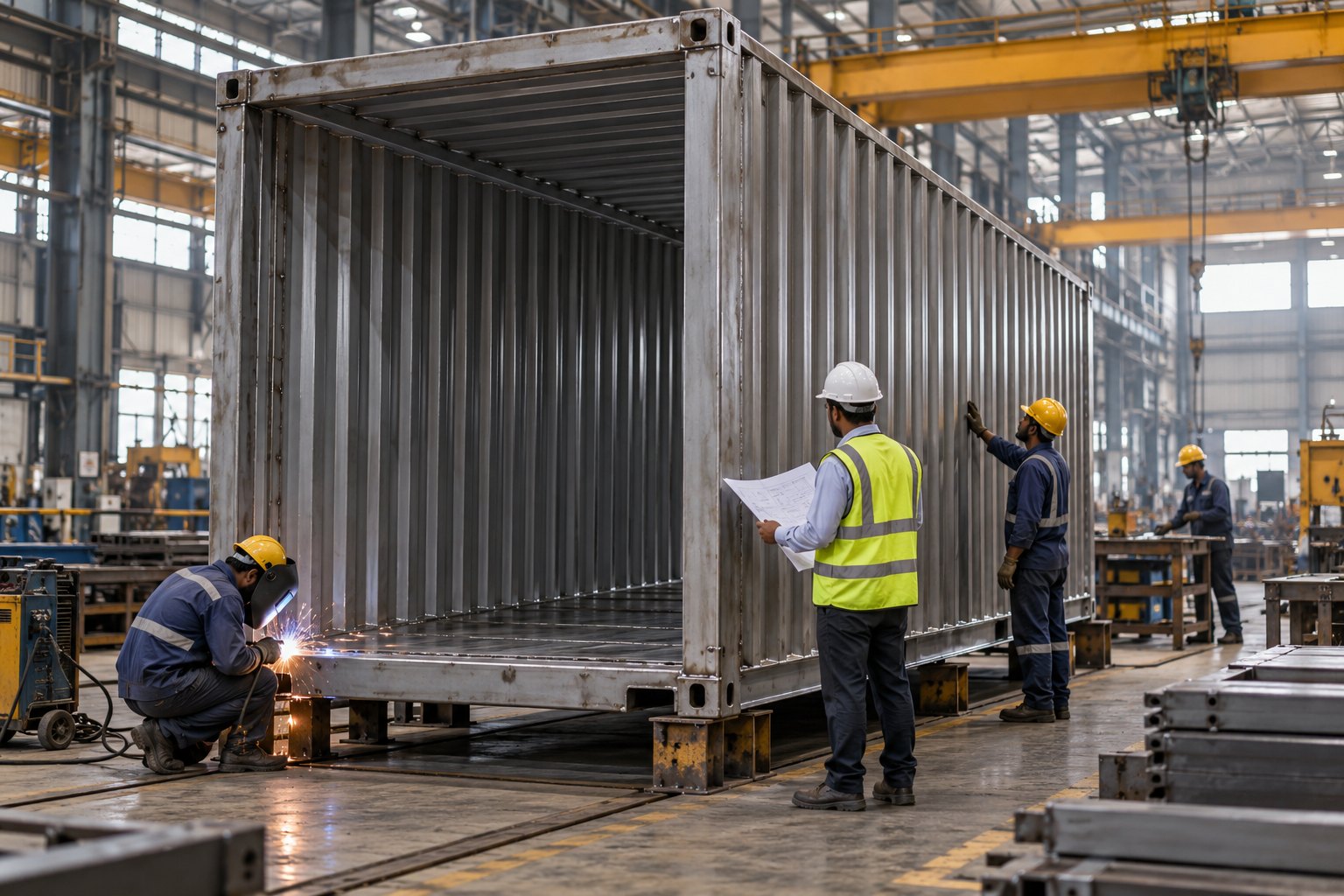
The Union Cabinet on 28 October 2026 approved the Container Manufacturing Promotion Scheme (CMPS), with an outlay of Rs 10,000 crore up to FY 2039-40. It offers interest subvention on loans, support for containers built to global shipping standards and sold, and testing facilities. The government aims to lift domestic capacity about ten-fold, to 7.5 lakh TEUs a year.
Syllabus: GS3 · Indian Economy & Growth; Prelims · Current Affairs & IR; GS3 · Liberalisation & Industry
Why this matters for UPSC
GS3 covers industrial policy, infrastructure (ports) and supply-chain resilience. Prelims can ask about TEUs, the International Convention for Safe Containers (CSC) and UNCTAD; Mains, about cutting import dependence in maritime logistics.
Why it matters
A garment or engineering exporter needs an empty box before a shipment can leave. When global freight is disrupted, those boxes grow scarce and costly, and orders wait at the factory gate. Building containers at home means the box can come from a plant inside India, so a crisis abroad hurts less. The money also reaches small suppliers of steel parts, timber and paint, and creates factory jobs. The larger issue is whether India can own the basic hardware of its trade, not just its ports and ships.
Prelims pointers
- Shipping containers follow ISO specifications; 20-foot and 40-foot boxes are the most common sizes.
- The CSC was adopted on 2 December 1972 and entered into force on 6 September 1977.
- Under the CSC, a safety approval granted by one Contracting State is recognised by the other Contracting States.
- The CSC covers containers of a prescribed minimum size with corner fittings, and leaves out those designed specially for air carriage.
- UNCTAD publishes the Review of Maritime Transport, its annual study of seaborne trade and shipping.
- PM Gati Shakti plans links between ports, rail lines, roads and industrial hubs; the Sagarmala Programme promotes port-led development.
Practise a UPSC-style question
With reference to shipping containers, consider the following statements:
1. A Twenty-foot Equivalent Unit (TEU) is the standard measure of container capacity.
2. The International Convention for Safe Containers was adopted under the aegis of the World Trade Organization.
Which of the statements given above is/are correct?
- (a) 1 only
- (b) 2 only
- (c) Both 1 and 2
- (d) Neither 1 nor 2
Show the answer
Answer: (a) 1 only
Answer: (a) 1 only. The TEU is the capacity unit; the CSC is an IMO treaty, not a WTO one.
Statement 1: correct. Container capacity is counted in Twenty-foot Equivalent Units, with 20-foot and 40-foot boxes the most common sizes.
Statement 2: incorrect. The CSC was adopted in 1972 at a conference convened jointly by the United Nations and the International Maritime Organization (IMO).
Eliminate: statement 2 names the wrong body. Out: (b), (c).
Eliminate: statement 1 is the standard definition of the TEU. Out: (d).
Trap: Swapped attribution. The trade body WTO is put in place of the IMO, the UN agency that handles shipping safety conventions.
Remember: TEU measures container capacity; the CSC (1972) is an IMO convention.
More from the 29 October 2026 edition
- Cabinet approves Khelo India Sports Goods Manufacturing Scheme with manufacturing zones Economy
- Cabinet approves PM Viksit Gram Swaraj Yojana to strengthen Panchayat governance Polity
- DRI seizes 55,000 e-cigarettes banned under 2019 Act at Kolkata port National
- India, Mexico sign Terms of Reference launching Preferential Trade Agreement talks World & IR
- CAQM direction: buses entering Delhi must be BS-VI, CNG or electric Environment
- Lancet Countdown finds climate's health harms outpacing action, urges emergency declaration Environment
- Central Empowered Committee seeks carrying capacity studies for Himachal's tourist hubs Environment
- Karnataka's final electoral roll after SIR: 4.55 crore electors, 17.92% fewer Polity