
Parliamentary panel seeks gender-inclusive criteria for defining urban areas
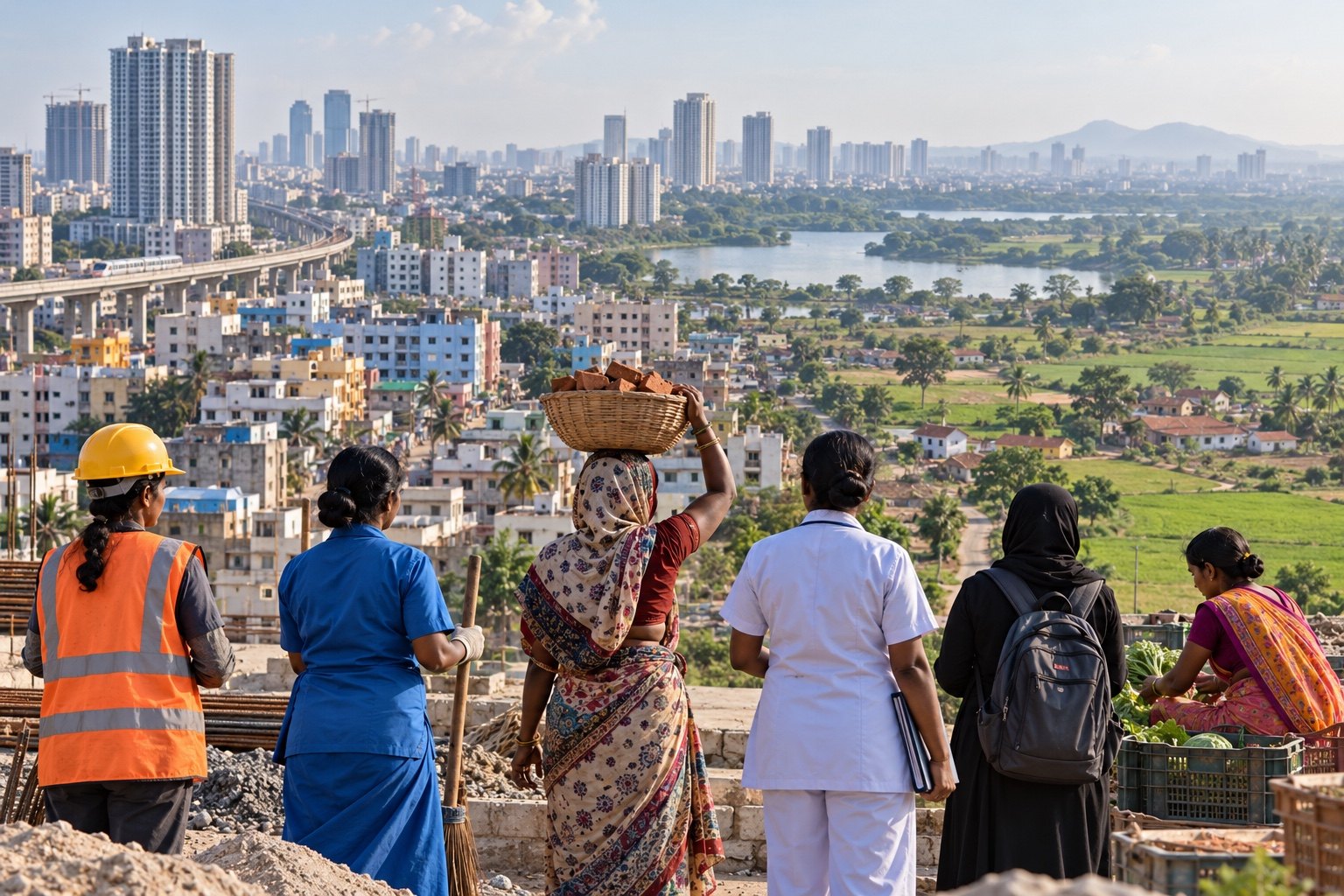
The Parliamentary Standing Committee on Housing and Urban Affairs has recommended a review of the Census criteria for defining urban areas. It called one test, 75% of male main workers in non-farm jobs, male-centric. Its report notes that over 3,000 of the 3,892 census towns of 2011 are still governed by rural local bodies.
Syllabus: GS2 · Federalism & Local Government; Prelims · Polity & Governance; GS1 · Women, Population & Urbanisation
Why this matters for UPSC
GS1 urbanisation and GS2 local government. Prelims can ask the tests for a census town, how it differs from a statutory town and what Article 243Q provides; Mains, about counting women's work and governing census towns.
Why it matters
A woman runs a tailoring business from her home in a fast-growing village near a city. She does not count when the Census decides whether that village has become a town, because only men's jobs are tested. Where such places do pass the test, most are still run by a gram panchayat, with a village's budget and staff, while facing a town's problems of drainage, garbage, traffic and unplanned building. Missions such as Swachh Bharat Mission (Urban) and AMRUT reach only statutory towns, so their residents miss out. How India defines 'urban' therefore decides who gets city services, planning and funds, and whether women's work is seen at all.
Prelims pointers
- Census 2011 counted 7,933 urban settlements: 4,041 statutory towns and 3,892 census towns; census towns' share of the urban population rose from 7.5% to 14.5% over 2001-11.
- Article 243Q(2): the Governor classifies urban areas by public notification, weighing population, density, local revenue, non-agricultural employment and economic importance.
- Article 243Q(1): every State must have Nagar Panchayats, Municipal Councils and Municipal Corporations; an industrial township may be exempted from having a Municipality.
- Part IXA ('The Municipalities') came into force on 1 June 1993; for it, 'population' means the figure at the last census whose figures are published (Article 243P).
- Outgrowths: areas next to a town's statutory limits with urban amenities; they are counted within an urban agglomeration but are not urban units on their own.
- Statutory towns with a population above 1,00,000 are classed as cities in the Census.
- The 16th Finance Commission recommended grants of Rs 9.47 lakh crore for 2026-31, of which about Rs 3.6 lakh crore is for urban local bodies.
- The Standing Committee on Housing and Urban Affairs has 31 members, 21 from the Lok Sabha and 10 from the Rajya Sabha, per PRS.
Practise a UPSC-style question
With reference to the criteria used by the Census of India to identify a census town, consider the following statements:
1. The settlement must have a population of at least 5,000.
2. Its population density must be at least 400 persons per square kilometre.
3. At least 75% of all its main workers, men and women together, must be engaged in non-agricultural work.
Which of the statements given above is/are correct?
- (a) 1 and 2 only
- (b) 2 and 3 only
- (c) 1 and 3 only
- (d) 1, 2 and 3
Show the answer
Answer: (a) 1 and 2 only
Answer: (a) 1 and 2 only. The population and density tests are right, but the work test counts male main workers only.
Statement 1: correct. A census town needs a minimum population of 5,000.
Statement 2: correct. It also needs a density of at least 400 persons per square kilometre.
Statement 3: incorrect. The 75% test applies to male main workers alone, which is why the Standing Committee called it male-centric.
Eliminate: Statement 3 counts women too, but the test counts only men. Out: (b), (c), (d).
Trap: Wrong scope. The statement widens a male-only workforce test to all workers, which sounds fairer and so feels right.
Remember: Census town = 5,000 people + 400 per sq km + 75% of MALE main workers in non-farm work.
More from the 24 October 2026 edition
- IAEA tells UN General Assembly nuclear power could triple by 2060 World & IR
- Haryana directs HERC under Section 108 to halt parallel power licence Polity
- NSO proposes PLFS redesign from 2027 to count platform workers Economy
- Karnataka HC: six guidelines curb mechanical FIRs, arrests over social-media posts Polity
- IMD forecasts Bay of Bengal cyclone heading for north Andhra, south Odisha Environment
- NMC withdraws 2023 medical education standards regulations, ends annual renewal Polity
- Orissa High Court: road pandals may stand if movement stays open Polity
- MHA tells Supreme Court of over 21,900 digital arrest complaints in 2026 National
- Jharkhand HC quashes Sentence Review Board's 'preordained' refusal of premature release Polity
- Allahabad HC: POCSO compensation cannot be refused for lack of injury Polity
- MoRTH draft proposes mandatory emergency braking (AEBS) in cars from 2030 National
- Kerala HC: State liable for wild-animal attacks despite not owning animals Environment