
IAEA tells UN General Assembly nuclear power could triple by 2060
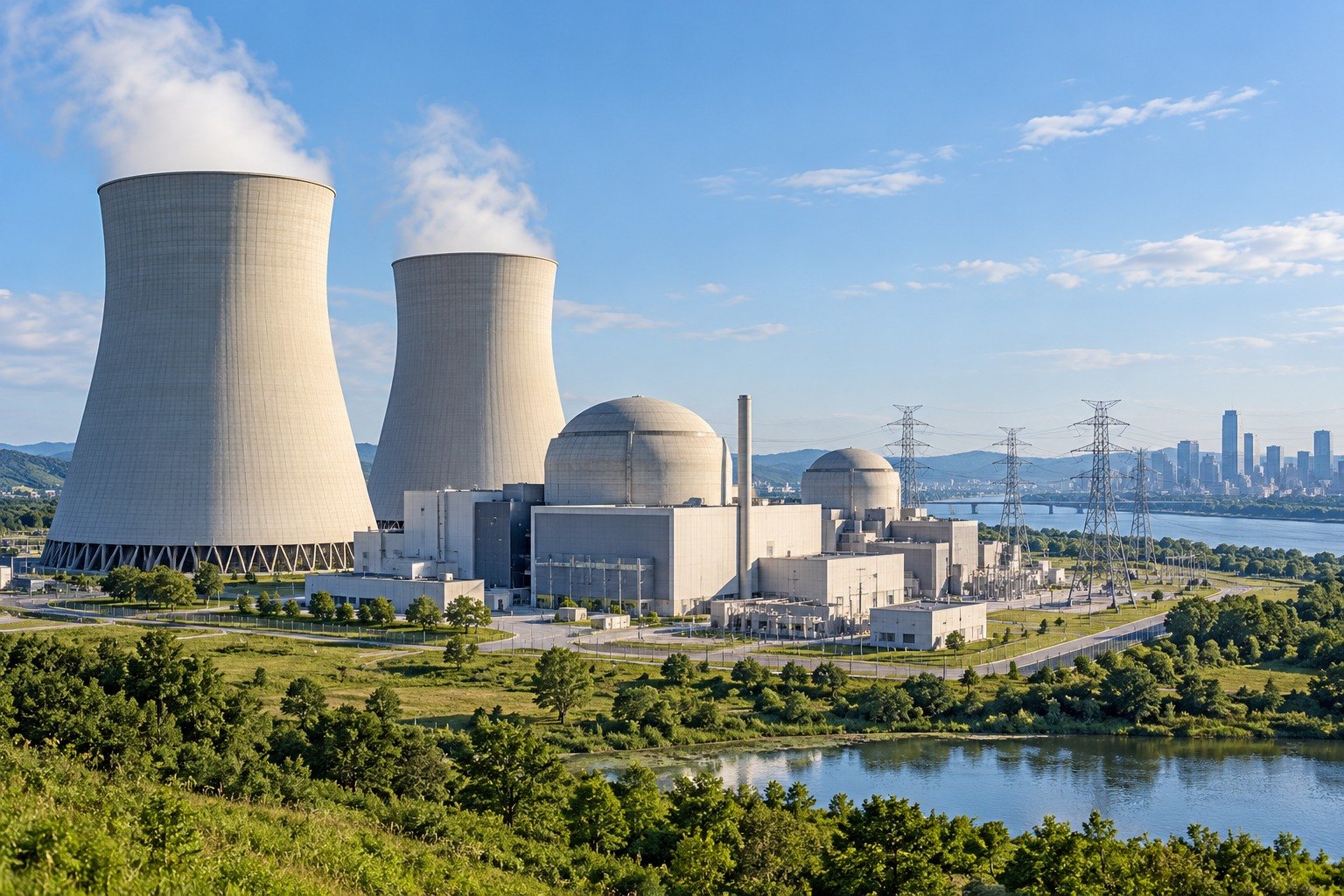
IAEA Director General Rafael Grossi presented the agency's annual report to the UN General Assembly on 23 October 2026. He said nuclear power use could more than triple by 2060. The IAEA's 14 September projections start from 377.1 GW(e) at end-2025. For 2060, they give 696 GW(e) in a low case and 1,284 GW(e) in a high case.
Syllabus: Prelims · Current Affairs & IR; GS3 · Infrastructure; GS3 · Science & Technology
Why this matters for UPSC
GS2 international institutions and GS3 energy. Prelims can ask how the IAEA reports to the UN under its Statute and how RDS-1 projections are built; Mains, nuclear power's role in India's energy security.
Why it matters
A factory, a hospital or a data centre needs power every hour of the day, including at night and on windless days when solar panels and wind turbines produce little. Nuclear plants run steadily and emit almost no carbon while doing so, which is why countries worried about fuel imports and climate targets are turning back to them. If capacity grows as fast as the agency's high case suggests, countries will compete for reactor parts, uranium, trained engineers and long-term loans. For Indian households and industry, the question is whether new plants can be built quickly and safely enough to supply cheaper, cleaner round-the-clock power, and whether old plants can be kept running longer.
Prelims pointers
- IAEA Statute, Article II: the Agency seeks to accelerate and enlarge atomic energy's contribution to peace, health and prosperity, and keeps its assistance from military use.
- IAEA Statute, Article III.A.5: authorises the Agency to establish and administer safeguards so that materials and facilities it supplies further no military purpose.
- IAEA Statute, Article V: the General Conference of all members meets in an annual regular session at headquarters; each member has one vote.
- RDS-1 method: nuclear capacity is estimated bottom-up, country by country and project by project, in a low and a high case; the IAEA says they are not predictions.
- RDS-1 low case: current market, technology and resource trends continue, with few changes in law, and national nuclear targets are not assumed met.
- RDS-1 inputs: the IAEA's Power Reactor Information System, an annual expert Consultancy Meeting, and the OECD Nuclear Energy Agency-IAEA uranium resources publication; demand comes from the MAED model.
- India stays outside the Nuclear Non-Proliferation Treaty (NPT); its Additional Protocol with the IAEA entered into force on 25 July 2014.
Practise a UPSC-style question
With reference to the Statute of the International Atomic Energy Agency (IAEA), consider the following statements:
1. The IAEA submits reports on its activities annually to the General Assembly of the United Nations.
2. In the IAEA's General Conference, members cast votes weighted by their contributions to the Agency's budget.
3. The IAEA must notify the UN Security Council of questions arising from its activities that fall within the Council's competence.
Which of the statements given above is/are correct?
- (a) 1 and 2 only
- (b) 2 and 3 only
- (c) 1 and 3 only
- (d) 1, 2 and 3
Show the answer
Answer: (c) 1 and 3 only
Answer: (c) 1 and 3 only. The Statute ties the IAEA to the UN through reports, but its General Conference works on one member, one vote.
Statement 1: correct. Article III.B.4 of the IAEA Statute requires annual reports on its activities to the UN General Assembly.
Statement 2: incorrect. Article V of the Statute gives each member of the General Conference one vote, not votes weighted by budget contributions.
Statement 3: correct. Article III.B.4 also requires the IAEA to notify the Security Council of questions within its competence, as the organ responsible for peace and security.
Eliminate: Statement 2 is incorrect, since each member has one vote. Out: (a), (b), (d).
Trap: Sounds right. Some international bodies weight votes by contribution, so a student may assume the IAEA does the same.
Remember: IAEA reports yearly to the UN General Assembly (Art. III.B.4); one member, one vote in its General Conference.
More from the 24 October 2026 edition
- Haryana directs HERC under Section 108 to halt parallel power licence Polity
- NSO proposes PLFS redesign from 2027 to count platform workers Economy
- Karnataka HC: six guidelines curb mechanical FIRs, arrests over social-media posts Polity
- IMD forecasts Bay of Bengal cyclone heading for north Andhra, south Odisha Environment
- NMC withdraws 2023 medical education standards regulations, ends annual renewal Polity
- Orissa High Court: road pandals may stand if movement stays open Polity
- MHA tells Supreme Court of over 21,900 digital arrest complaints in 2026 National
- Jharkhand HC quashes Sentence Review Board's 'preordained' refusal of premature release Polity
- Allahabad HC: POCSO compensation cannot be refused for lack of injury Polity
- MoRTH draft proposes mandatory emergency braking (AEBS) in cars from 2030 National
- Kerala HC: State liable for wild-animal attacks despite not owning animals Environment
- Supreme Court: public property may be re-auctioned before a contract binds Polity