
Orissa High Court: road pandals may stand if movement stays open
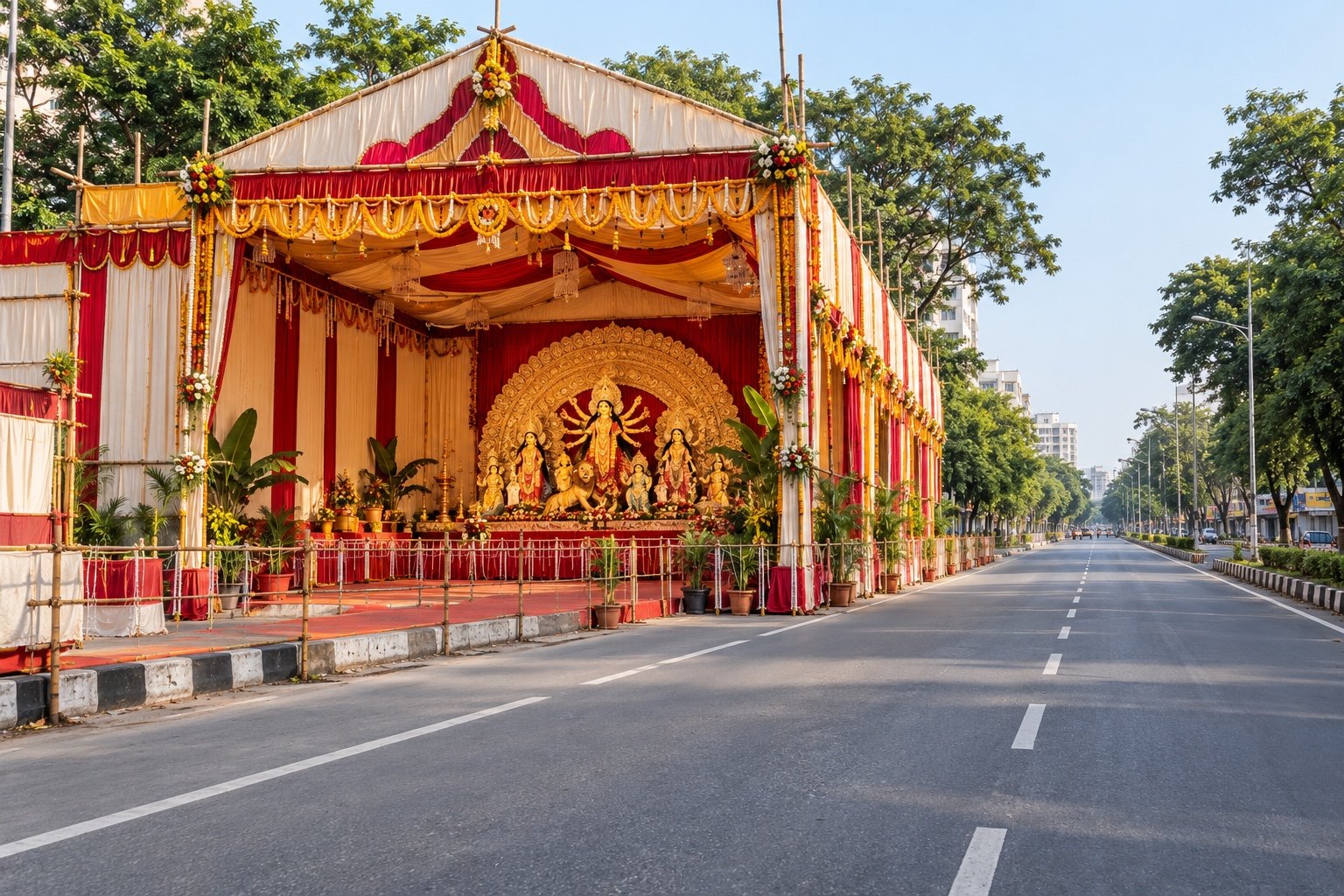
The Orissa High Court on 16 October 2026 declined to stop temporary puja pandals on public roads. It held that freedom of religion under Article 25 is subject to public order and other Fundamental Rights. The State must keep passage for residents, ambulances and fire engines. It must enforce sound limits and deadlines and size pandals to spare road space.
Syllabus: GS2 · Constitution; Prelims · Polity & Governance; GS4 · Case Studies
Why this matters for UPSC
GS2 Polity: Prelims can ask what limits Article 25 and Article 26 carry, who may claim Article 19(1)(d) and what Article 226 covers; GS2 and GS4 Mains, about balancing Fundamental Rights and Article 21.
Why it matters
Every festival season, families in crowded towns find the lane to their home narrowed by a pandal for days. For an elderly resident, a patient waiting for an ambulance or a household facing a fire, a fully blocked road can mean help that never arrives. The ruling does not ban community worship on roads, which many people value, but it makes the permit-giving authority answerable for leaving a usable way through. Local officials who approve pandals now have a court's direction to check the space left, the noise and the closing time. The larger question is how a democracy balances a community's freedom of religion against one person's freedom to move and to live safely.
Prelims pointers
- Article 25(2)(a): the State may make laws regulating or restricting economic, financial, political or other secular activity associated with religious practice.
- Article 26: a religious denomination may manage its own affairs in matters of religion, subject to public order, morality and health only.
- Article 25, Explanation I: wearing and carrying kirpans is deemed part of the profession of the Sikh religion.
- Article 19(5): reasonable restrictions on free movement and on residing anywhere in India, in the general public's interest or to protect any Scheduled Tribe.
- Seventh Schedule, List II: Entry 1 is public order, excluding Union armed forces used in aid of civil power; Entry 2 is police.
- Article 226: a High Court may issue writs to enforce Part III rights and for any other purpose; Article 32 covers Part III rights alone.
- Noise Rules, 2000, Rule 5: no loudspeaker from 10 p.m. to 6 a.m. outside closed premises; a State may allow till midnight on up to 15 festive days a year.
- Noise limits, residential area: 55 dB(A) by day and 45 dB(A) at night; silence zone: 50 and 40.
Practise a UPSC-style question
With reference to the freedom of religion under the Constitution of India, consider the following statements:
1. The rights under Article 25 are available to all persons, not to citizens alone.
2. Article 26 is made subject to public order, morality, health and the other provisions of Part III.
3. Under Article 25, the State may regulate secular activity associated with religious practice.
Which of the statements given above is/are correct?
- (a) 1 and 2 only
- (b) 2 and 3 only
- (c) 1 and 3 only
- (d) 1, 2 and 3
Show the answer
Answer: (c) 1 and 3 only
Answer: (c) 1 and 3 only. Article 26 lacks the words "other provisions of this Part".
Statement 1: correct. Article 25(1) says all persons are equally entitled to freedom of conscience and to profess, practise and propagate religion.
Statement 2: incorrect. Article 26 is subject to public order, morality and health only; the phrase on the other provisions of Part III is in Article 25.
Statement 3: correct. Article 25(2)(a) lets the State regulate or restrict economic, financial, political or other secular activity linked to religious practice.
Eliminate: statement 2 is wrong, so any option with 2 goes. Out: (a), (b), (d).
Trap: Swapped attribution. The qualifier "subject to the other provisions of this Part" belongs to Article 25 and is pinned on Article 26.
Remember: Article 25 yields to all of Part III; Article 26 to public order, morality and health.
More from the 24 October 2026 edition
- IAEA tells UN General Assembly nuclear power could triple by 2060 World & IR
- Haryana directs HERC under Section 108 to halt parallel power licence Polity
- NSO proposes PLFS redesign from 2027 to count platform workers Economy
- Karnataka HC: six guidelines curb mechanical FIRs, arrests over social-media posts Polity
- IMD forecasts Bay of Bengal cyclone heading for north Andhra, south Odisha Environment
- NMC withdraws 2023 medical education standards regulations, ends annual renewal Polity
- MHA tells Supreme Court of over 21,900 digital arrest complaints in 2026 National
- Jharkhand HC quashes Sentence Review Board's 'preordained' refusal of premature release Polity
- Allahabad HC: POCSO compensation cannot be refused for lack of injury Polity
- MoRTH draft proposes mandatory emergency braking (AEBS) in cars from 2030 National
- Kerala HC: State liable for wild-animal attacks despite not owning animals Environment
- Supreme Court: public property may be re-auctioned before a contract binds Polity