
MoRTH draft proposes mandatory emergency braking (AEBS) in cars from 2030
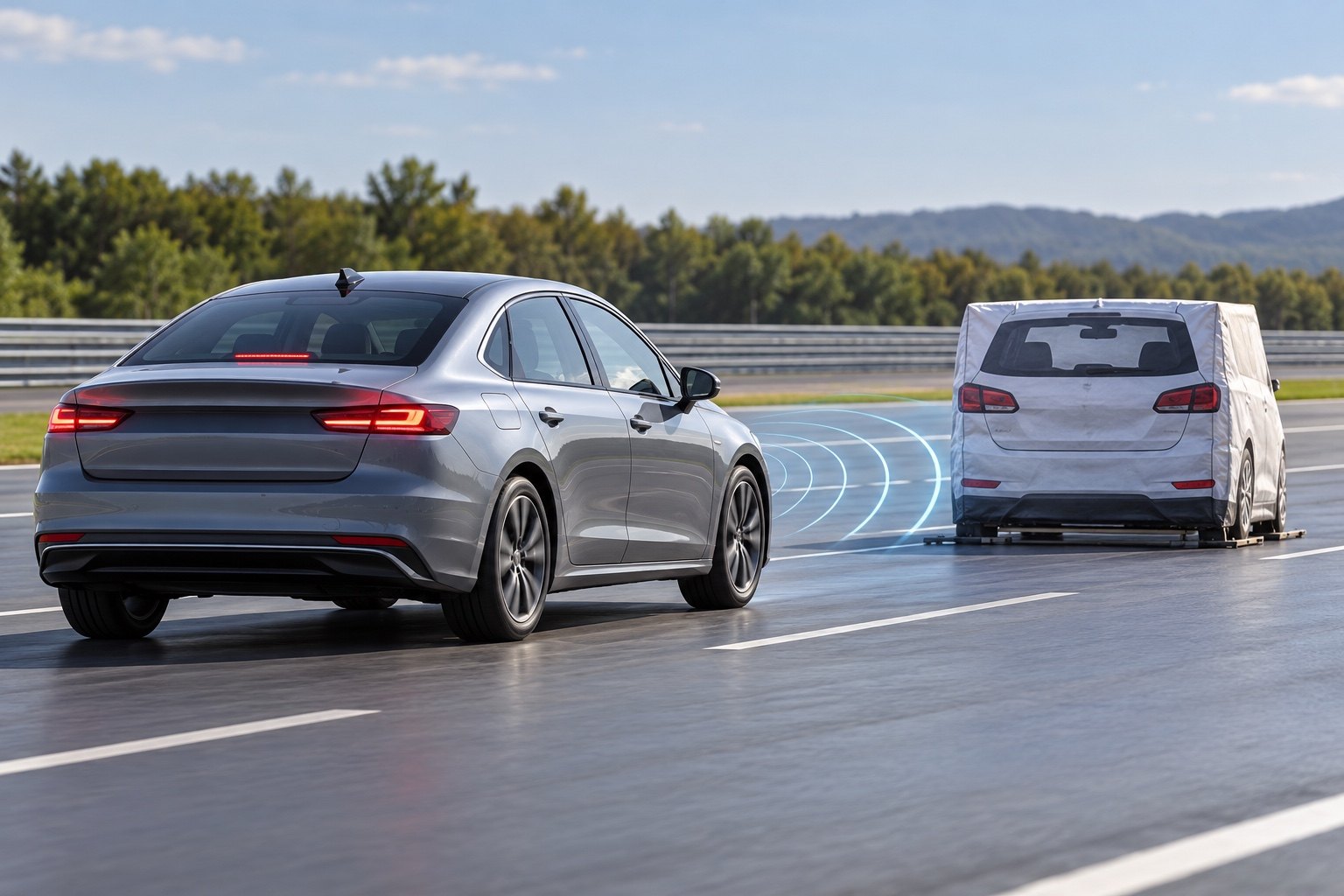
The Ministry of Road Transport and Highways proposes making the Advanced Emergency Braking System (AEBS) compulsory in cars. Its draft notification of 19 October 2026 would require it in new M1 models made from 1 October 2030 and in all M1 models from 1 October 2032. The draft, amending the Central Motor Vehicles Rules, 1989, invites objections for 30 days.
Syllabus: Prelims · Current Affairs & IR; GS3 · Infrastructure; GS2 · Government Policies
Why this matters for UPSC
GS3 infrastructure and GS2 government policy: Prelims can ask what AEBS and AIS standards are, who drafts and publishes them, and what the CMVR, 1989 and Motor Vehicles Act, 1988 provide; Mains, about road safety.
Why it matters
Most crashes begin with a moment's delay: a driver who looks away, dozes off or brakes too late. A car that brakes for itself in that moment can turn a fatal crash into a minor one, or avoid it. For a family buying a new car after 2032, this safety feature would come as standard rather than as a costly top-end option. Carmakers get years of lead time to redesign models and test them, while buyers may pay somewhat more. Taxi passengers and long-haul drivers stand to gain most, since fatigue is a large part of their risk. The larger question is whether technology can cut India's road deaths when speeding, poor roads and weak enforcement remain the main causes.
Prelims pointers
- Section 110, Motor Vehicles Act, 1988: empowers the Central Government to make rules on the construction, equipment and maintenance of motor vehicles and trailers.
- Section 212(1), Motor Vehicles Act, 1988: rules under the Act are made only after previous publication, so affected persons can file objections.
- Automotive Industry Standards Committee: constituted on 15 September 1997 by the erstwhile Ministry of Surface Transport; its standards go to the CMVR Technical Standing Committee for approval.
- ARAI, Pune: secretariat of the AISC and technical secretariat of the CMVR Technical Standing Committee; it is a research institute of the automotive industry with the Ministry of Heavy Industries.
- AIS-185 scope: Part 1 covers rear-end in-lane collisions with a passenger car; Part 2 covers impacts with a pedestrian. Car-to-cyclist cases are planned for later.
- Bharat NCAP: Rule 126E of the CMVR, 1989, inserted in September 2023; a voluntary star rating of type-approved M1 cars under AIS-197 from 1 October 2023.
- Decade of Action for Road Safety 2021-2030: launched by UN General Assembly resolution A/RES/74/299 (2020), with the goal of halving road deaths and injuries by 2030.
- MoRTH's road safety strategy rests on the 4Es: Education, Engineering (of roads and vehicles), Enforcement and Emergency Care.
Practise a UPSC-style question
With reference to the Advanced Emergency Braking System (AEBS), consider the following statements:
1. It detects an imminent forward collision, warns the driver and then brakes automatically if the driver does not respond.
2. Under AIS-185, once the system starts emergency braking, the driver cannot override it by steering or accelerating.
Which of the statements given above is/are correct?
- (a) 1 only
- (b) 2 only
- (c) Both 1 and 2
- (d) Neither 1 nor 2
Show the answer
Answer: (a) 1 only
Answer: (a) 1 only. AEBS warns and then brakes, but the driver keeps the final say.
Statement 1: correct. AIS-185 defines AEBS as a system that detects an imminent forward collision, warns the driver and activates the brakes if the driver does not respond.
Statement 2: incorrect. AIS-185 lets the driver take control at any time through a conscious action, such as steering or an accelerator kick-down.
Eliminate: statement 1 is the basic definition of emergency braking, so it is correct. Out: (b), (d).
Eliminate: statement 2 is wrong, because the driver can always override the system. Out: (c).
Trap: Sounds right. Statement 2 invents a lock-out that seems logical for a safety system, but the standard keeps the driver able to override it.
Remember: AEBS = detect, warn, brake; the driver can always override.
More from the 24 October 2026 edition
- IAEA tells UN General Assembly nuclear power could triple by 2060 World & IR
- Haryana directs HERC under Section 108 to halt parallel power licence Polity
- NSO proposes PLFS redesign from 2027 to count platform workers Economy
- Karnataka HC: six guidelines curb mechanical FIRs, arrests over social-media posts Polity
- IMD forecasts Bay of Bengal cyclone heading for north Andhra, south Odisha Environment
- NMC withdraws 2023 medical education standards regulations, ends annual renewal Polity
- Orissa High Court: road pandals may stand if movement stays open Polity
- MHA tells Supreme Court of over 21,900 digital arrest complaints in 2026 National
- Jharkhand HC quashes Sentence Review Board's 'preordained' refusal of premature release Polity
- Allahabad HC: POCSO compensation cannot be refused for lack of injury Polity
- Kerala HC: State liable for wild-animal attacks despite not owning animals Environment
- Supreme Court: public property may be re-auctioned before a contract binds Polity