
Right to protest: Delhi Police de-notifies Jantar Mantar, names three venues
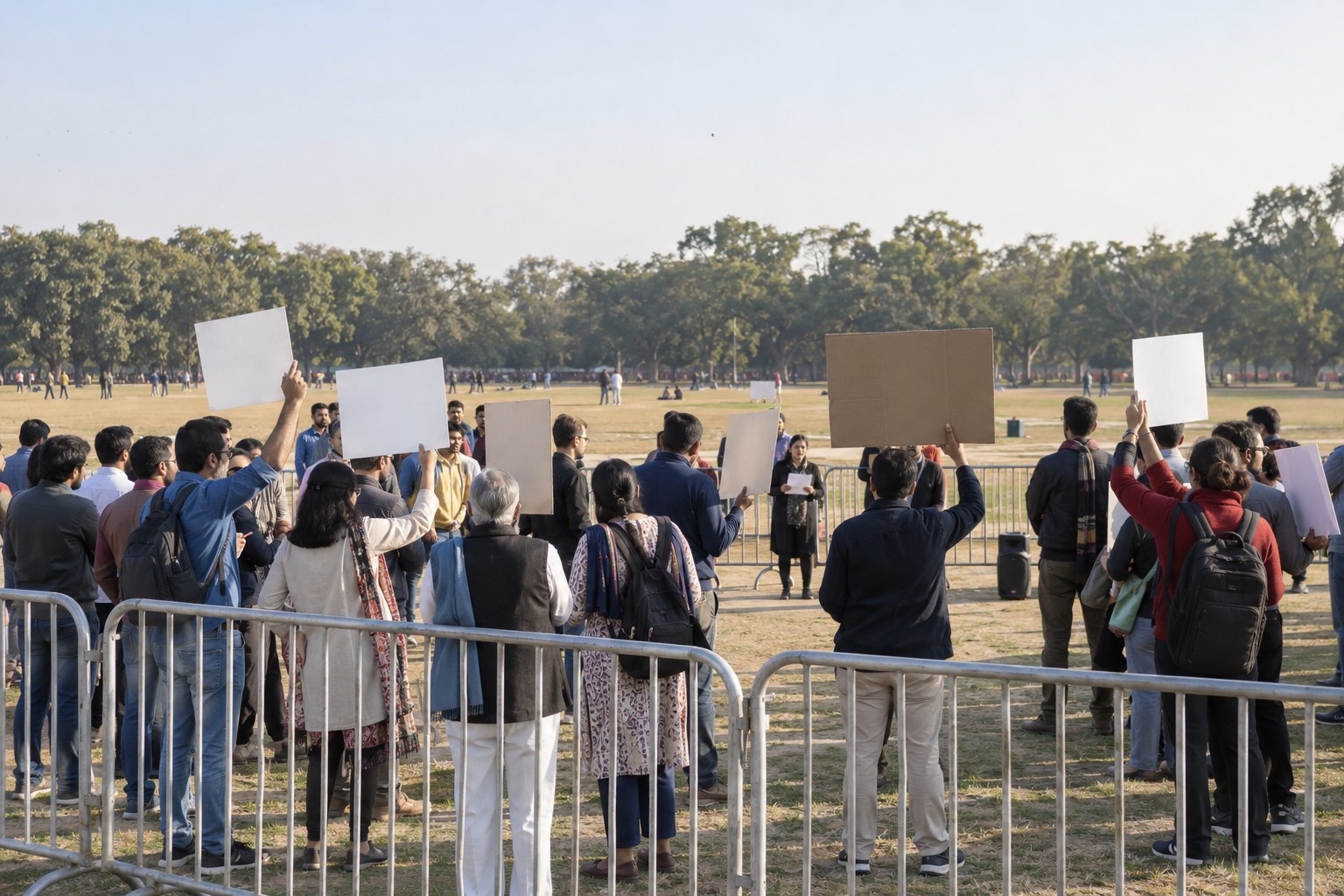
Delhi Police de-notified Jantar Mantar as the capital's designated protest site through a standing order dated October 11, made public on October 12. Ramlila Maidan, Burari Ground and CBD Ground in east Delhi replace it, on the recommendation of a committee set up by the Union Ministry of Home Affairs. Revised procedures for the three venues will follow.
Syllabus: GS2 · Constitution; GS2 · Federalism & Local Government; Prelims · Polity & Governance
Why this matters for UPSC
GS2 polity: fundamental rights and their reasonable restrictions. Prelims can ask what Article 19(1)(b) and Article 19(3) provide, what Article 239AA reserves to the Union, and the public order test; Mains, how far the State may regulate protest.
Why it matters
A farmers' union, a students' group or a citizens' campaign that wants to be heard near Parliament and the ministries must now gather at one of three grounds, some of them far from central Delhi. Protest that is moved away from the people it addresses can lose much of its force, which is exactly what petitioners argued in 2018. At the same time, residents near Jantar Mantar had long complained of noise, and traders said recent protests restricted access and closed metro stations. The case turns on a lasting constitutional question: when does regulating where and how people protest become a ban on protest itself, and who must justify it under which law.
Prelims pointers
- Article 19(1)(b): citizens' right to assemble peaceably and without arms; Article 19(3) permits restrictions for public order and the sovereignty and integrity of India.
- Article 19(2): grounds for restricting speech include public order, security of the State, friendly relations with foreign States, contempt of court and incitement to an offence.
- Article 239AA, inserted by the Constitution (Sixty-ninth Amendment) Act, 1991: the Delhi Assembly cannot legislate on public order, police and land.
- Ram Manohar Lohia v. State of Bihar (1966): law and order, public order and security of the State are three concentric circles, each narrower than the last.
- Himat Lal K. Shah v. Commissioner of Police (1972): police may require prior permission for street meetings, but assembly cannot be barred on every public street.
- Mazdoor Kisan Shakti Sangathan (2018): Indian courts use the 'apprehension of breach of peace' test, not the US 'clear and present danger' test.
- Section 163 of the BNSS succeeds Section 144 of the Code of Criminal Procedure, 1973; a magistrate's order lasts up to two months unless the State Government extends it.
Practise a UPSC-style question
With reference to the right of assembly under the Constitution of India, consider the following statements:
1. Article 19(1)(b) guarantees citizens the right to assemble peaceably and without arms.
2. Article 19(3) allows reasonable restrictions on this right in the interests of public order and the sovereignty and integrity of India.
Which of the statements given above is/are correct?
- (a) 1 only
- (b) 2 only
- (c) Both 1 and 2
- (d) Neither 1 nor 2
Show the answer
Answer: (c) Both 1 and 2
1 is correct: Article 19(1)(b) protects peaceful assembly without arms, which covers meetings and demonstrations. 2 is correct: Article 19(3) permits reasonable restrictions by law in the interests of the sovereignty and integrity of India or public order.
Explainers on this topic
More from the 13 October 2026 edition
- India wants terrorist acts in UN crimes against humanity convention World & IR
- NHAI makes independent proof-checking of complex highway designs mandatory Economy
- UNGA adopts pandemic declaration; WHO Pandemic Agreement awaits PABS annex World & IR
- IPC Alert flags rising Famine risk in Sudan's Darfur and Kordofan World & IR
- IMF's World Economic Outlook lifts India's 2026-27 growth forecast to 7% Economy
- Tribal Affairs Ministry launches financial literacy drive for PVTG villages National
- ECI publishes Punjab's final electoral roll after Special Intensive Revision Polity
- RSETIs get uniform training standards under MoRD pact with RUDSETI academy Economy
- Lakshadweep declared fully literate under ULLAS literacy scheme National
- IMD dedicates WebGIS cyclone and marine warning system to the nation Sci-Tech
- Army signs five-year MoU with Food Corporation of India, launches Bharat Rice National
- PM-SETU: AM/NS India pacts to upgrade nine ITIs in Surat, Visakhapatnam Economy