
NHAI makes independent proof-checking of complex highway designs mandatory
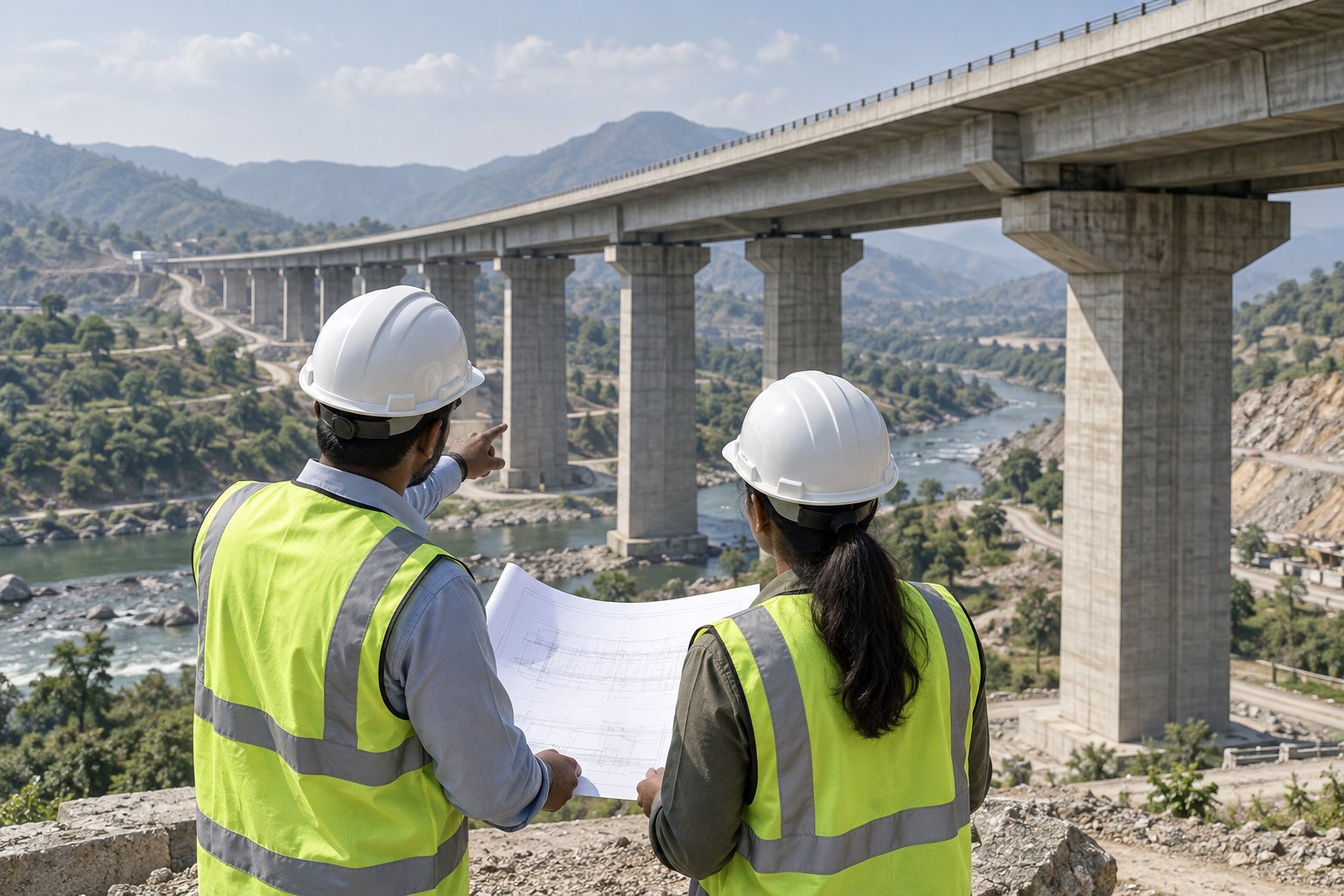
The National Highways Authority of India (NHAI) has made independent proof-checking of the designs of critical bridges, viaducts, tunnels and other complex highway structures mandatory from 1 December 2026, according to its circular as reported. Empanelled IITs, government technical institutions or reputed firms will vet the designs before approval, at the contractor's cost, across EPC, HAM and BOT projects.
Syllabus: Prelims · Current Affairs & IR; GS3 · Infrastructure; GS2 · Government Policies
Why this matters for UPSC
GS3 Infrastructure (roads, bridges): Prelims can ask who mandates NHAI's design proof-checking, which project modes (EPC, HAM, BOT) it covers and who pays; Mains, about safety and accountability in public infrastructure.
Why it matters
Every truck driver, bus passenger and family crossing a river on a national highway trusts that the bridge was designed right. From December, on every covered bridge or complex structure, an outside expert from an IIT, a government institution or a vetted firm must go through the foundations, flood flow, earthquake loads and scour protection before the design is approved. The aim is to catch a design error on paper, before construction begins, rather than in a structure meant to stand for a century. The rule belongs to a larger question: how India builds infrastructure meant to last a century while hundreds of existing bridges already need repair.
Prelims pointers
- National Highways Authority of India (NHAI): its circular, as reported, makes independent proof-checking of designs of critical bridges and complex structures mandatory from 1 December 2026.
- Ministry of Road Transport and Highways (MoRTH): per All India Radio (30 June 2026), it said the initiative aims at independent technical review of major bridges before construction.
- Indian Roads Congress (IRC): proof-checking is to ensure compliance with applicable IRC codes and specifications and with provisions of concession agreements.
- Modes covered: Engineering, Procurement and Construction (EPC), Hybrid Annuity Model (HAM), Build-Operate-Transfer (BOT) and other modes NHAI specifies; the contractor or concessionaire pays.
- Thresholds: major river bridges with design discharge of at least 3,000 cubic metres per second; structures with an individual effective span of 40 metres or more; special structures.
- Checklist: geotechnical investigations, foundation design, structural analysis, loading conditions, seismic assessments, scour protection, drainage, and consistency of drawings with design calculations; separate checklists for major bridges.
- Authority's Engineer or Independent Engineer: receives the designs first, and approves the changes the proof-checkers' observations call for before final approval.
Practise a UPSC-style question
With reference to the National Highways Authority of India's new framework for independent proof-checking of designs, consider the following statements:
1. The cost of proof-checking is borne by the contractor or concessionaire.
2. The proof-checking agency is chosen from a panel empanelled by the NITI Aayog.
3. It applies to projects awarded in EPC, HAM and BOT modes.
Which of the statements given above is/are correct?
- (a) 1 and 2 only
- (b) 2 and 3 only
- (c) 1 and 3 only
- (d) 1, 2 and 3
Show the answer
Answer: (c) 1 and 3 only
1 is correct: the contractor or concessionaire pays for the independent proof-check. 2 is incorrect: the agencies come from NHAI's own panel of IITs, government technical institutions and firms, not one drawn up by the NITI Aayog. 3 is correct: the framework covers EPC, HAM and BOT projects, and other modes NHAI specifies.
More from the 13 October 2026 edition
- India wants terrorist acts in UN crimes against humanity convention World & IR
- UNGA adopts pandemic declaration; WHO Pandemic Agreement awaits PABS annex World & IR
- IPC Alert flags rising Famine risk in Sudan's Darfur and Kordofan World & IR
- IMF's World Economic Outlook lifts India's 2026-27 growth forecast to 7% Economy
- Tribal Affairs Ministry launches financial literacy drive for PVTG villages National
- ECI publishes Punjab's final electoral roll after Special Intensive Revision Polity
- RSETIs get uniform training standards under MoRD pact with RUDSETI academy Economy
- Lakshadweep declared fully literate under ULLAS literacy scheme National
- IMD dedicates WebGIS cyclone and marine warning system to the nation Sci-Tech
- Army signs five-year MoU with Food Corporation of India, launches Bharat Rice National
- PM-SETU: AM/NS India pacts to upgrade nine ITIs in Surat, Visakhapatnam Economy
- RDI Fund clears first 19 fund managers, commits ₹7,131 crore Sci-Tech