
Tribal Affairs Ministry launches financial literacy drive for PVTG villages
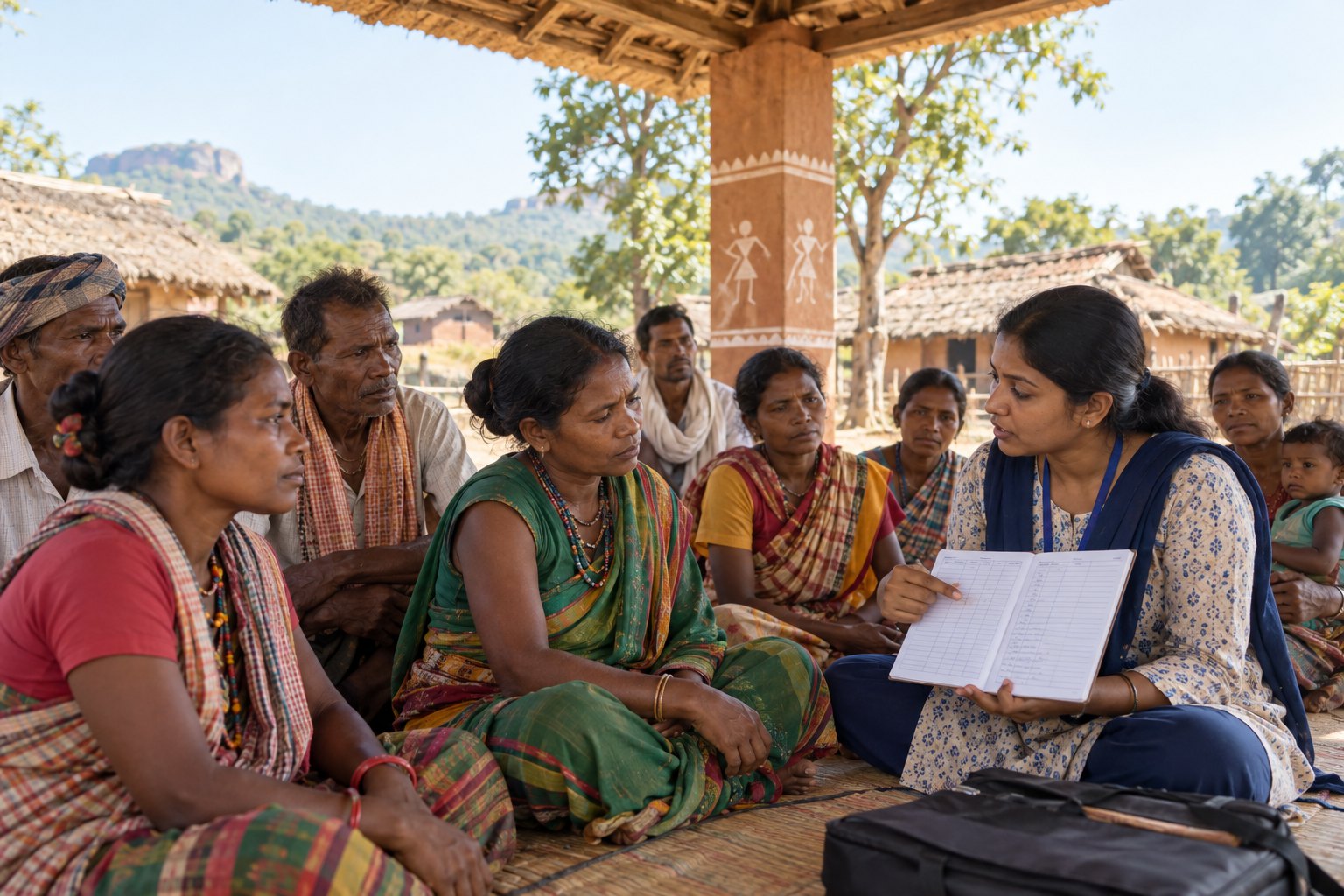
The Ministry of Tribal Affairs and the National Scheduled Tribes Finance and Development Corporation (NSTFDC) have launched PVTG Vitta Samriddha Gram, a financial-literacy drive for Particularly Vulnerable Tribal Groups. Officials said its first phase aims to cover about 200 villages in Madhya Pradesh, Odisha, Maharashtra and Chhattisgarh by March 2027, through camps explaining concessional loans.
Syllabus: GS3 · Inclusive Growth; Prelims · Economy & Social Development; GS2 · Welfare of Vulnerable Sections
Why this matters for UPSC
GS2 welfare schemes for vulnerable sections and GS3 inclusive growth: Prelims can ask how PVTGs are identified, what PM-JANMAN covers and which ministry NSTFDC works under; Mains, about financial inclusion of tribal households.
Why it matters
Think of a family in a remote PVTG hamlet that wants to buy goats or start a small shop. A bank may exist in the district, and NSTFDC offers cheap loans for exactly this, yet the family often does not know the scheme, the papers it needs or how to apply. It then borrows from a moneylender or does not borrow at all. The camps aim to close that gap by explaining the loans and helping with the forms. The ministry says the larger aim is to move beyond simply owning a bank account to actually using institutional credit for livelihoods. Whether village camps work will be judged after Phase I, and that lesson matters for financial inclusion of the poorest groups everywhere.
Prelims pointers
- PVTG criteria: pre-agricultural level of technology, low literacy, economic backwardness, and a stagnant or declining population.
- PVTGs are identified by the Union government through the Ministry of Tribal Affairs; they were earlier called Primitive Tribal Groups.
- The Dhebar Commission (1960-61) found unequal development among Scheduled Tribes, which led to a separate category for the least developed groups.
- Article 342: the President specifies Scheduled Tribes for a State after consulting the Governor; only Parliament may change the list by law.
- Fifth Schedule: Scheduled Areas and Scheduled Tribes in States other than Assam, Meghalaya, Tripura and Mizoram; the President declares Scheduled Areas.
- Sixth Schedule: tribal areas of Assam, Meghalaya, Tripura and Mizoram, run through autonomous district councils.
- PM-JANMAN: nodal ministry is the Ministry of Tribal Affairs; aimed at PVTG households and habitations.
- NSTFDC: a Central Public Sector Enterprise under the Ministry of Tribal Affairs giving concessional loans to Scheduled Tribe persons.
Practise a UPSC-style question
With reference to Particularly Vulnerable Tribal Groups (PVTGs) in India, consider the following statements:
1. The criteria for identifying them include a pre-agricultural level of technology, low literacy, economic backwardness and a stagnant or declining population.
2. The list of PVTGs is drawn up and notified by the National Commission for Scheduled Tribes.
Which of the statements given above is/are correct?
- (a) 1 only
- (b) 2 only
- (c) Both 1 and 2
- (d) Neither 1 nor 2
Show the answer
Answer: (a) 1 only
1 is correct: these four criteria have been used by the Union government to mark out the most vulnerable among the Scheduled Tribes. 2 is incorrect: PVTGs are identified by the Union government through the Ministry of Tribal Affairs, not by the National Commission for Scheduled Tribes, a constitutional body under Article 338A.
More from the 13 October 2026 edition
- India wants terrorist acts in UN crimes against humanity convention World & IR
- NHAI makes independent proof-checking of complex highway designs mandatory Economy
- UNGA adopts pandemic declaration; WHO Pandemic Agreement awaits PABS annex World & IR
- IPC Alert flags rising Famine risk in Sudan's Darfur and Kordofan World & IR
- IMF's World Economic Outlook lifts India's 2026-27 growth forecast to 7% Economy
- ECI publishes Punjab's final electoral roll after Special Intensive Revision Polity
- RSETIs get uniform training standards under MoRD pact with RUDSETI academy Economy
- Lakshadweep declared fully literate under ULLAS literacy scheme National
- IMD dedicates WebGIS cyclone and marine warning system to the nation Sci-Tech
- Army signs five-year MoU with Food Corporation of India, launches Bharat Rice National
- PM-SETU: AM/NS India pacts to upgrade nine ITIs in Surat, Visakhapatnam Economy
- RDI Fund clears first 19 fund managers, commits ₹7,131 crore Sci-Tech