
Army signs five-year MoU with Food Corporation of India, launches Bharat Rice
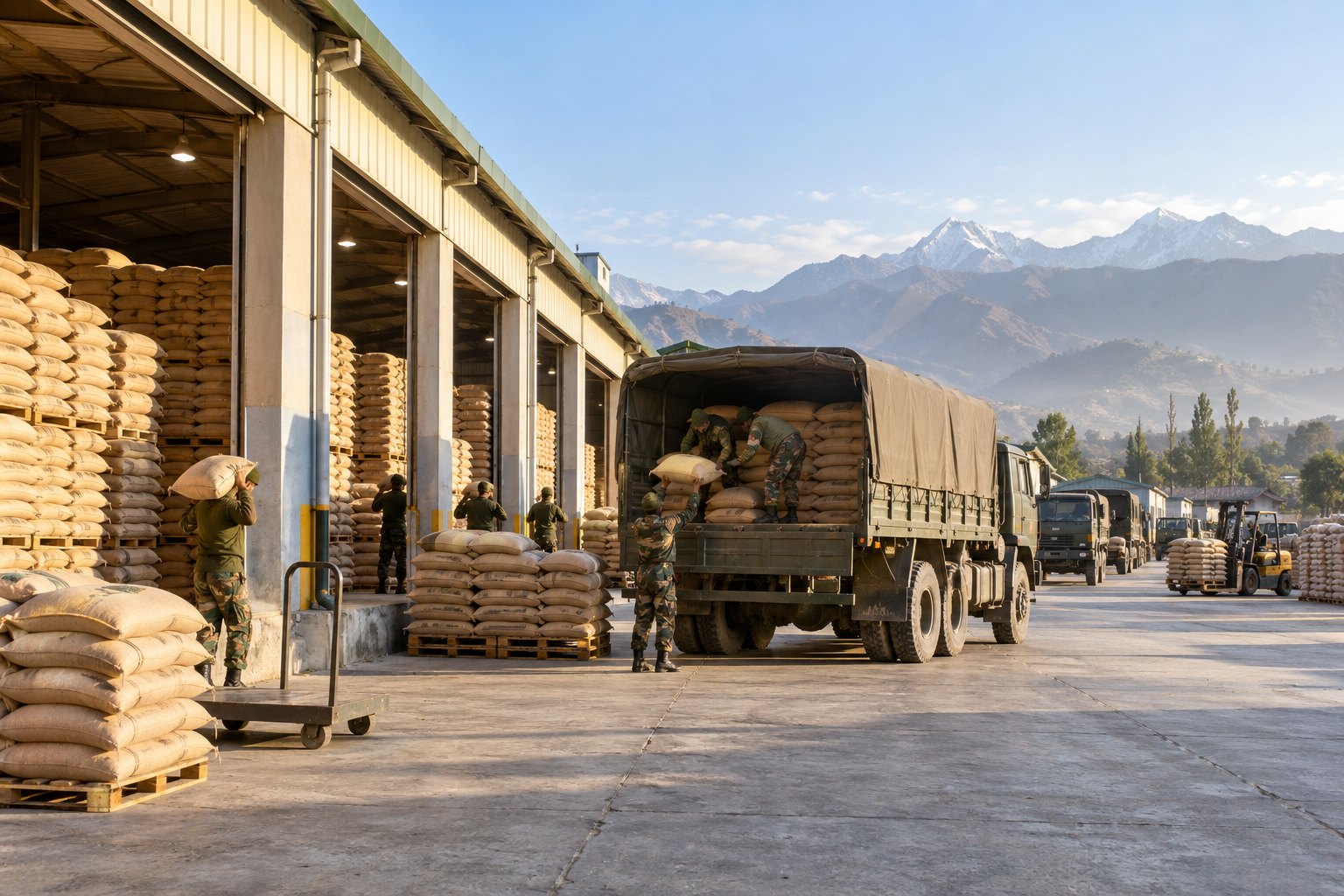
The Indian Army on 12 October 2026 launched 'Bharat Rice' for defence personnel and signed a five-year MoU letting it use the Food Corporation of India's warehouses, manpower and material-handling equipment in operational contingencies. NAFED will supply the rice, milled to defence specifications, during 2026-27, delivering it straight to Army supply depots in Ladakh, the North-east and elsewhere.
Syllabus: Prelims · Current Affairs & IR; GS3 · Agriculture & Irrigation; GS3 · MSP, Subsidies & Food Security
Why this matters for UPSC
GS3 food security and storage of agricultural produce: Prelims can ask what the Food Corporation of India and NAFED are and under which law; Mains, how civil food-storage networks can serve military logistics.
Why it matters
A soldier at a forward post in Ladakh or the North-east depends on rations that arrive on time and in usable condition. Until now Army depots had to fetch rice from the nearest FCI godown; under the new arrangement it comes to them, in bags small enough to carry up difficult terrain. If a conflict breaks out with little warning, the Army can also use FCI's national storage and handling network to stock food and equipment nearer the front, instead of building all of that capacity itself. The larger issue is civil-military integration: India's food-security institutions, built to feed ration-card holders and steady grain prices, are now part of national defence preparedness.
Prelims pointers
- Food Corporation of India: statutory body under the Food Corporations Act, 1964; works under the Department of Food and Public Distribution, Ministry of Consumer Affairs, Food and Public Distribution.
- FCI's core tasks: procurement of wheat and rice at MSP, maintaining buffer stocks of the central pool, and moving grain for the Public Distribution System.
- Minimum Support Price: announced by the Union government on the recommendation of the Commission for Agricultural Costs and Prices (CACP).
- NAFED: national cooperative federation set up in 1958, registered under the Multi-State Cooperative Societies Act, 2002; a nodal agency for price-support procurement of pulses and oilseeds.
- Open Market Sale Scheme (Domestic): FCI sells central-pool wheat and rice in the open market to add supply and moderate prices.
- National Food Security Act, 2013: covers up to 75% of the rural and 50% of the urban population; priority households get 5 kg of grain per person a month.
- Bharat brand: packaged, subsidised staples sold by the Union government to the public, including Bharat Atta, Bharat Dal and Bharat Rice.
Practise a UPSC-style question
Consider the following statements:
1. The Food Corporation of India began functioning in 1965, a year after Parliament passed the law creating it.
2. The Central Warehousing Corporation is under the administrative control of the Ministry of Agriculture and Farmers Welfare.
Which of the statements given above is/are correct?
- (a) 1 only
- (b) 2 only
- (c) Both 1 and 2
- (d) Neither 1 nor 2
Show the answer
Answer: (a) 1 only
1 is correct: Parliament passed the Food Corporations Act, 1964, and the Food Corporation of India was set up on 14 January 1965. 2 is incorrect: the Central Warehousing Corporation, a statutory body under the Warehousing Corporations Act, 1962, works under the Department of Food and Public Distribution of the Ministry of Consumer Affairs, Food and Public Distribution, not the Agriculture Ministry.
More from the 13 October 2026 edition
- India wants terrorist acts in UN crimes against humanity convention World & IR
- NHAI makes independent proof-checking of complex highway designs mandatory Economy
- UNGA adopts pandemic declaration; WHO Pandemic Agreement awaits PABS annex World & IR
- IPC Alert flags rising Famine risk in Sudan's Darfur and Kordofan World & IR
- IMF's World Economic Outlook lifts India's 2026-27 growth forecast to 7% Economy
- Tribal Affairs Ministry launches financial literacy drive for PVTG villages National
- ECI publishes Punjab's final electoral roll after Special Intensive Revision Polity
- RSETIs get uniform training standards under MoRD pact with RUDSETI academy Economy
- Lakshadweep declared fully literate under ULLAS literacy scheme National
- IMD dedicates WebGIS cyclone and marine warning system to the nation Sci-Tech
- PM-SETU: AM/NS India pacts to upgrade nine ITIs in Surat, Visakhapatnam Economy
- RDI Fund clears first 19 fund managers, commits ₹7,131 crore Sci-Tech